Skip to content
Ochre Editions
ArtArtistsCollectionsGalleriesDrops
SearchSign inCart (0)
The galleries · Time and place

The Netherlands

Works made in the Netherlands, from every century in the collection.

163 works · hang 2956 ·

Share The Netherlands, in the galleries

The rooms are imagined; every work on their walls is real.

Walk this roomRehang this room

First room, north wall

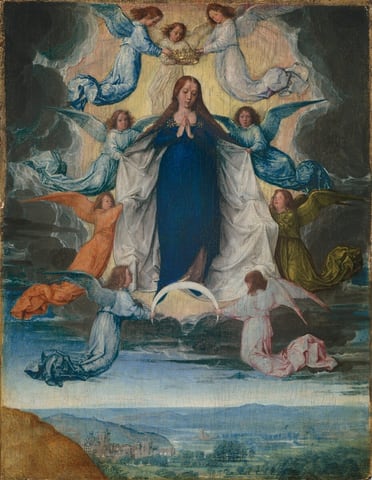
  1. A woman wearing a long, royal-blue dress is surrounded by nine winged angels as she floats on a thin, bright white, downward-pointing crescent moon above a deep landscape with a town tucked into rolling hills in this vertical painting. The woman, Mary, and all the angels have pale, peachy skin and long, brown hair. Mary and the angels float against a pale yellow and pale peach field of light enclosed within a mass of steel-gray clouds. She presses her fingertips together in front of her chest and gazes down and to our right, her dark eyes almost closed. She has a delicate, straight nose, and her small mouth is closed. Her brown hair parts in the middle and flows down over her shoulders. The angels wear flowing gowns in sky or topaz blue, olive green, tangerine orange, white, or light pink, each with matching wings. Three angels place a gold crown on Mary's head. Four others hold up the edges of a silvery white cape, which is fastened across her shoulders with brooches of white pearls surrounding ruby-red stones. The final two angels hold up the downward-facing points of the crescent moon beneath her. In the landscape below, groupings of trees are dotted among the rolling hills, with a village in the distance to our left. The blue, hazy horizon comes about a sixth of the way up the composition. A brown boulder sits in the bottom left corner, closer to us. The paint is visibly cracked throughout.
    The Assumption of the VirginMichel Sittow, c. 1500Courtesy National Gallery of Art, Washington
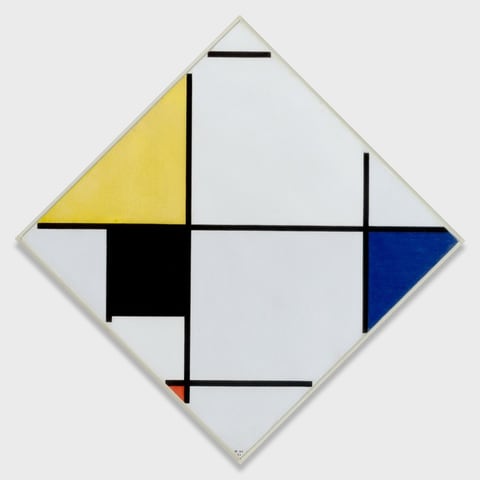
  2. A square white tile, rotated 90 degrees, crossed by black lines intersecting at 90-degree angles. A few of the shapes thus formed—some partial squares, some rectangles—are colored in a single shade of yellow, blue, black, or red.
    Lozenge Composition with Yellow, Black, Blue, Red, and GrayPiet Mondrian, 1921Courtesy of the Art Institute of Chicago
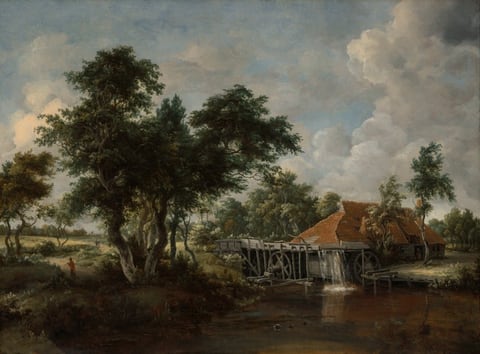
  3. Landscape painting featuring a wavy tree tree in the foreground and a watermill with a red roof adjacent to a river at right. Colors are subdued earth tones, the foliage a dark green and the river a muddy brown. Water flows through the mill wheel under a cloudy sky of gray and blue. Three individuals can be seen in the distance at left.
    The Watermill with the Great Red RoofMeindert Hobbema, c. 1665Courtesy of the Art Institute of Chicago
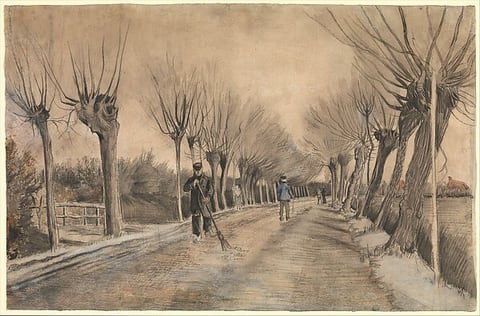
  4. Road in Etten, by Vincent van Gogh, 1881
    Road in EttenVincent van Gogh, 1881Courtesy of The Metropolitan Museum of Art

First room, south wall
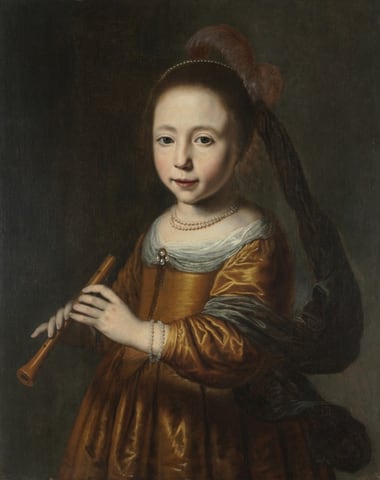
  1. Portrait of Elizabeth Spiegel, by Dirck Dircksz. Santvoort, 1639
    Portrait of Elizabeth SpiegelDirck Dircksz. Santvoort, 1639Courtesy of the Cleveland Museum of Art
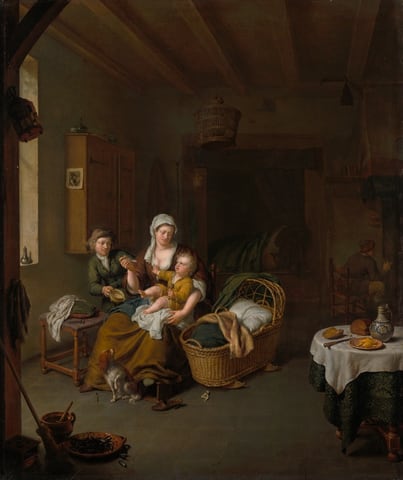
  2. Painting of a scene in a dimly-lit, cavernous room with a bassinet and small table. A shaft of light falls on four figures: a light-skinned woman in a white head covering, a baby on her lap, a male figure at her side, and a small dog at their feet. The couple feeds the fussing baby from a bowl, smiling.
    A Mother Feeding her Child (The Happy Mother)Willem van Mieris, 1707Courtesy of the Art Institute of Chicago
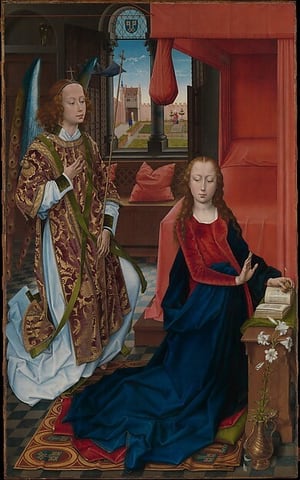
  3. The Annunciation, by Hans Memling, ca. 1465–70
    The AnnunciationHans Memling, ca. 1465–70Courtesy of The Metropolitan Museum of Art

Second room, south wall
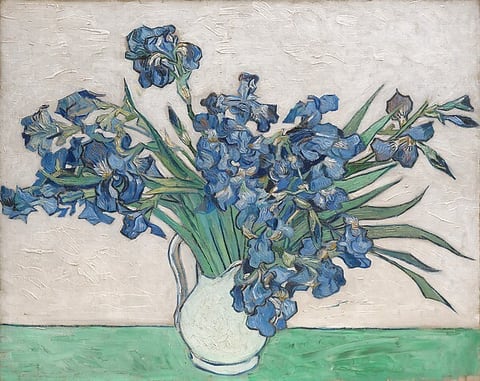
  1. Irises, by Vincent van Gogh, 1890
    IrisesVincent van Gogh, 1890Courtesy of The Metropolitan Museum of Art
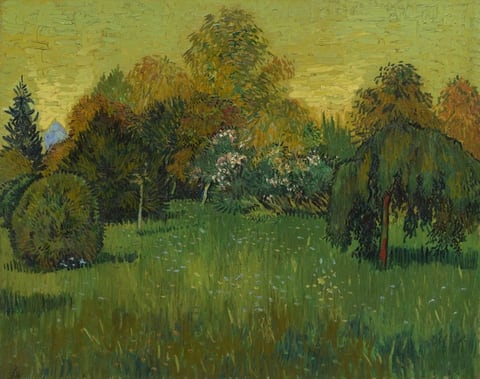
  2. Lush tall grasses with small white flowers foreground a grove of bushy trees of varying types and heights, their leaves ranging from deep green to golden. Beneath a dense and heavy yellow sky, a small blue triangle suggesting a mountain peak crests above the treeline at far left.
    The Poet's GardenVincent van Gogh, 1888Courtesy of the Art Institute of Chicago
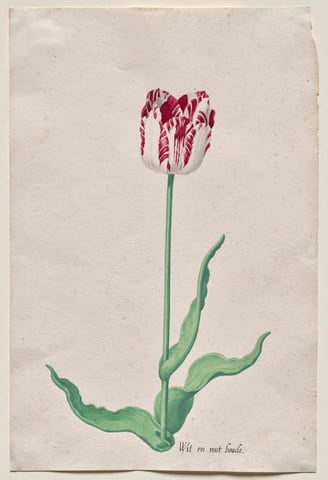
  3. Study of a Tulip (Wit en root boode), by Pieter Holsteyn II, c. 1645
    Study of a Tulip (Wit en root boode)Pieter Holsteyn II, c. 1645Courtesy of the Cleveland Museum of Art

Second room, north wall
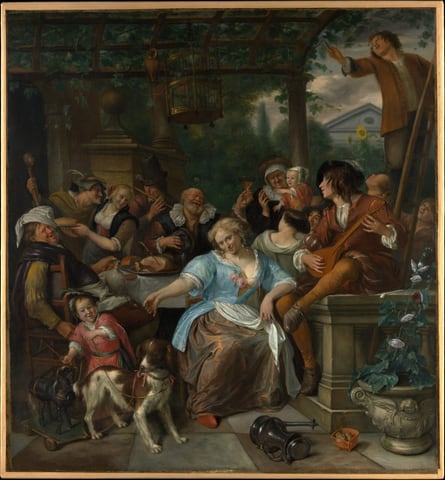
  1. Merry Company on a Terrace, by Jan Steen, ca. 1670
    Merry Company on a TerraceJan Steen, ca. 1670Courtesy of The Metropolitan Museum of Art
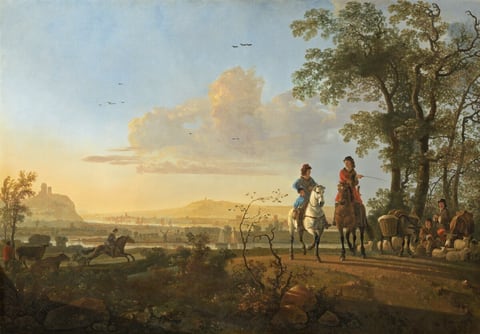
  2. Golden sunlight pours across a landscape with three people on horseback and two more people near a flock of sheep, a cow, and a mule in this horizontal painting. The people all have pale, peachy skin. The horizon is about a third of the way up the composition and is lined with towers on distant, hazy, pale yellow hills. Two of the horses are to the right of center, both facing us. The horse on the left is white, and the rider wears an azure-blue tunic and red brimless cap. The other horse is brown with a white blaze, and its rider wears a red tunic and black cap. That second rider points with a whip to the sitting and standing people near the sheep, to the right. Those two people wear brown jackets, and the standing man has a mustache. The seated person rests a long staff over one shoulder. About half of the nine sheep there lie on the ground, and the others stand. The cow dips her head down to the sheep, and the splay-footed donkey has baskets hung to each side. This grouping is in front of a copse of tall trees that nearly reach the top edge of the composition. The third rider is to our left and a short distance away. That dark brown horse gallops to our right. A short distance away, another herdsman along the left edge of the composition wears a red tunic and brown pants, and he rests a long staff on one shoulder. One cow stands and one lies down next to that herdsman. Sunlight rakes across twigs, leafy plants, scrubby growth, and rocks in the foreground, closest to us. Sailboats float on the waterways that stretch horizontally across the painting in the distance, and the land separating those bodies of water is dotted with spires, windmills, towers, and other structures. A dozen dark birds fly high in the sky, which takes up the top two-thirds of the picture. A bank of iridescent yellow and pearly white clouds trundle across the pale blue sky. The artist signed the painting in the lower right corner, “A.cuijp.”
    Horsemen and Herdsmen with CattleAelbert Cuyp, 1655/1660Courtesy National Gallery of Art, Washington

Third room, north wall
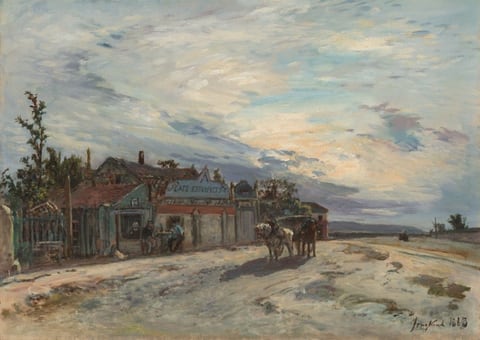
  1. A work made of oil on canvas.
    A Roadside TavernJohan Barthold Jongkind, 1863Courtesy of the Art Institute of Chicago
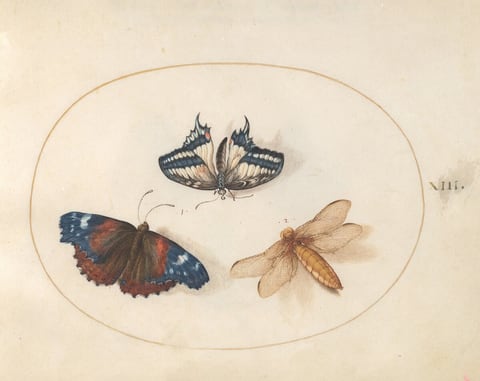
  2. Three insects are depicted in the image: a butterfly with dark blue and red wings on the bottom left, a larger butterfly with white, black, and blue patterns at the top center, and a dragonfly with brown and gold tones on the bottom right. The color palette includes rich blues, reds, browns, and golds against a neutral background. The central butterfly is positioned higher than the other two insects, with the left butterfly and right dragonfly symmetrically arranged below.
    Plate 13: Yellow Swallowtail and Red Admiral Butterflies with a Dragonfly (Broad-Bodied Chaser?)Joris Hoefnagel, c.1575/1590sCourtesy National Gallery of Art, Washington
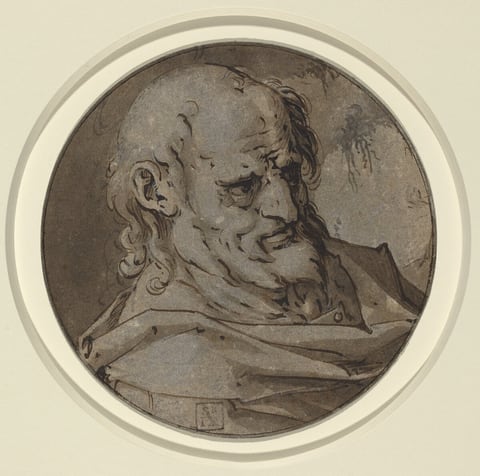
  3. The image features the upper body and head of a man in a circular frame. The man is facing slightly to the side and downward, with his body oriented to the left and his head turned towards the viewer. He has a prominent forehead, a defined nose, a furrowed brow, and a scrunched face. His hair is thinning on top, with longer strands curling around the back and sides of his head. The man has a beard with similar curled texture as his hair. He is wearing a garment that drapes over his shoulders, with visible folds and a texture that suggests a substantial fabric. No jewelry or objects are in his hands, as they are not visible in this image. The background is plain with a light, sketchy look, focusing attention on the man as the central figure in the circular composition.
    Head of an ApostleHendrick GoltziusCourtesy National Gallery of Art, Washington
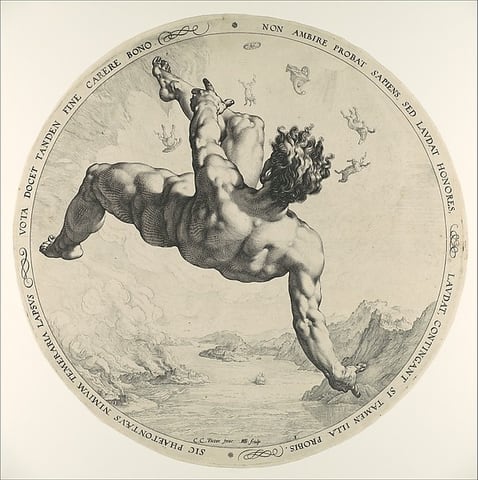
  4. Phaeton, from "The Four Disgracers", by Hendrick Goltzius, 1588
    Phaeton, from "The Four Disgracers"Hendrick Goltzius, 1588Courtesy of The Metropolitan Museum of Art

Walk on

  • The Netherlands, room 2
  • More by Hendrick Goltzius 7 works
  • More Northern Renaissance 62 works
Ochre Editions

The world's museums, on your wall. Every work here is a reproduction of a public-domain original, credited to the museum that holds it.

Shop

All artCollectionsLimited dropsPrints and framing

Help

Find an orderShippingReturnsVerify a certificate

About

About Ochre EditionsMuseum creditsFor agentsDevelopers

Legal

Terms of UseTerms of SaleLimited Editions and CertificatesPrivacy PolicyCookie PolicyAcceptable Use PolicyAgent & API TermsCopyright and DMCA PolicyPrinting Your Own PhotoVulnerability Disclosure PolicyAccessibility StatementOpen-Access Credits
© 2026 Ochre EditionsPrices in US dollars. Prints ship within the United States.