Skip to content
Ochre Editions
ArtArtistsCollectionsGalleriesDrops
SearchSign inCart (0)
The galleries · Time and place

The 19th century

Works made in the 19th century, anywhere in the world.

731 works · hang 1 ·

Share The 19th century, in the galleries

The rooms are imagined; every work on their walls is real.

Walk this roomRehang this room

Section 1, north wall

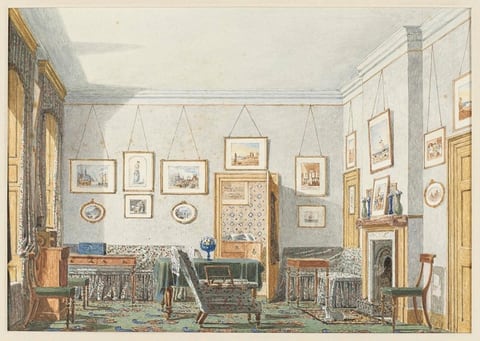
  1. GEORGE JAMES DRUMMOND'S ROOM AT OXFORD, 1853
    George James Drummond's Room at Oxford, 1853George Pyne, 1853Courtesy of Cooper Hewitt, Smithsonian Design Museum
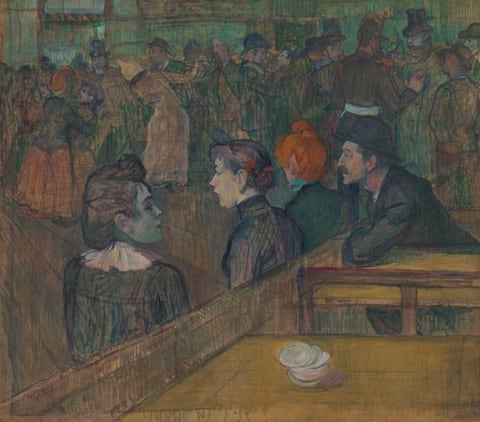
  2. A scene in brown and green tones of people dancing indoors. In the foreground, three women stand near boothed tables while a man sits.
    Moulin de la GaletteHenri de Toulouse-Lautrec, 1889Courtesy of the Art Institute of Chicago
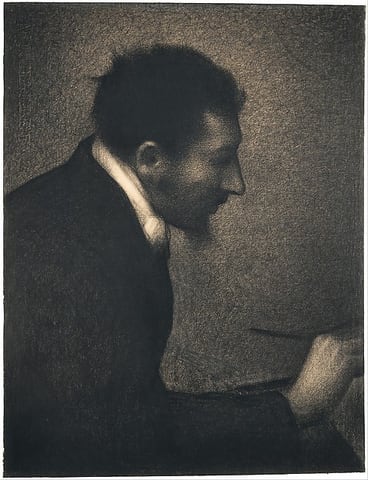
  3. Aman-Jean (Portrait of Edmond François Aman-Jean), by Georges Seurat, 1882–83
    Aman-Jean (Portrait of Edmond François Aman-Jean)Georges Seurat, 1882–83Courtesy of The Metropolitan Museum of Art

Section 1, south wall
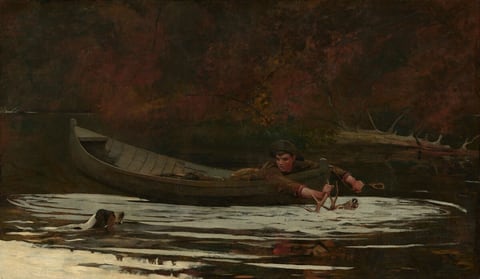
  1. A young man with a peachy, ruddy complexion lies on his stomach in a wooden rowboat on a river, reaching forward to grasp the horn of a stag almost completely submerged in the rippling water with one hand. On the opposite riverbank, gold, rust, and scarlet-red trees span the width of this horizontal painting. The boy’s arms straddle the stern of the boat so one holds the antler with his right hand, closer to us, while the other clutches a rope with a loop at the end. He turns his face, mouth agape and cheeks flushed, over his right shoulder to look to our left, at a dog swimming toward the boat. The dog has white and caramel-brown markings, with dark brown ears. The boy wears earth-brown clothing and the front of his wide-brimmed hat is pushed up to reveal dark eyes and sable-brown bangs and brows. The stag and dog are between us and the boat, and are surrounded by thick brushstrokes of parchment white to create ripples in the forest-green water. Only the open muzzle, part of the eye, and the tips of the stag’s antlers are above the water’s surface. To our right, a bare, fallen tree lies along the far riverbank parallel to the boat. The boat and water fill the lower half of the scene and the autumn trees fill the upper half. The artist has signed and dated the painting in the lower right, “Winslow Homer 1892.”
    Hound and HunterWinslow Homer, 1892Courtesy National Gallery of Art, Washington
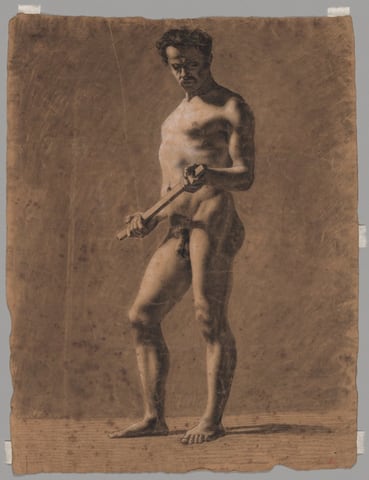
  2. A work made of black chalk and charcoal with stumping, heightened with white chalk (recto), and black chalk and charcoal with stumping (verso), on dark tan laid paper.
    Standing Academic Male Nude (recto); Sketch of Upper Arm (verso)Eugène Delacroix, 1816Courtesy of the Art Institute of Chicago
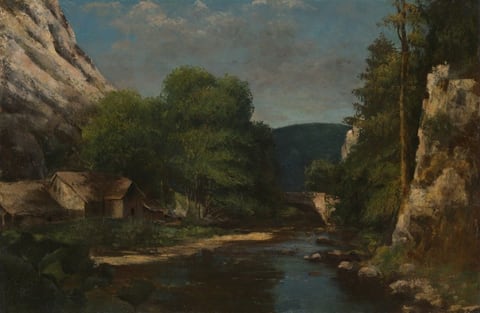
  3. A work made of oil on canvas.
    LandscapeMarcel Ordinaire, 1867Courtesy of the Art Institute of Chicago

Section 2, south wall
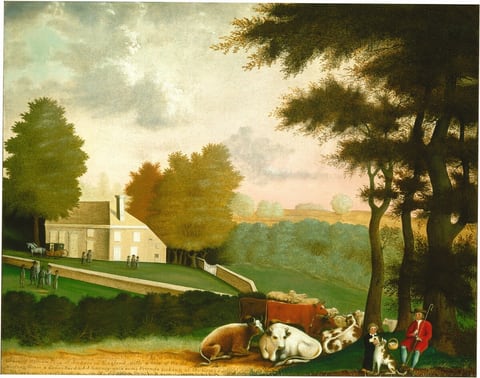
  1. This painting shows a pastoral setting with a large white-and-gray house on a hill to the left. Distant people stand in front of the house, along with a horse-drawn wagon. In the bottom right corner, two people sit in the grass under a tree, one dressed in red holding a tall crook and the other wearing a black garment and a yellow hat and petting a large brown-and-white dog. There is a basket on the ground between them, and next to them is a large herd of cows and sheep, all resting on the grass. The landscape includes trees with green leaves and yellow hills in the distance. The sky above is in pastel shades of pink and blue, with fluffy clouds. In the bottom left, a patch of yellow ground has several lines of text written over it.
    The Grave of William PennEdward Hicks, c. 1847/1848Courtesy National Gallery of Art, Washington
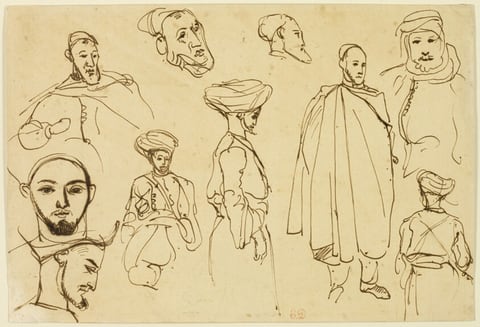
  2. A work made of pen and brown ink, with traces of graphite, on tan wove paper, laid down on cream wove paper.
    Sketches of Algerian MenEugène Delacroix, c. 1832Courtesy of the Art Institute of Chicago
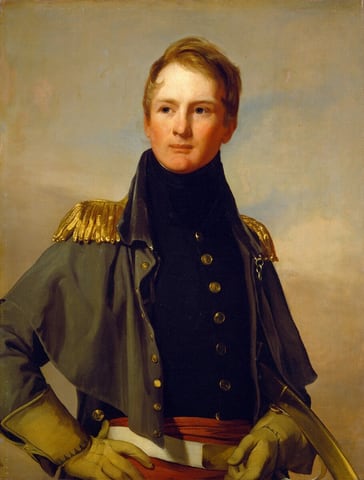
  3. Major Thomas Biddle, by Thomas Wilcocks Sully, 1832
    Major Thomas BiddleThomas Wilcocks Sully, 1832Courtesy National Gallery of Art, Washington
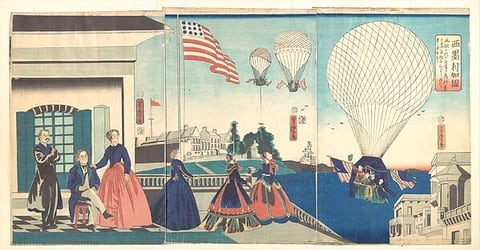
  4. “America”: Enjoying Hot Air Balloons, by Utagawa Yoshitora, 1867
    “America”: Enjoying Hot Air BalloonsUtagawa Yoshitora, 1867Courtesy of The Metropolitan Museum of Art

Section 2, north wall
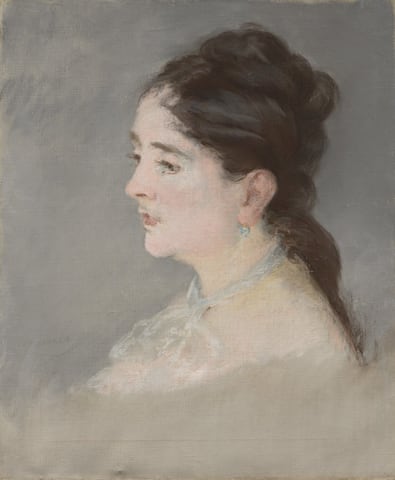
  1. Claire Campbell, by Édouard Manet, 1876
    Claire CampbellÉdouard Manet, 1876Courtesy of the Cleveland Museum of Art
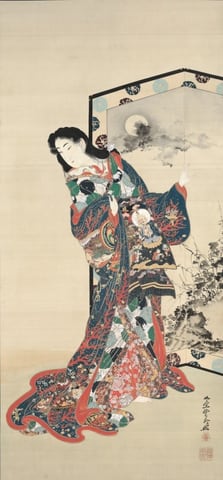
  2. Hell Courtesan, by Kawanabe Kyōsai, 1871–89
    Hell CourtesanKawanabe Kyōsai, 1871–89Courtesy of the Cleveland Museum of Art
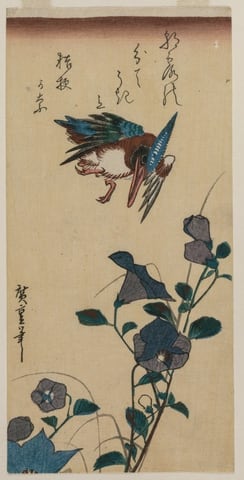
  3. Kingfisher and Chinese Bellflowers, by Utagawa Hiroshige, early or mid-1830s
    Kingfisher and Chinese BellflowersUtagawa Hiroshige, early or mid-1830sCourtesy of the Cleveland Museum of Art

Section 3, north wall
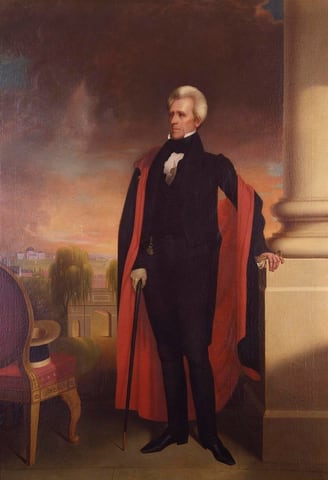
  1. Andrew Jackson, by Ralph Eleaser Whiteside Earl, 1836-1837
    Andrew JacksonRalph Eleaser Whiteside Earl, 1836-1837Courtesy of the Smithsonian American Art Museum
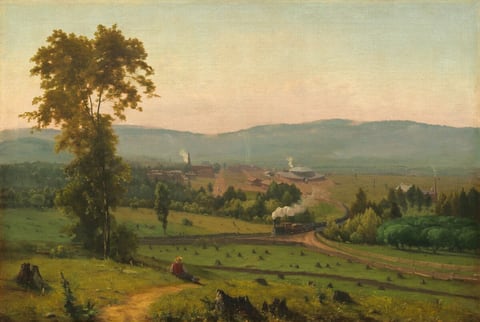
  2. We look across and down into a valley with a person sitting near a tall tree and a train puffing smoke beyond, all enclosed by a band of mountains in the distance in this horizontal landscape painting. Closest to us, several broken, jagged tree stumps are spaced across the painting’s width. A little distance away and to our left, the person wears a yellow, broad-brimmed hat, red vest, and gray pants. He reclines propped on his left elbow near a walking path beside a tall, slender tree with golden leaves. The green meadow stretching in front of him is dotted with tree stumps cut close to the ground. Beyond the meadow, puffs of white smoke trail behind a long steam locomotive that crosses a bridge spanning a tree-filled ravine, headed to our left. The ravine creates a diagonal line across the canvas, moving subtly away from us to our left. The train has climbed out of the valley, away from a cluster of brick-red buildings. The most prominent structure is a train roundhouse, a large building with a high, domed roof to the right of the tracks. Smoke rises from chimneys on long, warehouse-like buildings, and a steeple and smaller structures suggest a church and homes to our left. Hazy in the distance, a row of mountains lines the horizon, which comes about halfway up the composition. The sky above deepens from pale, shell pink over the mountains to watery, pale blue above. The artist signed the work in tiny letters in the lower left corner: “G. Inness.”
    The Lackawanna ValleyGeorge Inness, c. 1856Courtesy National Gallery of Art, Washington
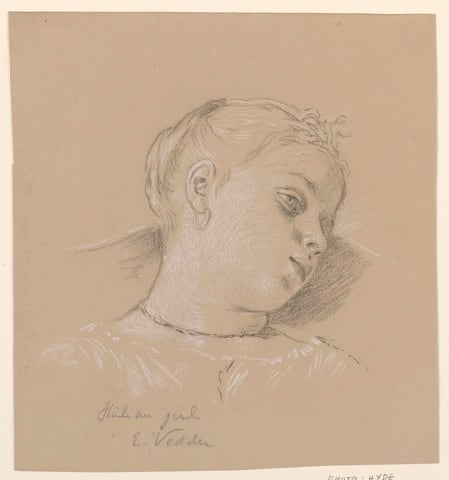
  3. ITALIAN GIRL
    Italian girlElihu Vedder, ca. 1885Courtesy of Cooper Hewitt, Smithsonian Design Museum

Walk on

  • The 19th century, room 2
  • Elihu Vedder's contemporaries 8 works
  • More American Gilded Age 67 works
Ochre Editions

The world's museums, on your wall. Every work here is a reproduction of a public-domain original, credited to the museum that holds it.

Shop

All artCollectionsLimited dropsPrints and framing

Help

Find an orderShippingReturnsVerify a certificate

About

About Ochre EditionsMuseum creditsFor agentsDevelopers

Legal

Terms of UseTerms of SaleLimited Editions and CertificatesPrivacy PolicyCookie PolicyAcceptable Use PolicyAgent & API TermsCopyright and DMCA PolicyPrinting Your Own PhotoVulnerability Disclosure PolicyAccessibility StatementOpen-Access Credits
© 2026 Ochre EditionsPrices in US dollars. Prints ship within the United States.