Skip to content
Ochre Editions
ArtArtistsCollectionsGalleriesDrops
SearchSign inCart (0)
The galleries · Time and place

19th-century France

Works made in France in the 19th century.

237 works · hang 7523 ·

Share 19th-century France, in the galleries

The rooms are imagined; every work on their walls is real.

Walk this roomRehang this room

First room, north wall

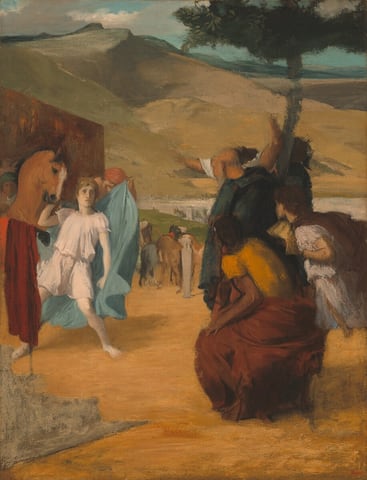
  1. Two groups of people face off in front of a hilly landscape in this loosely painted, vertical scene. On our left, a pale young man in a white tunic looks with eyes wide and lips parted at a group of three people on our right. The young man's right hand, on our left, is raised to stroke the head of a reddish-brown horse at his right shoulder. He stands with feet planted wide, knees bent, and he curls his left hand into a fist. Behind him, a man holds up a fluttering, light blue cape. A mottled red wall forms a backdrop to this scene on our left. The tight group gathered under a tree on our right stares back at the young man. The trio is made up of a balding, older man, a light-skinned boy also wearing a white tunic, and, closest to us, a brown-skinned woman wearing a marigold-orange shirt and a maroon-red skirt. Behind this group, a pair of pale raised arms suggests a fourth person, but the head is missing or has been painted over. The ground under the people is saffron orange. In the center of the picture, beyond the people, a group of horses stands near a green bank by a river, its surface reflecting white. The far bank is lined with white buildings. Tan and olive-green slopes rise from the opposite riverbank under a pale blue sky with cream-white clouds sweeping along the top edge of the composition. The artist signed his name in red paint in the lower right corner: “Degas.”
    Alexander and BucephalusEdgar Degas, 1861/1862Courtesy National Gallery of Art, Washington
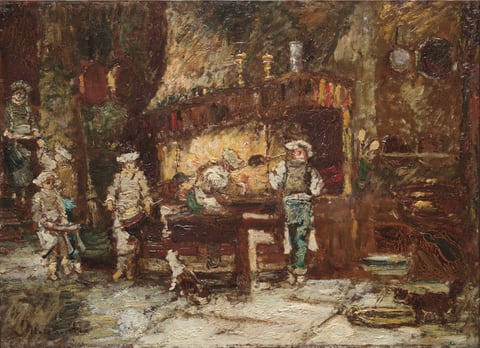
  2. The Kitchen of the Rôtisserie des Deux Paons, by Adolphe Monticelli, c. 1875–1881
    The Kitchen of the Rôtisserie des Deux PaonsAdolphe Monticelli, c. 1875–1881Courtesy of the Cleveland Museum of Art
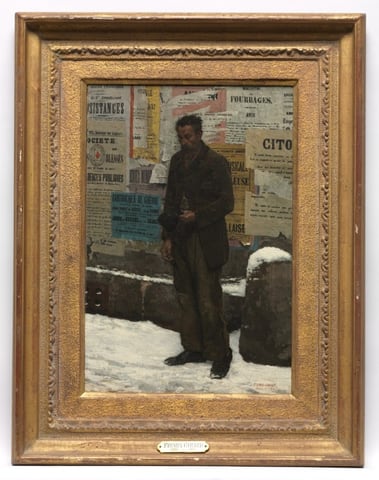
  3. The Veteran, by Marie-François Firmin-Girard, 1870
    The VeteranMarie-François Firmin-Girard, 1870Courtesy of the Cleveland Museum of Art

First room, south wall
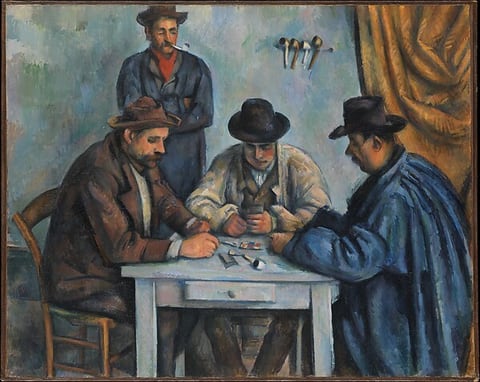
  1. The Card Players, by Paul Cézanne, 1890–92
    The Card PlayersPaul Cézanne, 1890–92Courtesy of The Metropolitan Museum of Art
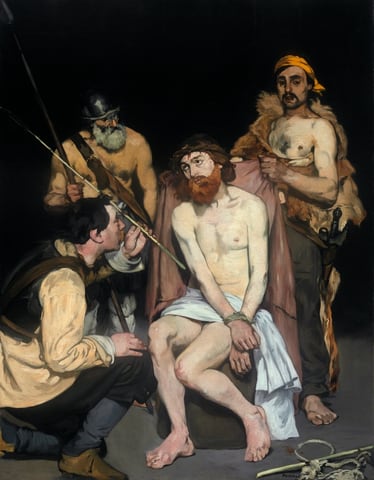
  2. Large, dark painting of Jesus sitting with three standing soldiers.
    Jesus Mocked by the SoldiersÉdouard Manet, 1865Courtesy of the Art Institute of Chicago
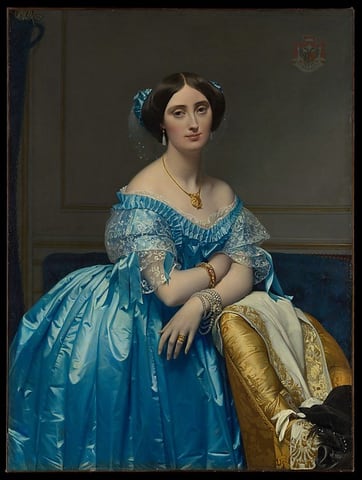
  3. Joséphine-Éléonore-Marie-Pauline de Galard de Brassac de Béarn (1825–1860), Princesse de Broglie, by Jean Auguste Dominique Ingres, 1851–53
    Joséphine-Éléonore-Marie-Pauline de Galard de Brassac de Béarn (1825–1860), Princesse de BroglieJean Auguste Dominique Ingres, 1851–53Courtesy of The Metropolitan Museum of Art

Second room, south wall
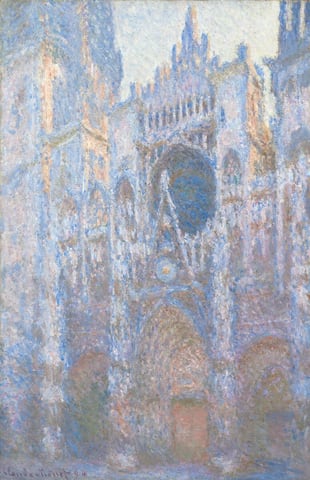
  1. We look up at the exterior of a church that soars the height of this vertical painting. The church is painted with visible dabs and strokes of azure blue, peach, lavender purple, and camel brown to create a blurred look, as if seeing a reflection in the rippling surface of a puddle. The church façade is angled to our left, away from us. The main door and its surround takes up the center of the composition, where a rectangular door is set within nested, pointed arches that lead up to a narrow, tall, triangular gable. The point of that gable overlaps the round, dark rose window, which is the same width as the portal surround below. Spires flank the central section and rise precipitously off the top edge of the painting. The sky above is painted with daubs of white and pale blue. The artist signed and dated the lower left, “Claude Monet 94.”
    Rouen Cathedral, West FaçadeClaude Monet, 1894Courtesy National Gallery of Art, Washington
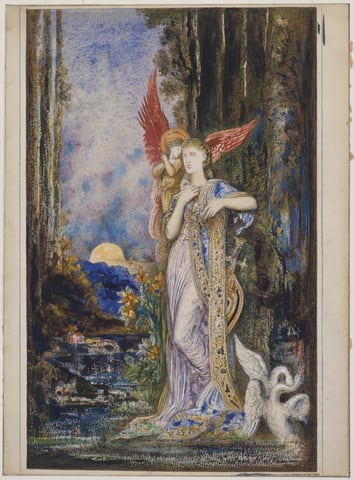
  2. A work made of watercolor and gouache, with pen and blue ink, over traces of graphite, on ivory wove paper, wrapped and adhered on verso to wood pulp board.
    InspirationGustave Moreau, c. 1893Courtesy of the Art Institute of Chicago
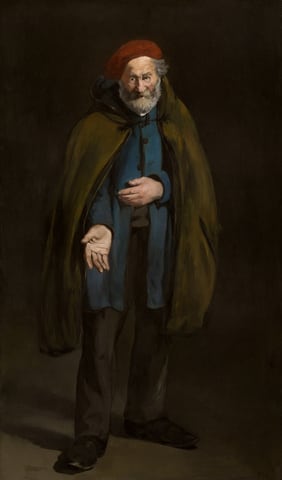
  3. A work made of oil on canvas.
    Beggar with a Duffle Coat (Philosopher)Édouard Manet, 1865–67Courtesy of the Art Institute of Chicago

Second room, north wall
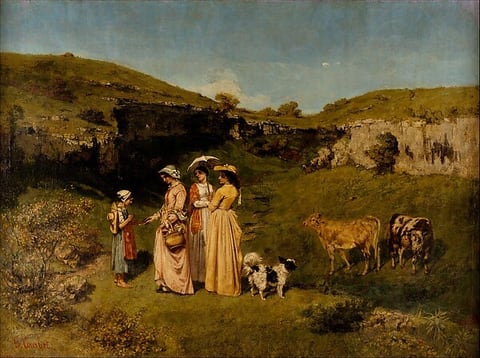
  1. Young Ladies of the Village, by Gustave Courbet, 1851–52
    Young Ladies of the VillageGustave Courbet, 1851–52Courtesy of The Metropolitan Museum of Art
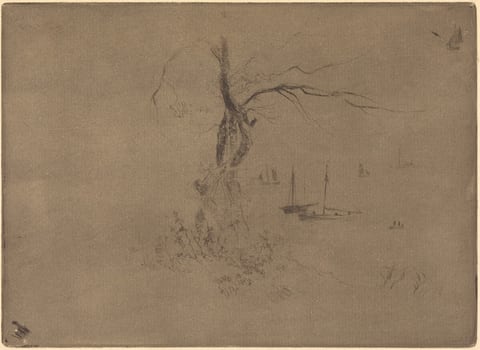
  2. The image shows a sparse drawing of a landscape. A tree with elongated branches is on the left side, with a twist in its trunk. Near the horizon, there are several sailing boats on calm water. The composition suggests a vast openness and distance. The sketching is subtle and precise, focusing on gentle contouring and minimal detail. The color palette is monochromatic, dominated by a muted brown tone. The overall impact is serene and understated, inviting the viewer to focus on the hints of narrative within the scene.
    Arbres et Bateaux (Trees and Boats)Félix-Hilaire BuhotCourtesy National Gallery of Art, Washington
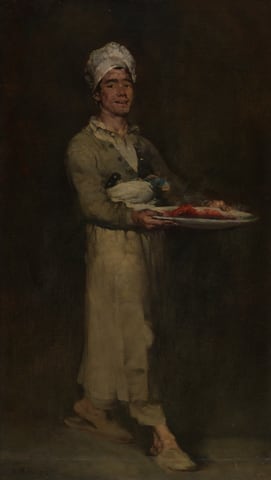
  3. A work made of oil on canvas.
    The ScullionAugustin Théodule Ribot, c. 1865Courtesy of the Art Institute of Chicago

Third room, north wall
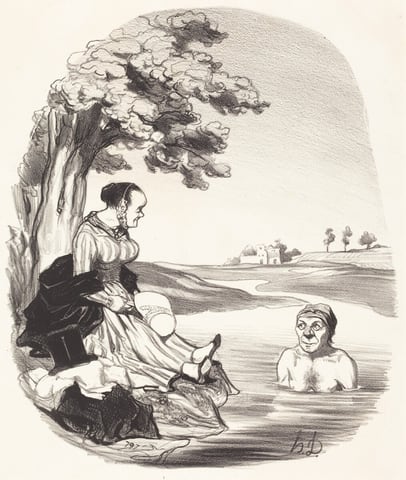
  1. The image shows a woman sitting beside a body of water, under a tree. She is wearing a long dress and holding a bonnet by her side. In the water, a person is visible from the shoulders up with short hair. The background includes a landscape with trees, water, and a distant structure that resembles a house or castle.
    L'Eau est délicieuse... je t'assure...Honoré Daumier, 1845Courtesy National Gallery of Art, Washington
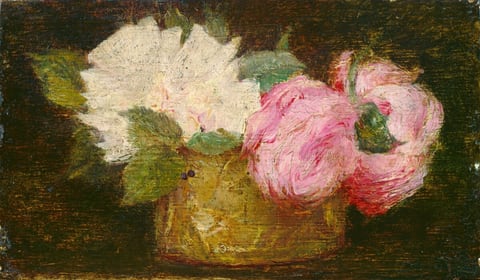
  2. Roses in a Vase, 1880/1900
    Roses in a VaseUnrecorded French maker, 1880/1900Courtesy National Gallery of Art, Washington
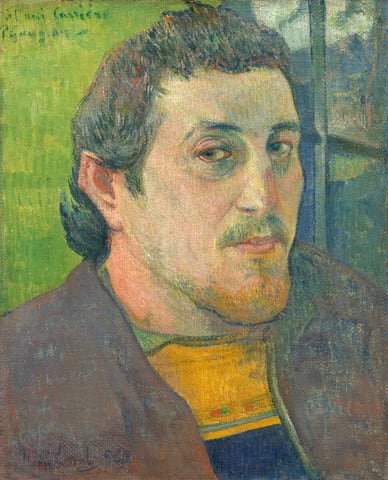
  3. Painted in muted lime green, plum purple, buttercup yellow, slate and royal blue, the head and shoulders of a man with peach-colored skin sitting in front of a window looks at us in this stylized, vertical portrait. His body and face are angled to our right but he looks at us from the corners of his eyes, which are grass-green with touches of yellow. One cobalt-blue eyebrow is cocked, and shading in denim blue, butter yellow, and fern green create hollows under both eyes. His flat nose has a broad bridge, and his pale pink lips are closed, the far corner pulled slightly up. His mustache is painted with visible strokes of forest green and his ginger-orange beard is trimmed along his prominent, jutting chin. His short, dark hair is brushed back from his temples and is painted with strokes of pine green, navy blue, and coral orange. His shirt has a wide, golden yellow stripe along the collar above indigo blue, under a grayish-violet purple jacket. The wall over his shoulder, in the upper left corner, is painted vivid lime green with long, vertical brushstrokes. The view through the window beyond his other shoulder is of vegetation and mountains. The portrait is painted with visible brushstrokes throughout, and is especially loose in the background, hair, and jacket. An inscription in dark green script in the upper left reads, “a l'ami Carriere PGauguin.” A second inscription in the lower left is written with dark brown paint: “l'ami Laval PGo.”
    Self-Portrait Dedicated to CarrièrePaul Gauguin, 1888 or 1889Courtesy National Gallery of Art, Washington
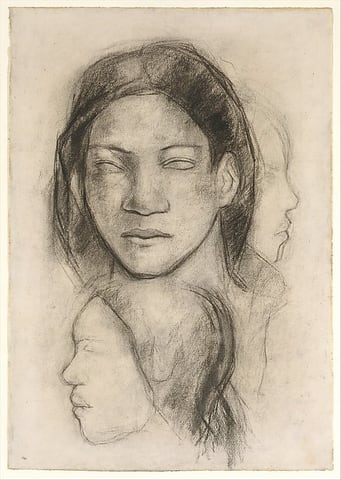
  4. Tahitian Faces (Frontal View and Profiles), by Paul Gauguin, ca. 1899
    Tahitian Faces (Frontal View and Profiles)Paul Gauguin, ca. 1899Courtesy of The Metropolitan Museum of Art

Walk on

  • 19th-century France, room 2
  • More by Paul Gauguin 10 works
  • More Post-Impressionism 62 works
Ochre Editions

The world's museums, on your wall. Every work here is a reproduction of a public-domain original, credited to the museum that holds it.

Shop

All artCollectionsLimited dropsPrints and framing

Help

Find an orderShippingReturnsVerify a certificate

About

About Ochre EditionsMuseum creditsFor agentsDevelopers

Legal

Terms of UseTerms of SaleLimited Editions and CertificatesPrivacy PolicyCookie PolicyAcceptable Use PolicyAgent & API TermsCopyright and DMCA PolicyPrinting Your Own PhotoVulnerability Disclosure PolicyAccessibility StatementOpen-Access Credits
© 2026 Ochre EditionsPrices in US dollars. Prints ship within the United States.