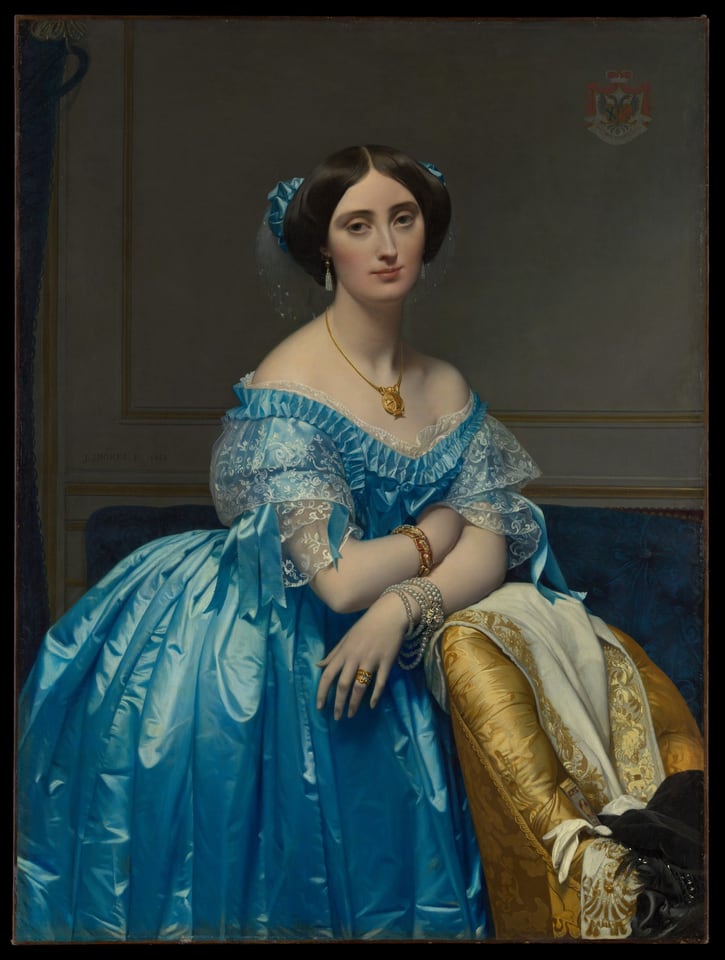
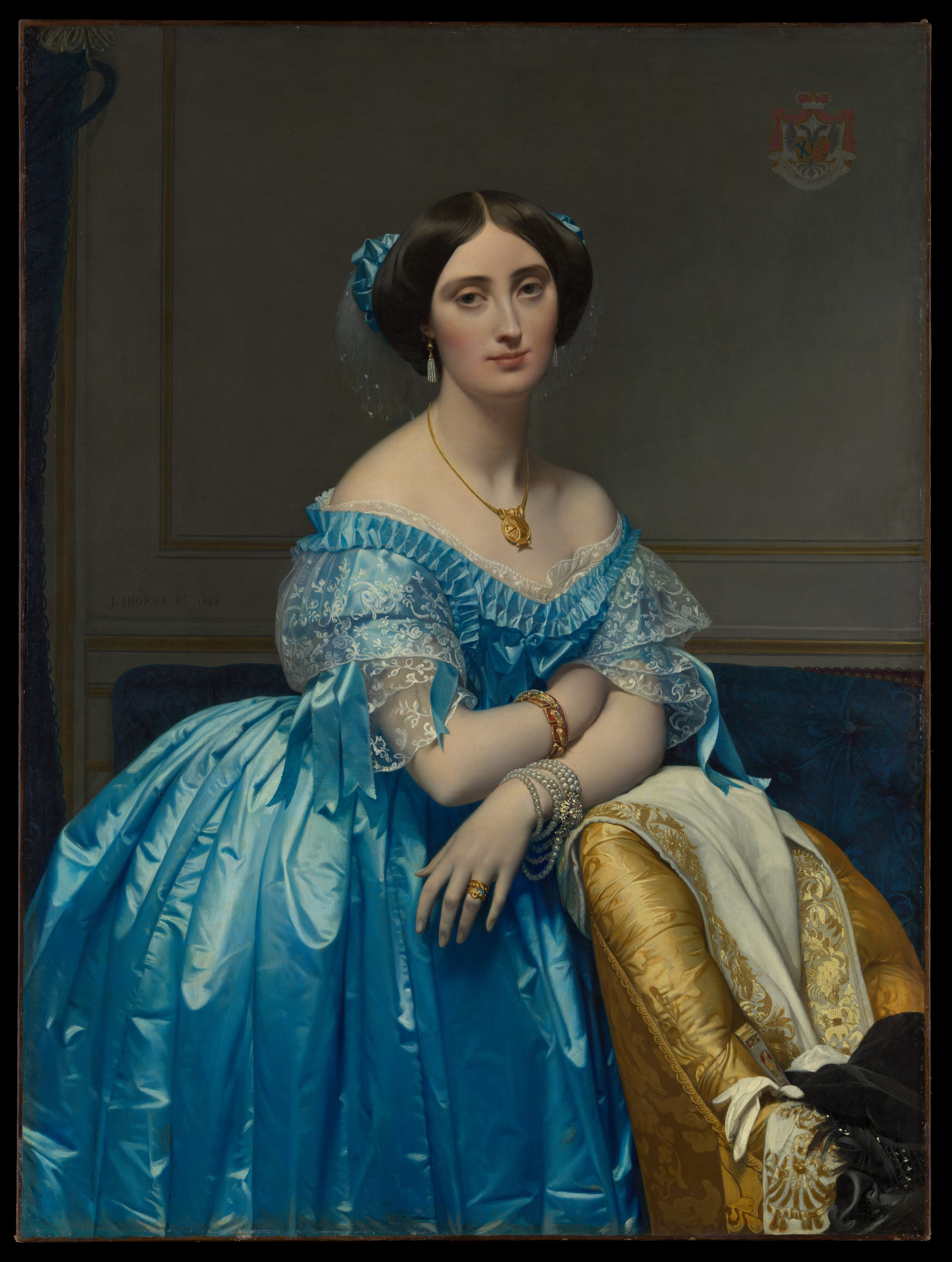
Joséphine-Éléonore-Marie-Pauline de Galard de Brassac de Béarn (1825–1860), Princesse de Broglie1851–53
The Princesse de Broglie leans on an upholstered armchair in a gown of pale blue satin, her hands clasped and jewels at her throat and wrists. More about this work
About this work
The Princesse de Broglie leans on an upholstered armchair in a gown of pale blue satin, her hands clasped and jewels at her throat and wrists. Ingres, then in his seventies, rendered every surface with porcelain smoothness: the cool, gleaming satin, the glint of gold, the flawless skin and the slightly melancholy face. The princess, admired for her intelligence and reserve, died of tuberculosis at thirty-five, a few years after the portrait was finished. It is among the last and most refined of Ingres’s portraits of women.
Written by Ochre Editions.
How it was made
- Oil paint
- Pigment ground in a drying oil, usually linseed. It dries slowly, so painters could blend on the canvas, build up thin translucent glazes, and rework a picture over weeks. Canvas replaced wooden panels in the 1500s because it is lighter and can be rolled.
Jean Auguste Dominique Ingres
French, 1780–1867 · Born in Montauban; died in Paris.
Ingres trained under Jacques-Louis David and won the Prix de Rome, then spent nearly two decades in Italy, absorbing Raphael above all. He became the champion of line and classical tradition against Delacroix’s Romanticism, and later directed the French Academy in Rome. Though he thought history painting his true calling, he is now most admired for his portraits, both his polished oils and the precise graphite drawings he made of visitors in Rome and Florence.
Written by Ochre Editions.
Rights and the museum’s record
Public domain. The Met has dedicated this image to the public domain under CC0, so anyone may copy, adapt and use it, for any purpose, without asking. Our prints and files are reproductions made from the museum’s image; the museum doesn’t endorse them.
- Object number
- 1975.1.186
- Credit
- Courtesy of The Metropolitan Museum of Art
- Type
- Paintings
- Department
- Robert Lehman Collection
- Licence
- CC0 1.0 Universal
- Museum record
- See it on the museum’s site
Report this work
More by Jean Auguste Dominique Ingres
All their works
Close in colour