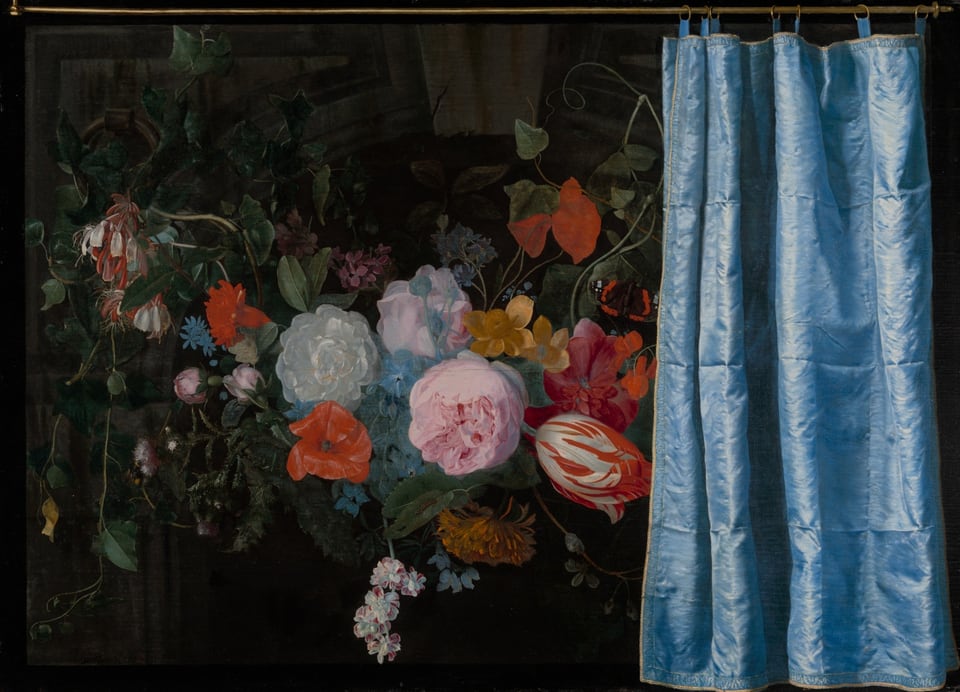
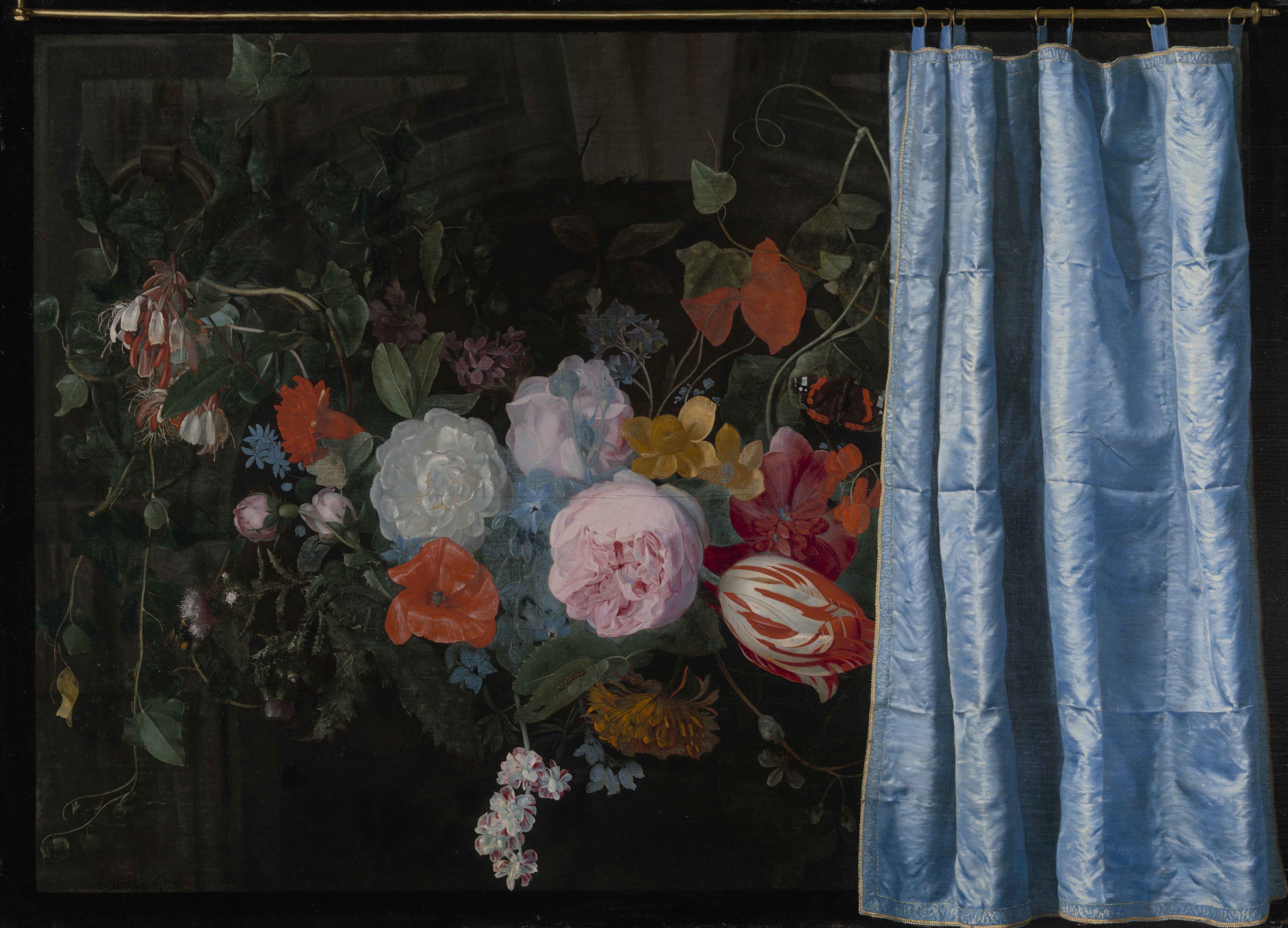
Trompe-l'Oeil Still Life with a Flower Garland and a Curtain1658
Van der Spelt’s splendid garland displays about 20 floral varieties—including a tulip, a 16th-century import from Persia that is now an icon of Dutch culture. More about this work
About this work
Van der Spelt’s splendid garland displays about 20 floral varieties—including a tulip, a 16th-century import from Persia that is now an icon of Dutch culture. The deceptively realistic blue curtain, painted by Frans van Mieris, refers to the historical strategy for protecting paintings but also to the tale of Parhassius, a skilled Greek artist who fooled a rival into attempting to pull back a curtain painted onto one of his pictures.
Text from the Art Institute of Chicago.
What you’re looking at
A work made of oil on panel.
Description from the Art Institute of Chicago.
How it was made
- Oil on panel
- Oil paint on prepared wooden boards, usually oak in the north and poplar in Italy. The rigid, smooth surface suits fine detail and thin, glowing glazes.
- Oil paint
- Pigment ground in a drying oil, usually linseed. It dries slowly, so painters could blend on the canvas, build up thin translucent glazes, and rework a picture over weeks. Canvas replaced wooden panels in the 1500s because it is lighter and can be rolled.
Adriaen van der Spelt
Dutch, 1630–1673
Dutch Golden Age
Seventeenth-century painting from the Dutch Republic: still lifes, interiors, portraits and flat, wide skies.
Rights and the museum’s record
Public domain. The Art Institute of Chicago has dedicated this image to the public domain under CC0, so anyone may copy, adapt and use it, for any purpose, without asking. Our prints and files are reproductions made from the museum’s image; the museum doesn’t endorse them.
- Object number
- 1949.585
- Credit
- Courtesy of the Art Institute of Chicago
- Type
- Painting
- Department
- Painting and Sculpture of Europe
- Licence
- CC0 1.0 Universal
- Museum record
- See it on the museum’s site
Report this work
Close in colour