Skip to content
Ochre Editions
ArtArtistsCollectionsGalleriesDrops
SearchSign inCart (0)
The galleries · Time and place

18th-century France

Works made in France in the 18th century.

75 works · hang 3361 ·

Share 18th-century France, in the galleries

The rooms are imagined; every work on their walls is real.

Walk this roomRehang this room

Section 1, north wall

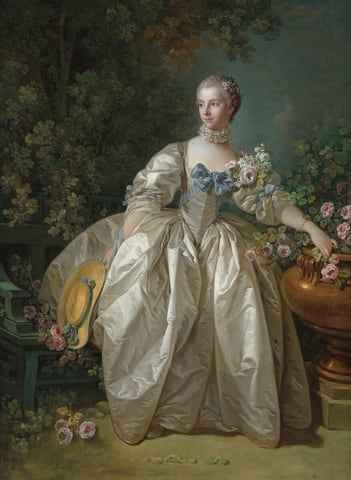
  1. A young woman with light skin stands in a garden, wearing a voluminous, full-length, silvery, shimmering gown in this vertical portrait painting. Her body faces us, as she looks into the distance to our left. She has rosy cheeks, gray-green eyes under gently arched, light brown brows, and her coral-pink, thin, closed lips curve in a slight smile. Her ash-brown hair is pulled back and adorned with tiny shell-pink and azure-blue flowers along the left side top of head, to our right. A pleated lace ruffle encircles her smooth neck. Her gown is parchment white where the light glints off the stiff fabric and is silvery gray in the shadows, creating a silk-like sheen. The dress is cut low across the chest, fits tightly around her narrow waist, and has puffy sleeves tied at the elbows with topaz-blue bows. Another blue bow is tied at her chest, and the ends wrap around her back along her waist. A corsage at her left shoulder, to our right, is a profusion of white flowers around a pale pink rose. In her other hand, to our left, she holds a straw hat with a shallow crown and a wide brim, trimmed with sky-blue ribbon. The arm holding the hat is nearly engulfed in the deep folds of her full skirt. She holds a pink rose in her other hand, which rests on the lip of a shiny, copper-colored urn filled with pink flowers and delicate green leaves. On that wrist she wears a bracelet with four strands of white pearls holding a cameo. She stands on a pale, dirt ground. A teal-blue bench in the lower left corner of the painting is tucked into sage-green shrubbery. Sprigs of pink roses are strewn across the seat and on the ground. The woman is framed to either side with olive and celery-green trees and vegetation, which blend into the hazy distance beyond her head.
    Madame BergeretFrançois Boucher, possibly 1766Courtesy National Gallery of Art, Washington
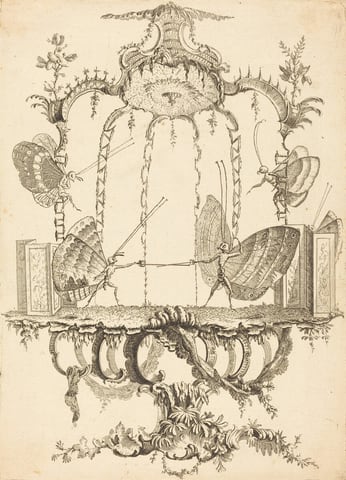
  2. This is a drawing of anthropomorphic butterflies engaged in a duel with fencing swords. The butterflies have human-like bodies with wings resembling cloaks or capes. They stand on an ornate structure featuring decorative architectural elements like columns with floral and leaf motifs. Above them are arches, canopies, and hanging vines, creating a theatrical setting. The drawing combines fantasy and nature elements, showcasing elegance and imagination.
    Le Duel (The Duel)Charles Germain de Saint-Aubin, in or after 1756Courtesy National Gallery of Art, Washington
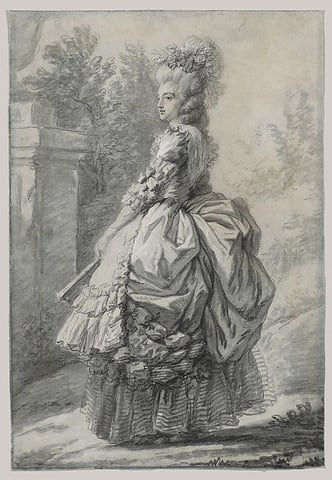
  3. Marie Antoinette in a Park, by Elisabeth Louise Vigée Le Brun, ca. 1780–81
    Marie Antoinette in a ParkElisabeth Louise Vigée Le Brun, ca. 1780–81Courtesy of The Metropolitan Museum of Art
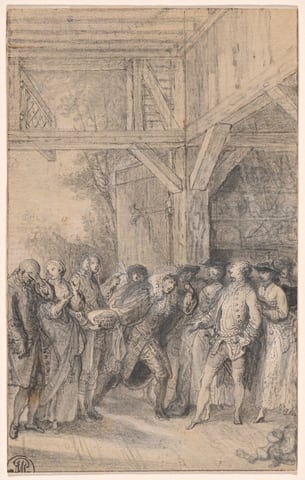
  4. A work made of graphite and pen and black ink, with touches of opaque, white watercolor on cream laid paper.
    Farmer Requesting Permission to Marry a Nobleman's DaughterGabriel de Saint-Aubin, 1761Courtesy of the Art Institute of Chicago

Section 1, south wall
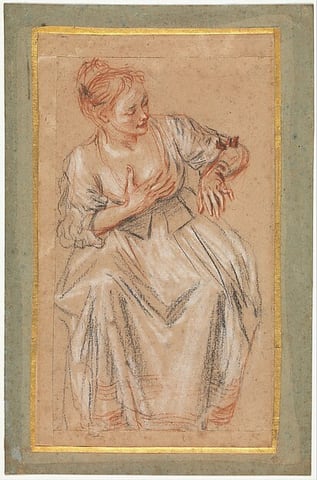
  1. Seated Woman, by Antoine Watteau, 1716–17
    Seated WomanAntoine Watteau, 1716–17Courtesy of The Metropolitan Museum of Art
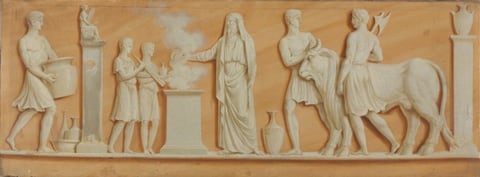
  2. Overdoor Painting, by Pierre Rousseau, 1790s
    Overdoor PaintingPierre Rousseau, 1790sCourtesy of the Cleveland Museum of Art
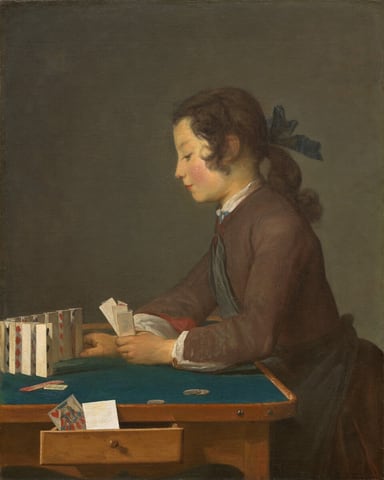
  3. Shown from about the lap up, a young person with brown hair and a peachy complexion faces our left in profile as he leans onto a table and sets folded playing cards up in a row in this vertical painting. Shown against a dark background, his long, brown hair curls by his ears and is pulled back with a navy-blue ribbon at the nape of his neck. He has a delicately sloping nose, his pink lips are closed, the cheek facing us is flushed, and he looks down at the tabletop under lowered lids. He wears a chestnut-brown, long-sleeved coat with a dark blue sash across his chest and tied around his waist. The white of his undershirt peeks out at the high neck and wrists, and the brick-red lining of the sleeve of his jacket rolls back at his right wrist. The wooden table is lined with teal-blue fabric on its surface, and three coins lie near his left hand, closer to us. In that hand he holds three nested, vertically folded playing cards. With his right hand he places the last in a line of ten cards, standing vertically but close together like dominoes, in a curving row in front of him. Scarlet-red diamonds and hearts and the edges of some black shapes are visible within the bent cards. A jack of hearts and a piece of paper or the back of another card sit in a drawer that opens toward us along the side of the table. The artist signed the work in dark brown paint in the lower right corner: “J. Chardin.”
    The House of CardsJean Siméon Chardin, probably 1737Courtesy National Gallery of Art, Washington
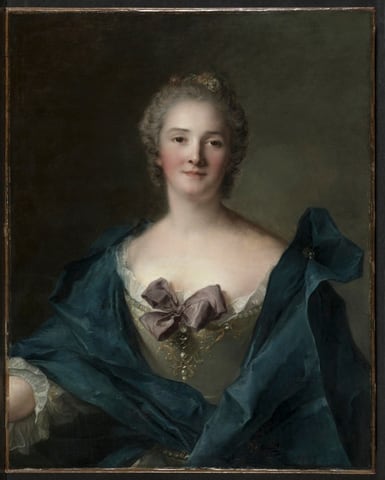
  4. Portrait of a Woman, by Jean-Marc Nattier, c. 1748
    Portrait of a WomanJean-Marc Nattier, c. 1748Courtesy of the Cleveland Museum of Art

Section 2, south wall
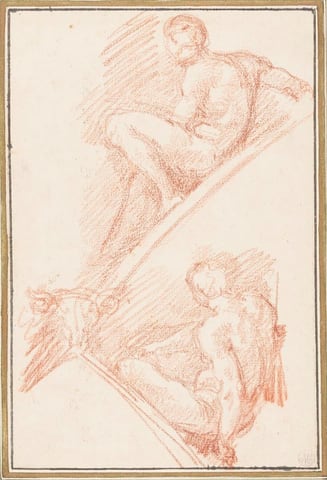
  1. FIGURES FROM SISTINE CHAPEL CEILING
    Figures from Sistine Chapel ceilingJean-Robert Ango, ca. 1759–70Courtesy of Cooper Hewitt, Smithsonian Design Museum
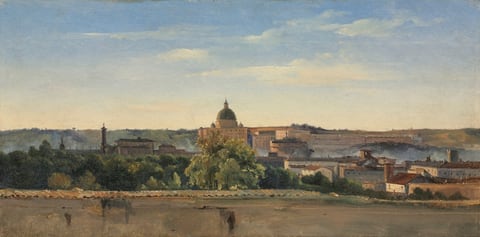
  2. View of Rome, by Pierre Henri de Valenciennes, c. 1782–84
    View of RomePierre Henri de Valenciennes, c. 1782–84Courtesy of the Cleveland Museum of Art
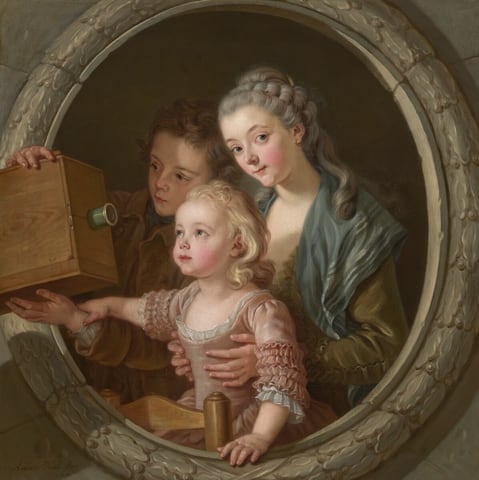
  3. A young woman and two children are shown from the waist up through an oval, stone opening, holding and looking at a wooden box with a lens protruding from one side in this square painting. All three people have pale skin with rosy cheeks. To our right, the young woman’s body is angled to our left as she braces the torso of a young girl. The young woman looks at us from the corners of her sage-green eyes, under lifted brows. Her small, pink mouth is pursed in a slight smile, and she has a faint dimple in her rounded chin. Her heather-gray hair is partially plaited over the crown of her head, and long curls fall over her shoulders. She wears a spruce-blue shawl over the shoulders of her low-cut, olive-green dress. The child she braces has chubby cheeks, and her wavy blond hair is brushed back from her forehead and falls loosely to her shoulders. She wears a blush-pink dress with ruffles on the half-length sleeves and gossamer-white trim around the neckline and cuffs. The top and side rails of a wooden, ladderback chair up against the inside of the opening suggests she stands or kneels on a backward-facing chair. She rests her left hand on the edge of the stone opening and her other hand on the wrist of the boy standing close behind her. Mostly in the shadow behind the others, the boy has small, pointed features and short, curly, sable-brown hair. He wears a tan coat, and a muted blue scarf is tied at his throat. The two children gaze at the wooden box the boy holds, which is about the size of a toaster. A short, cylindrical, brass-lined lens pokes out of the center of the side facing the trio. The oval opening through which we see them is carved on our side with stylized leaves and berries, and the wall around it is the same elephant gray as the carvings. The girl and the box cast a shadow across the opening. The artist signed and dated the painting in the lower left corner, “Amedee Can Loo./1764.”
    The Camera ObscuraCharles Amédée Philippe Van Loo, 1764Courtesy National Gallery of Art, Washington

Section 2, north wall
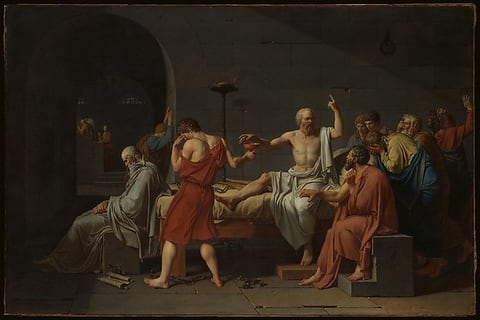
  1. The Death of Socrates, by Jacques-Louis David, 1787
    The Death of SocratesJacques-Louis David, 1787Courtesy of The Metropolitan Museum of Art
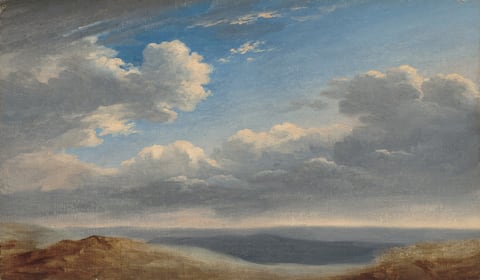
  2. A sliver of land across the bottom of this composition gives way to a procession of puffy gray and white clouds sweeping up across a vivid blue, panoramic sky in this horizontal landscape painting. An area of darker gray beyond the brown land could be a valley, mountain, or shadows from the billowing clouds. About one-fifth of the way up the composition, the horizon glows the faintest peach. The clouds trundle from our left up and to our right. The view is loosely painted, especially in the land.
    Study of Clouds over the Roman CampagnaPierre Henri de Valenciennes, c. 1782/1785Courtesy National Gallery of Art, Washington
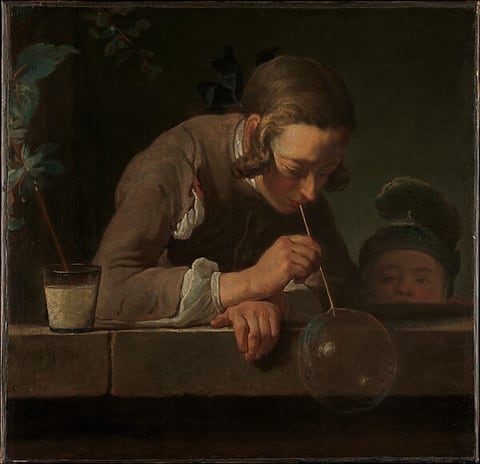
  3. Soap Bubbles, by Jean Siméon Chardin, ca. 1733–34
    Soap BubblesJean Siméon Chardin, ca. 1733–34Courtesy of The Metropolitan Museum of Art

Section 3, north wall
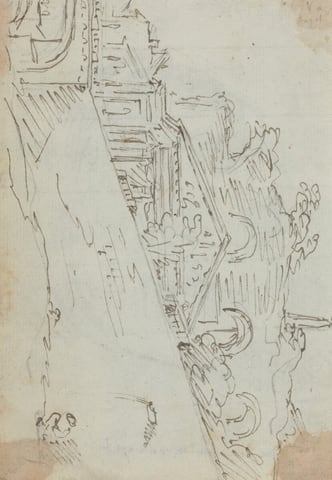
  1. The image shows a sketch of an architectural scene with structures lining a road or pathway. The horizon is not clearly defined, and the sketch focuses on architectural details. The drawing features loose, freehand lines outlining buildings and trees, with classical elements like columns and entablatures. The color palette is monochromatic, with light parchment and dark ink strokes creating contrast. Close-up details are lightly shaded for depth, while distant details are less defined. The composition is open and airy, emphasizing architectural features over precision.
    Ancient Ruins on the Bank of the TiberAugustin Pajou, 1752/1756Courtesy National Gallery of Art, Washington
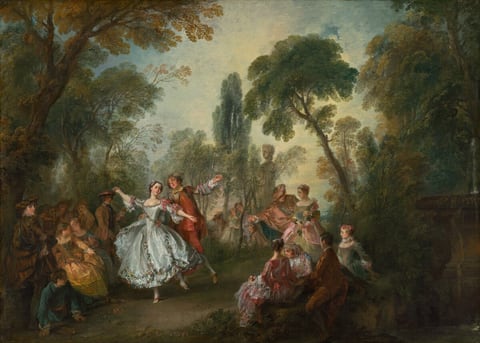
  2. Twenty-one men in long waistcoats and women in elegantly trimmed gowns gather and dance within a verdant landscape in this horizontal painting. The men wear jackets and breeches in ginger brown, pale pink, or spruce blue. The women’s gowns have full sleeves, tight-fitting bodices, and full skirts in shades of bronze, teal blue, butterscotch gold, or rich pink edged with ribbons and lace. Some of them wear floral wreaths or ribbons in their upswept hair. Groups gather around a woman and man who dance together to our left in the scene. Some in the group of onlookers to our left hold musical instruments, including a violin and a pipe. Another group is nestled among trees just beyond the dancers, at the center of the painting, and more sit and stand to our right. The dancing woman wears a gleaming, ice-blue gown with rows of flowers in muted pink, blue, and gold down the full skirt and around the bottom hem, which falls short of her thin ankles. More garlands cross her chest and shoulders, and flowers are tucked into her dark gray hair. She faces us with her head turned to our right as she looks off in that direction with dark eyes under curving brows. She has a delicate nose, rosy, round cheeks, and pink lips. She holds her arms spread wide with the thumb touching the index finger of each hand. The man with whom she dances wears a coral-red tunic and breeches with sleeves decorated with pale pink and blue ribbons. The brim of his brown hat is turned up. His body faces us but he turns his head to look at the woman, his lips parted. The man and woman each have one gracefully pointed foot raised. The dancers and groups are enclosed within a park-like setting with tall trees to either side, and a screen of trees across the back of the space. The trees have slender trunks and canopies in shades of pine, sage, and moss green. Near the back middle of the scene, a stone column topped by a human head wearing a wreath of laurel leaves rises above the central group. A fountain with a vertical jet of water is tucked into the shadows within a grove of trees along the right edge of the painting. The water falls into a pool in the lower right corner.
    La Camargo DancingNicolas Lancret, c. 1730Courtesy National Gallery of Art, Washington

Walk on

  • 18th-century France, room 2
  • Nicolas Lancret's contemporaries 8 works
  • More French eighteenth century 35 works
Ochre Editions

The world's museums, on your wall. Every work here is a reproduction of a public-domain original, credited to the museum that holds it.

Shop

All artCollectionsLimited dropsPrints and framing

Help

Find an orderShippingReturnsVerify a certificate

About

About Ochre EditionsMuseum creditsFor agentsDevelopers

Legal

Terms of UseTerms of SaleLimited Editions and CertificatesPrivacy PolicyCookie PolicyAcceptable Use PolicyAgent & API TermsCopyright and DMCA PolicyPrinting Your Own PhotoVulnerability Disclosure PolicyAccessibility StatementOpen-Access Credits
© 2026 Ochre EditionsPrices in US dollars. Prints ship within the United States.