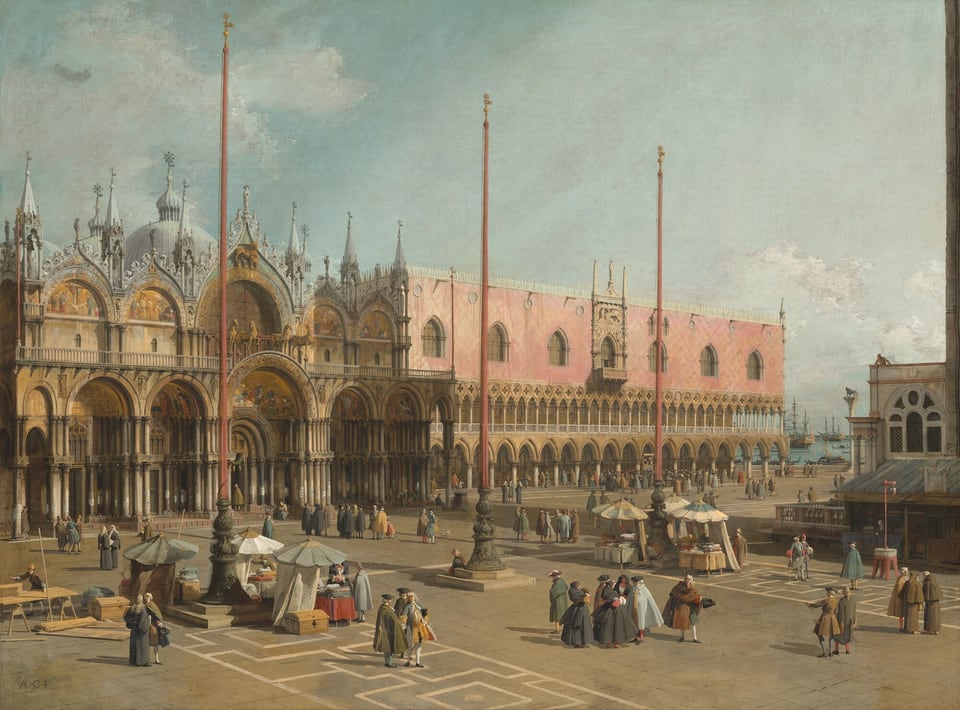
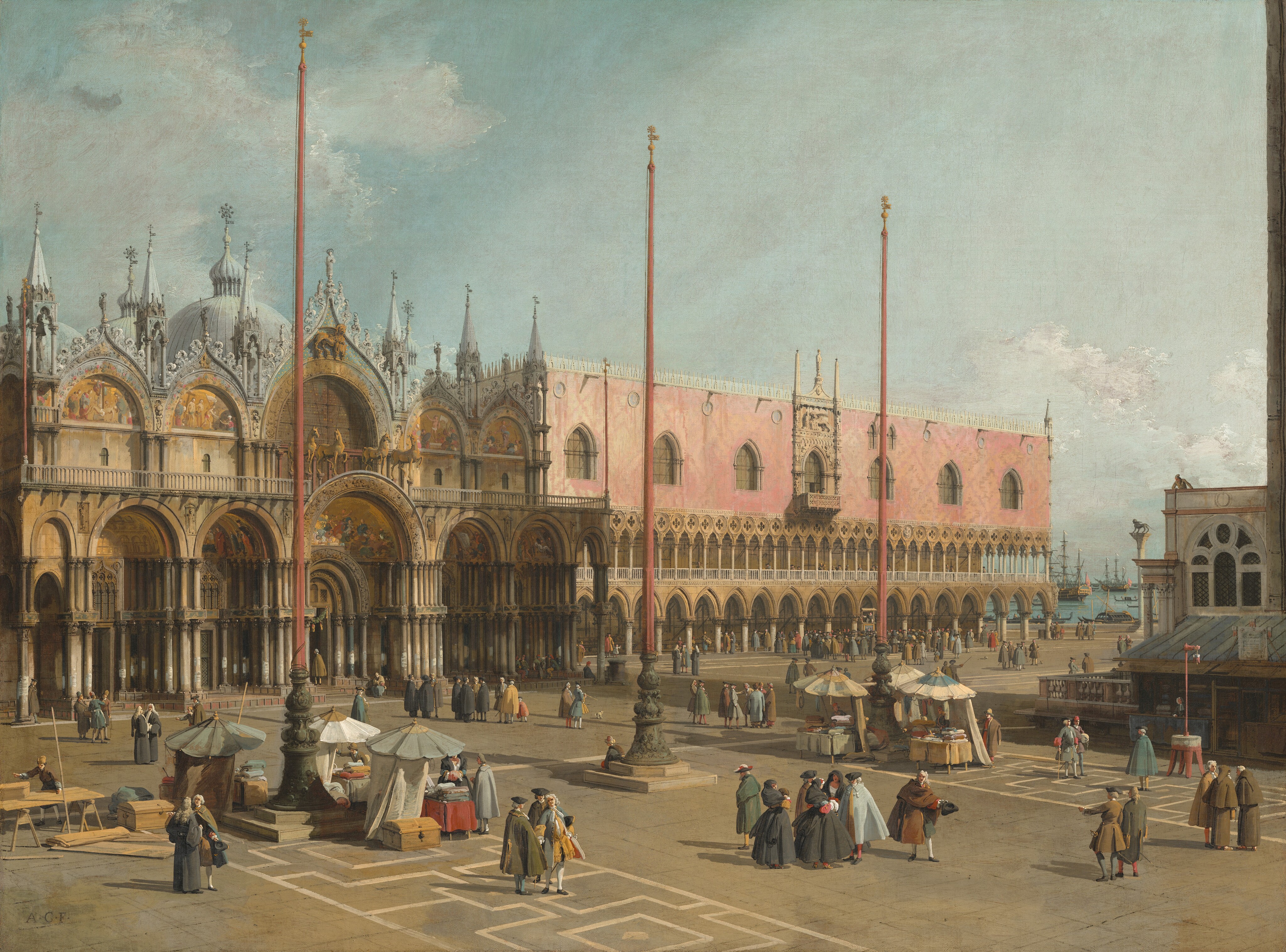
The Square of Saint Mark's, Venice1742/1744
Sunlight floods the Piazza San Marco, where Venetians in capes and tricorn hats stroll and talk among market stalls set up around three red flagstaffs. More about this work
About this work
Sunlight floods the Piazza San Marco, where Venetians in capes and tricorn hats stroll and talk among market stalls set up around three red flagstaffs. At the left rise the domes, arches and gold-ground mosaics of the basilica, crowned by its four gilded horses; at the right stretches the pink and white façade of the Doge’s Palace, and between them a glimpse of the winged lion on its column and ships on the lagoon beyond. Canaletto painted such views largely for British visitors on the Grand Tour, and he signed this one with his initials, A.C.F., at lower left.
Written by Ochre Editions.
What you’re looking at
Dozens of men with several women and a few children gather in pairs or small groups across a sun-drenched plaza in front of a domed church next to a long, pale pink building in this horizontal painting. The people’s faces and hands we can see have pale, peachy skin. The men wear hats and shin-length capes or jackets over stockings in tones of charcoal gray, olive green, butterscotch yellow, black, and brown. The women wear black capes covering their heads and long, full skirts. The ash-brown plaza has two zones where geometric patterns are picked out in a lighter, oatmeal brown. Three coral-red flagpoles are spaced along the center of the plaza parallel to the two buildings. Each flagpole rests on an olive-green base about a third of the height of the pole. Tables under open umbrellas clustered around the outer two flagpoles display piles of cloth, and a few people gather around the wares. The domed building extends into the scene from the left edge of the painting, and reaches about a third of the way across as it angles away from us. It has a central portal with nested arches, flanked to each side by a pair of slightly smaller, arched portals. Scenes against gold backgrounds appear in the archway of each of the five doors. There is a second level of arches above. The smaller arches to either side are decorated with more scenes of people against gold backgrounds. Four gold horses stand atop the central, lower arch, each with one front and one back hoof raised. The arch behind them is dim, the back side of a stained-glass window. The stone of the arches and front of the building are light brown. The upper arches are lined with pale, slate-gray spires and curling tracery. The three-story pink building sits close by to our right, extending into the distance on the same angle as the church, and as tall as its neighbor. The lowest level is a series of open, pointed arches. The second level is also a row of arches, but more closely spaced. People walk and stand under both covered walkways. The top half of the building has a carnation-pink façade with seven windows evenly spaced across its width. The central window is surrounded by carved stone ornament. Along the right edge of the painting and closer to us than the large buildings is the corner of a two-story building. The lower level is in shadow under a sloping awning, creating a merchant’s stall, and the second level has a rounded, arched window. One person stands at the front corner of the roof and looks down into the square. In the narrow gap between the row of buildings to our left and the smaller structure to our right is a winged lion atop a tall column. Beyond that is sparkling blue water with several masted ships and long, narrow gondolas. The sky above has thin white clouds against a pale blue sky. The artist signed the lower left, “A.C.F.”
Description from the National Gallery of Art.
How it was made
- Oil paint
- Pigment ground in a drying oil, usually linseed. It dries slowly, so painters could blend on the canvas, build up thin translucent glazes, and rework a picture over weeks. Canvas replaced wooden panels in the 1500s because it is lighter and can be rolled.
Canaletto
Italian, 1697–1768 · Born and died in Venice.
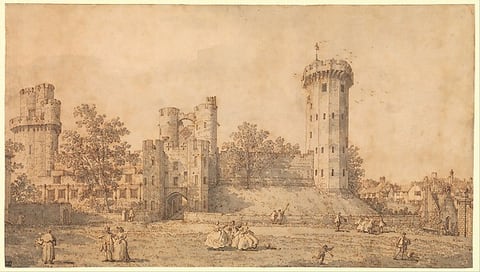
Canaletto, the son of a Venetian painter of theatre scenery, turned in the 1720s to painting views of his native city and became its leading vedutista. British travellers on the Grand Tour were his most eager patrons, many through the merchant and consul Joseph Smith. When war cut off that trade he went to England, working there from 1746 to the mid-1750s on views of London and country houses such as Warwick Castle. He also made a set of etchings that includes imaginary views.
Written by Ochre Editions.
Rights and the museum’s record
Public domain. The National Gallery of Art has dedicated this image to the public domain under CC0, so anyone may copy, adapt and use it, for any purpose, without asking. Our prints and files are reproductions made from the museum’s image; the museum doesn’t endorse them.
- Object number
- 1945.15.3
- Credit
- Courtesy National Gallery of Art, Washington
- Type
- Painting
- Licence
- CC0 1.0 Universal
- Museum record
- See it on the museum’s site
Report this work
More by Canaletto
All their works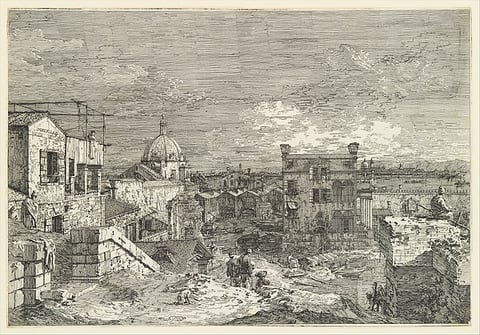
Close in colour