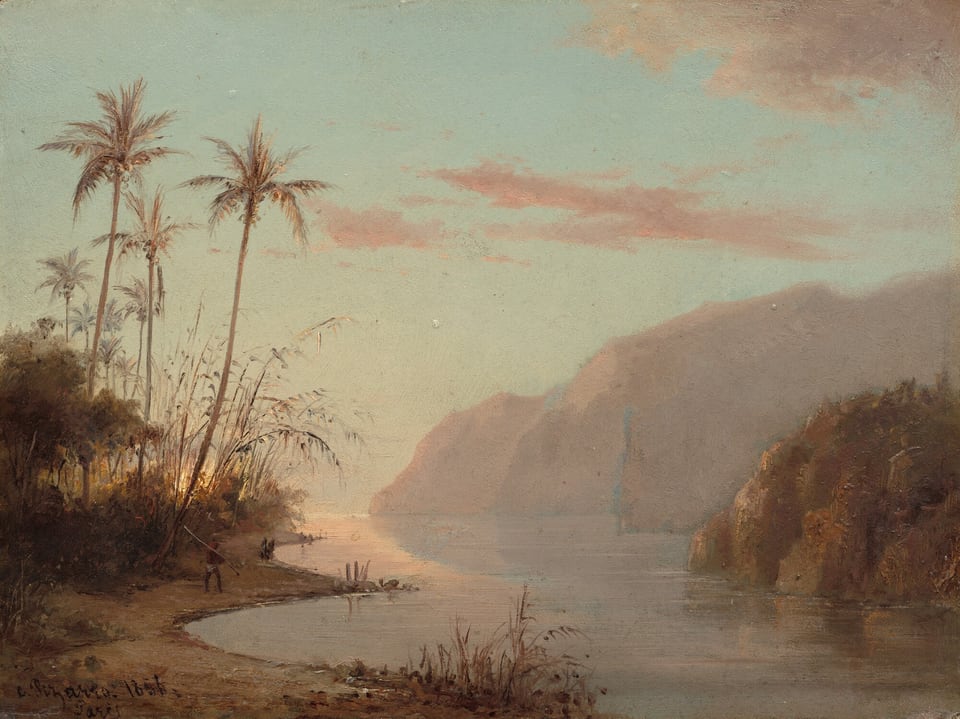
A Creek in St. Thomas (Virgin Islands)1856
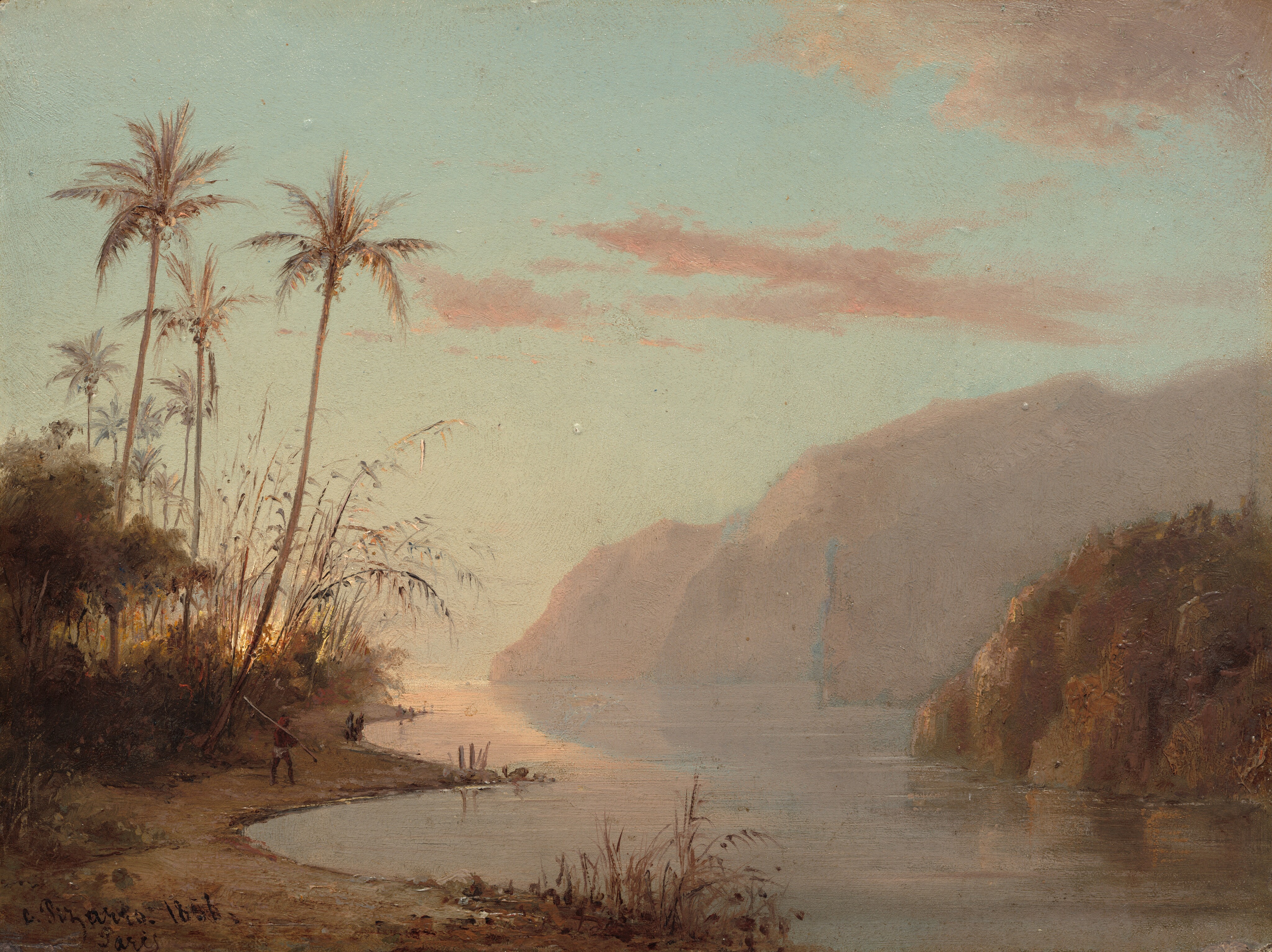
A wide creek winds between a grove of palms and tree-covered boulders, with mauve-pink mountains on the far shore and a low sun laying a yellow streak across the still water. More about this work
About this work
A wide creek winds between a grove of palms and tree-covered boulders, with mauve-pink mountains on the far shore and a low sun laying a yellow streak across the still water. A man in a white loincloth walks the bank with a long stick. Pissarro was born on St Thomas, then a Danish colony in the Caribbean, and he signed this small painting “C. Pizarro. 1856. Paris.”, the year after he settled in France: it is a memory of the island, made long before he became one of the founders of Impressionism. The careful, even finish is quite unlike his later broken brushwork.
Written by Ochre Editions.
What you’re looking at
A wide creek winds between a tree-lined bank to our left and hazy mountains to our right in this horizontal landscape painting. The riverbank curves deeply like a backward capital letter B. Marshy grasses grow in tufts, and palm and other trees grow in a grove to our left. One brown-skinned person wearing only a white cloth around the hips carries a long stick near the shoreline. Dabs of brown and muted dark pink suggest other people farther along the riverside. Tree-covered boulders jut into the creek from our right. A band of rocky, mountains are smoky mauve-pink across the rightmost two-thirds of the horizon, which comes a third of the way up the composition. The butter-yellow sun is low on the horizon to our right, peeking through the grove of palm trees. The light pours across the placid surface of the creek, creating a soft yellow streak next to the reflection of the mountain ridge. A few heather-pink clouds drift across the pale turquoise sky. The artist signed and dated the painting in the lower left corner, “C. Pizarro. 1856. Paris.”
Description from the National Gallery of Art.
How it was made
- Oil paint
- Pigment ground in a drying oil, usually linseed. It dries slowly, so painters could blend on the canvas, build up thin translucent glazes, and rework a picture over weeks. Canvas replaced wooden panels in the 1500s because it is lighter and can be rolled.
Camille Pissarro
French, 1830–1903 · Born in Charlotte Amalie, Saint Thomas; died in Paris.
Pissarro was born on the Caribbean island of Saint Thomas and moved to France in 1855. Encouraged by Corot, he became the elder statesman of Impressionism, the only painter to show at all eight of the group’s exhibitions, and a generous mentor to Cézanne and Gauguin. He painted the villages and fields around Pontoise and Éragny, briefly adopted Seurat’s divided brushwork, and in his last decade made series of Paris, Rouen and Le Havre seen from hotel windows.
Written by Ochre Editions.
Impressionism
Painters in 1870s Paris who worked quickly, often outdoors, to catch light as it changed.
Rights and the museum’s record
Public domain. The National Gallery of Art has dedicated this image to the public domain under CC0, so anyone may copy, adapt and use it, for any purpose, without asking. Our prints and files are reproductions made from the museum’s image; the museum doesn’t endorse them.
- Object number
- 1985.64.29
- Credit
- Courtesy National Gallery of Art, Washington
- Type
- Painting
- Licence
- CC0 1.0 Universal
- Museum record
- See it on the museum’s site
Report this work
More by Camille Pissarro
All their works
Close in colour