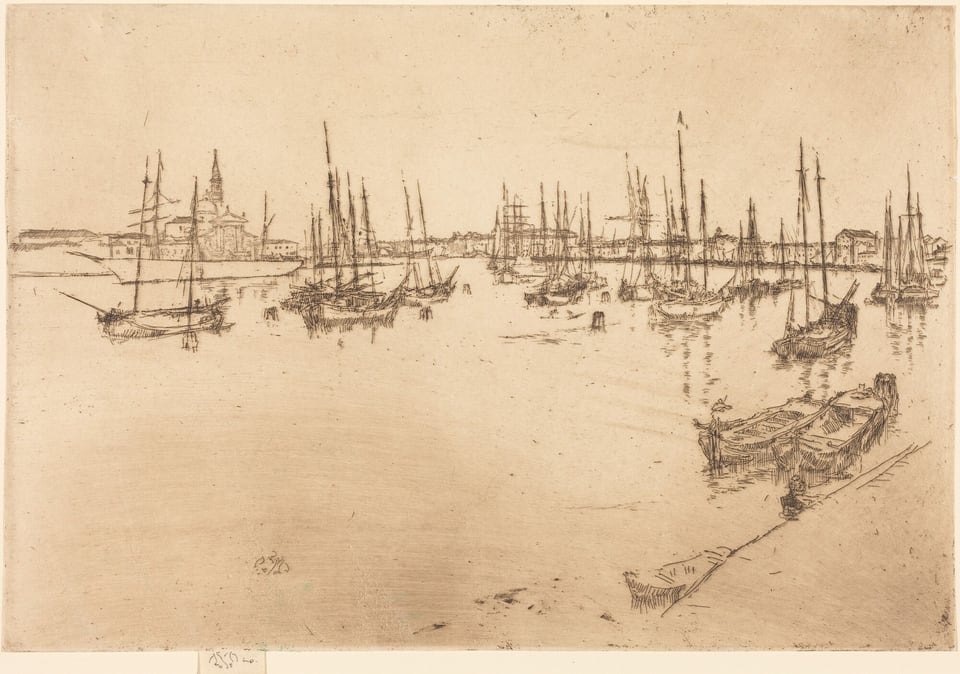
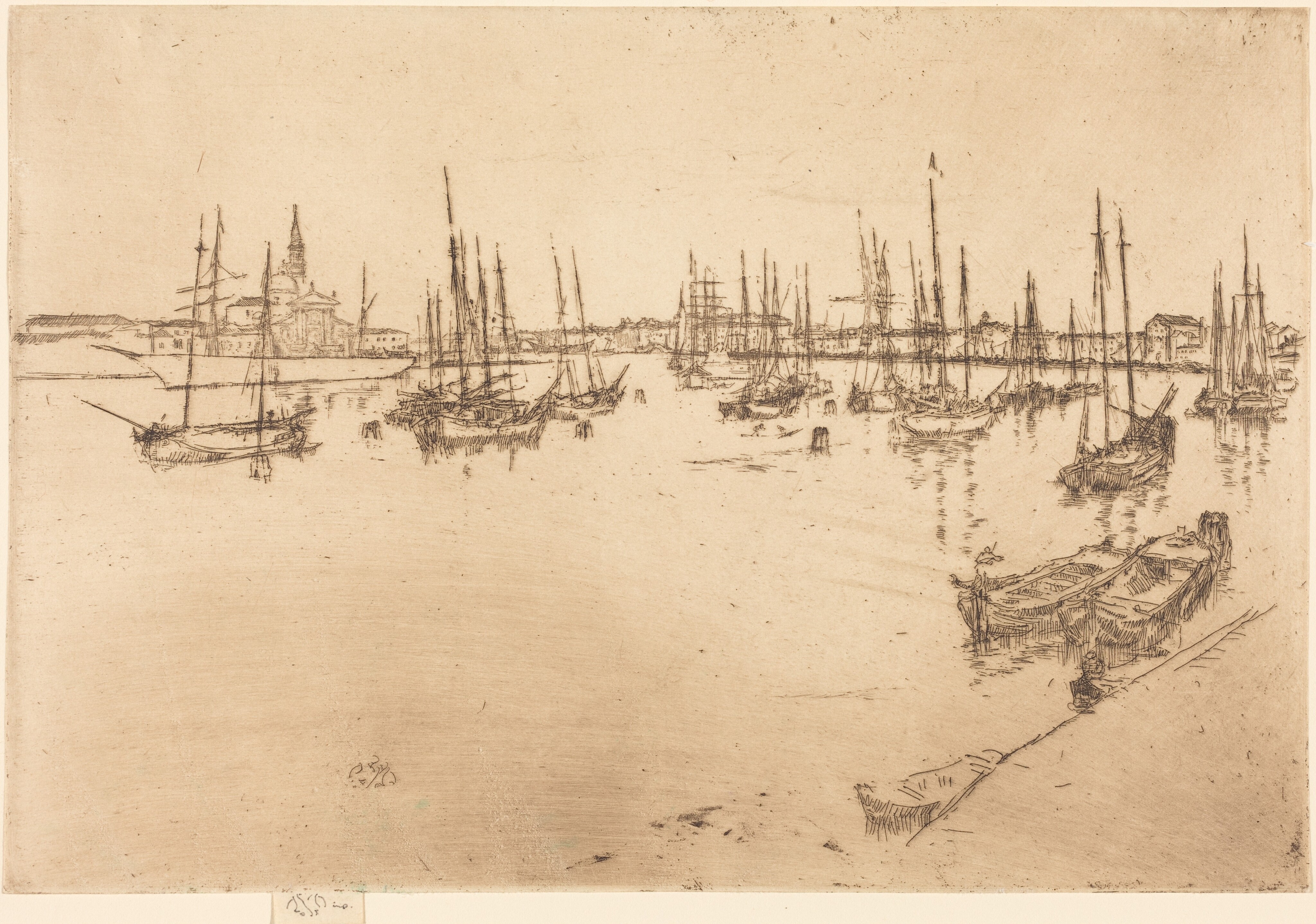
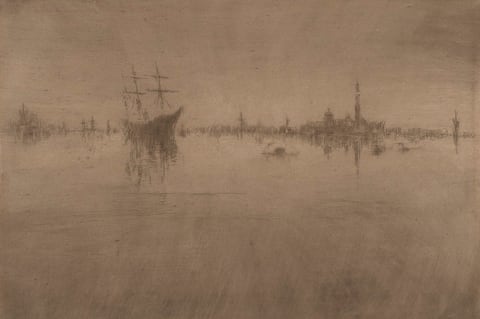
San Giorgio1880
Masted ships ride at anchor in the foreground, their reflections trembling in the water, while across the lagoon the church of San Giorgio Maggiore and its neighbours lie in a faint line along the horizon. More about this work
About this work
Masted ships ride at anchor in the foreground, their reflections trembling in the water, while across the lagoon the church of San Giorgio Maggiore and its neighbours lie in a faint line along the horizon. Whistler etched the view in Venice in 1880, during the fourteen-month stay that produced his celebrated Venetian prints. He used the empty paper as much as the etched line, leaving the sky and much of the water bare so that the scene seems to float in light. This impression is printed on Asian laid paper, which he favoured for its warm tone.
Written by Ochre Editions.
What you’re looking at
The image displays a harbor filled with boats and ships. The perspective is slightly elevated, likely from a dock, with a partially visible boat and dock at the forefront. The horizon is in the upper third of the image, showing a distant cityscape with spires and structures. The brushwork is delicate, with fine, linear strokes typical of etching. The color palette is monochromatic, sepia tones creating a vintage and serene mood. The ships with tall masts populate the water, with reflections giving a sense of stillness. In the distance, faint impressions of buildings line the harbor, blending into the horizon.
Description from the National Gallery of Art.
How it was made
- Drypoint
- Lines scratched straight into the plate with a needle throw up a ridge of metal, the burr, which holds ink and prints a soft, furred line. The burr wears down, so early impressions are the richest.
- Etching
- The artist draws with a needle through a waxy coating on a copper plate, and acid bites the exposed lines. The plate is then inked, wiped and printed under pressure, so the line keeps the freedom of drawing.
- Laid paper
- Handmade on a mould of close-set wires, which leave fine parallel lines you can see when the sheet is held to the light.
James McNeill Whistler
American, 1834–1903 · Born in Lowell, Massachusetts; died in London.
Whistler spent part of his boyhood in Russia, left West Point without graduating and trained as a painter in Paris before settling in London in 1859. He held that a picture was an arrangement of colour and form, and named his works symphonies, harmonies and nocturnes; a hostile review of one nocturne led to his 1878 libel suit against John Ruskin. He was equally committed to etching, and in his Venice plates of 1879–80 he left films of ink on the copper to suggest water and dusk.
Written by Ochre Editions.
Rights and the museum’s record
Public domain. The National Gallery of Art has dedicated this image to the public domain under CC0, so anyone may copy, adapt and use it, for any purpose, without asking. Our prints and files are reproductions made from the museum’s image; the museum doesn’t endorse them.
- Object number
- 1943.3.8533
- Credit
- Courtesy National Gallery of Art, Washington
- Type
- Licence
- CC0 1.0 Universal
- Museum record
- See it on the museum’s site
Report this work
More by James McNeill Whistler
All their works
Close in colour