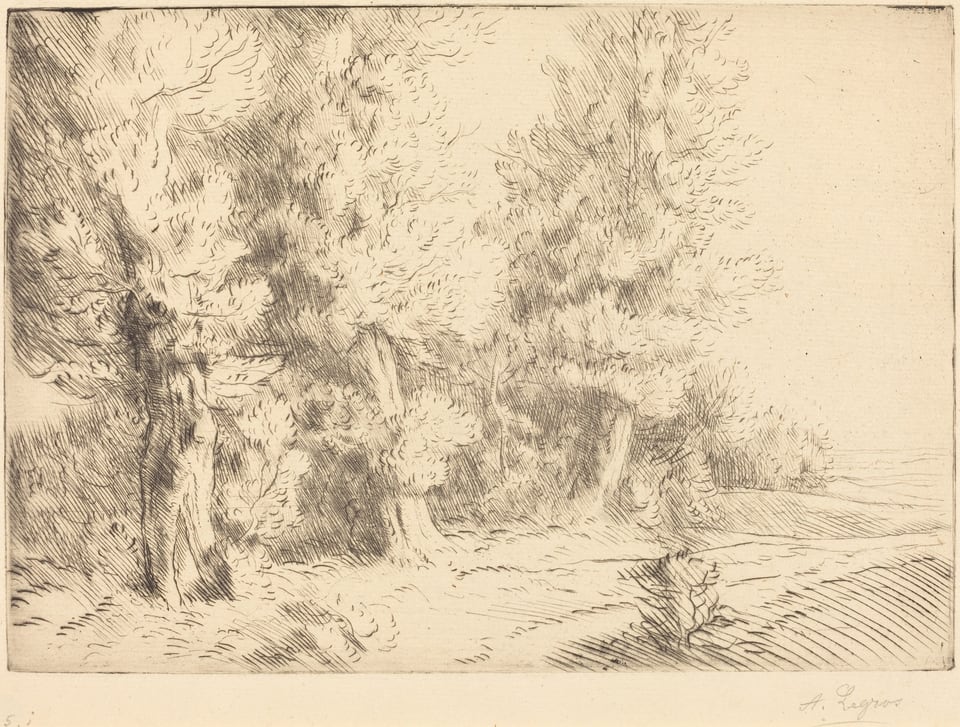
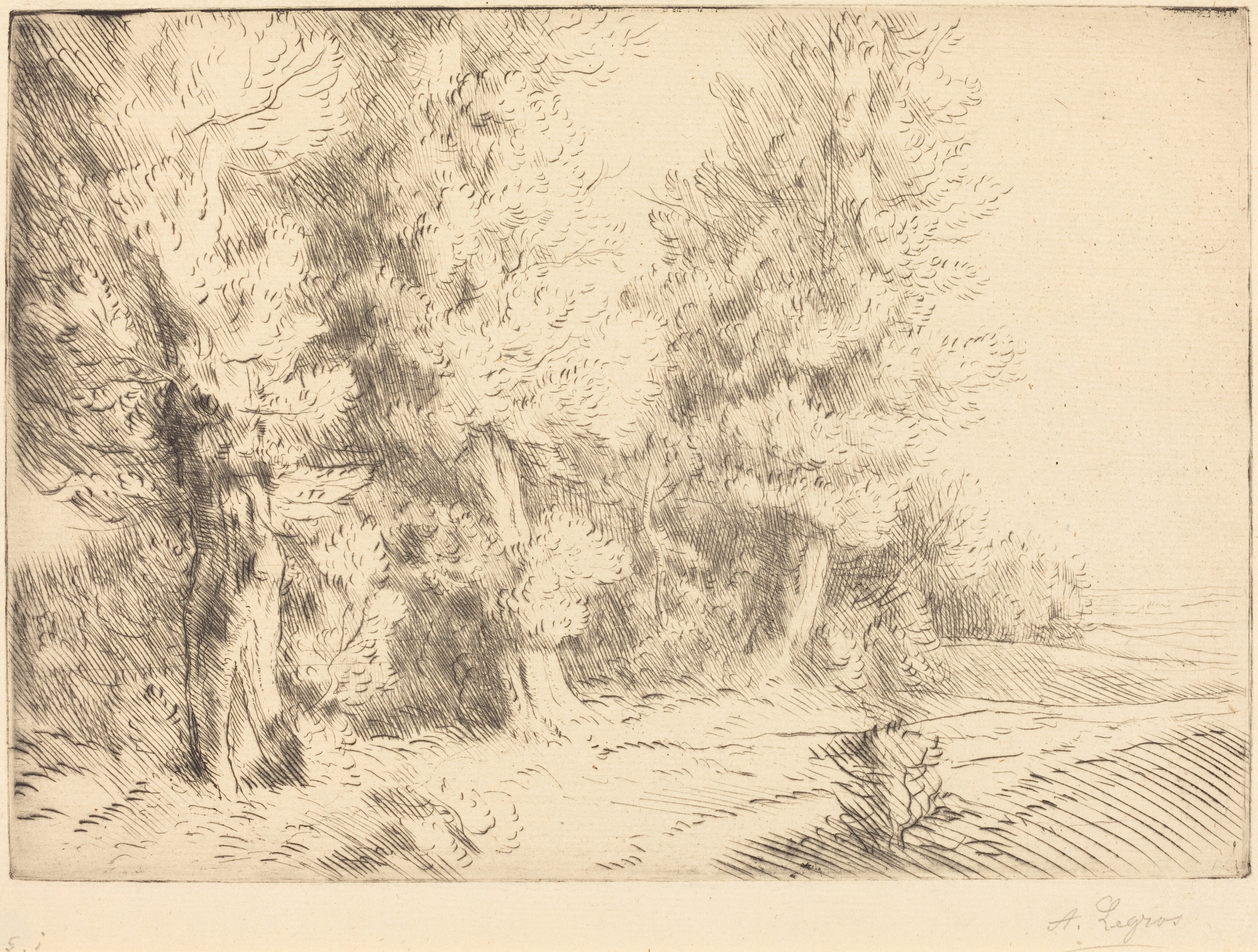
In the Forest of Fontainebleau (Dans la foret de Fontainebleau)
Alphonse Legros made this. It is now at the National Gallery of Art in Washington, DC. More about this work
About this work
The image shows a sketch-like scene viewed from a slightly elevated perspective, depicting a landscape dominated by a line of trees. The horizon is low in the image, just above a rising slope, with tall trees extending towards the sky. The trees and foliage are characterized by brushstrokes and crosshatching technique, conveying texture and shading. The color palette is monochromatic, with dark and light tones for a serene, natural quality. Line and shadow add movement and highlight the beauty of the trees as they recede into the distance, merging with the sky.
Description from the National Gallery of Art.
Alphonse Legros made this. It is now at the National Gallery of Art in Washington, DC.
How it was made
- Drypoint
- Lines scratched straight into the plate with a needle throw up a ridge of metal, the burr, which holds ink and prints a soft, furred line. The burr wears down, so early impressions are the richest.
- Etching
- The artist draws with a needle through a waxy coating on a copper plate, and acid bites the exposed lines. The plate is then inked, wiped and printed under pressure, so the line keeps the freedom of drawing.
Alphonse Legros
French, 1837–1911
Legros trained in Dijon and Paris, where he befriended Whistler and Fantin-Latour, and in 1863 he settled in London at Whistler’s suggestion. His etchings and paintings of peasants, beggars, monks and forests carry the sober realism of his French training. He became an influential teacher, serving as Slade Professor at University College London from 1876 to 1892, and helped to revive etching and the cast portrait medal in Britain.
Written by Ochre Editions.
Rights and the museum’s record
Public domain. The National Gallery of Art has dedicated this image to the public domain under CC0, so anyone may copy, adapt and use it, for any purpose, without asking. Our prints and files are reproductions made from the museum’s image; the museum doesn’t endorse them.
- Object number
- 1946.4.22
- Credit
- Courtesy National Gallery of Art, Washington
- Type
- Licence
- CC0 1.0 Universal
- Museum record
- See it on the museum’s site
Report this work
More by Alphonse Legros
All their works
Close in colour