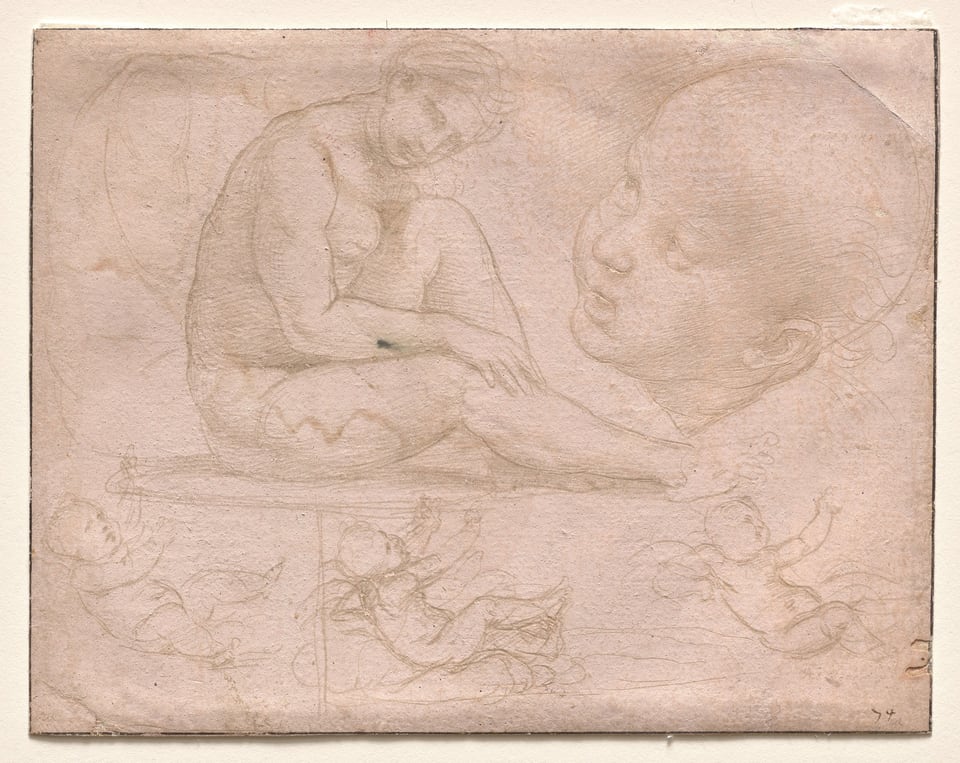
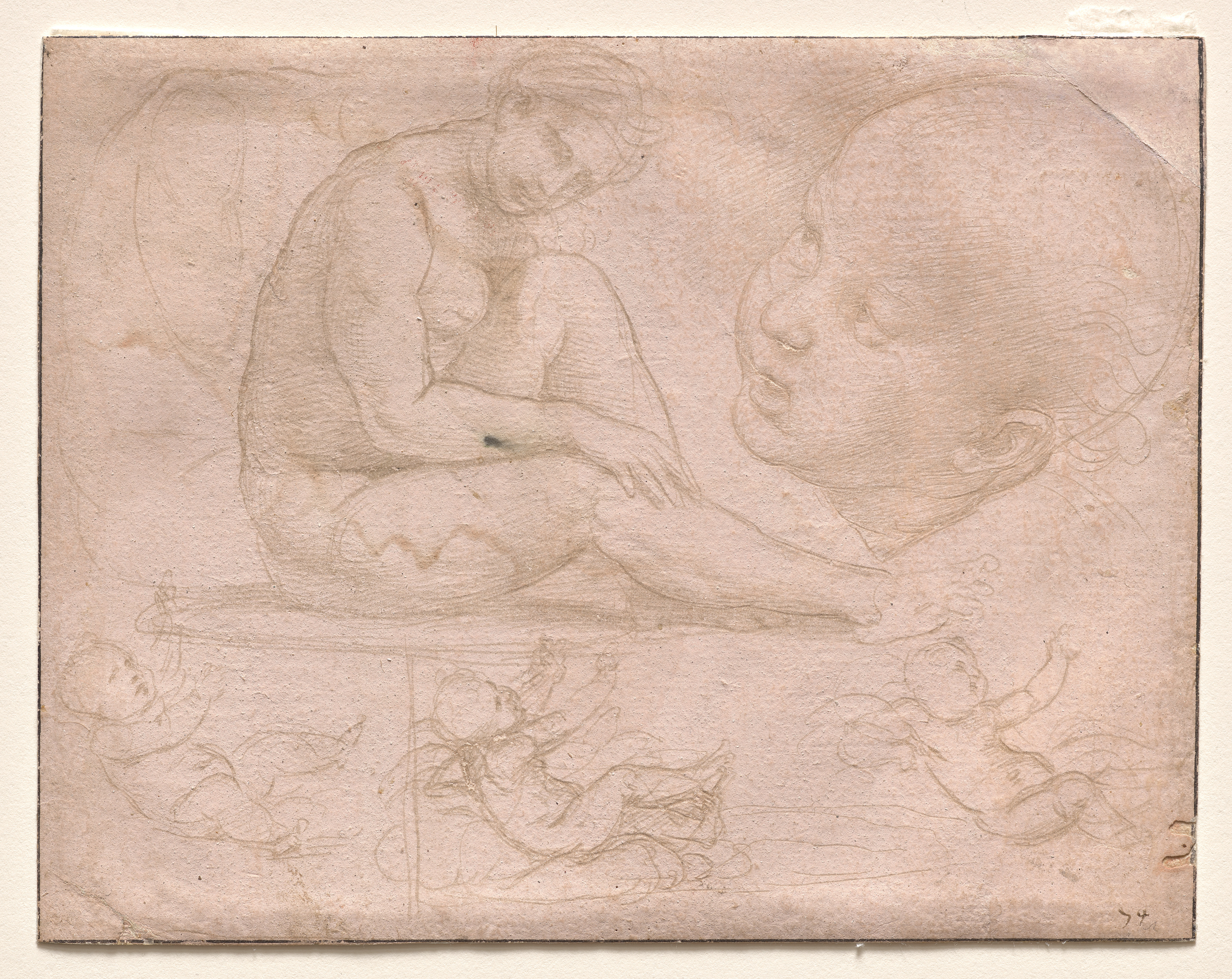
Studies of a Seated Female, Child's Head, and Three Studies of a Babyc. 1507–8
This drawing is from Raphael’s "pink sketchbook," comprised of ten sheets of roughly equal size that each portray variations of a mother and child. More about this work
About this work
This drawing is from Raphael’s "pink sketchbook," comprised of ten sheets of roughly equal size that each portray variations of a mother and child. Today, six of the drawings at the Palais des Beaux-Arts, Lille; two are at the British Museum; one is in a private collection; and one is in Cleveland. The small format of the sheets would have enabled the artist to carry the notebook as he traveled from Florence to Rome in 1508. Raphael used metalpoint, a technique popular in 15th- and early 16th-century Italy on a pink prepared surface. The pose of the infant's head in the drawing was based on that of the Christ child in Leonardo da Vinci's Benois Madonna , then in a private collection in Florence, with changes—such as the uplifted eyes and open mouth—made by Raphael. The curving back of the female nude is echoed in the roundness of the child's head. The three sketches of a reclining infant at the bottom of the sheet are freely handled and improvisational, relaying the child's squirming, continuous movement with repeated contour lines.
Text from the Cleveland Museum of Art.
Raphael
Italian, 1483–1520 · Born in Urbino; died in Rome.
Raphael trained in Urbino and in Perugino’s orbit, absorbed the lessons of Leonardo and Michelangelo in Florence from 1504, and in 1508 was called to Rome by Pope Julius II. There he painted the frescoes of the papal apartments, including The School of Athens, and under Leo X directed the decoration of the Vatican Loggia, designed tapestries for the Sistine Chapel and took charge of building St Peter’s. His balanced compositions became the model of classical art for centuries. He died at thirty-seven.
Written by Ochre Editions.
Renaissance
European art from about 1400 to 1600, when painters rediscovered perspective and the classical past.
Rights and the museum’s record
Public domain. The Cleveland Museum of Art has dedicated this image to the public domain under CC0, so anyone may copy, adapt and use it, for any purpose, without asking. Our prints and files are reproductions made from the museum’s image; the museum doesn’t endorse them.
- Object number
- 1978.37
- Credit
- Courtesy of the Cleveland Museum of Art
- Type
- Drawing
- Department
- Drawings
- Licence
- CC0 1.0 Universal
- Museum record
- See it on the museum’s site
Report this work
More by Raphael
All their works
Close in colour