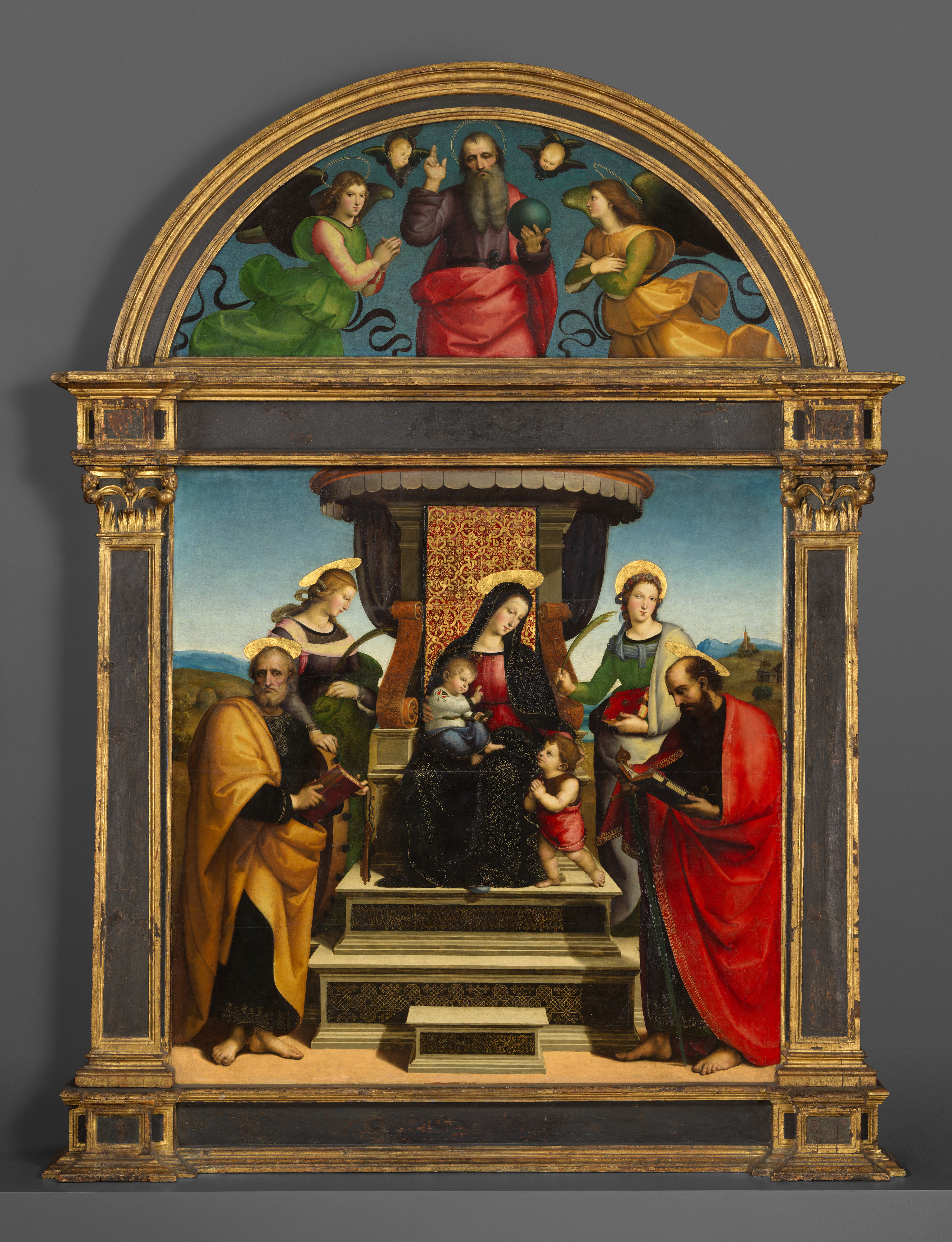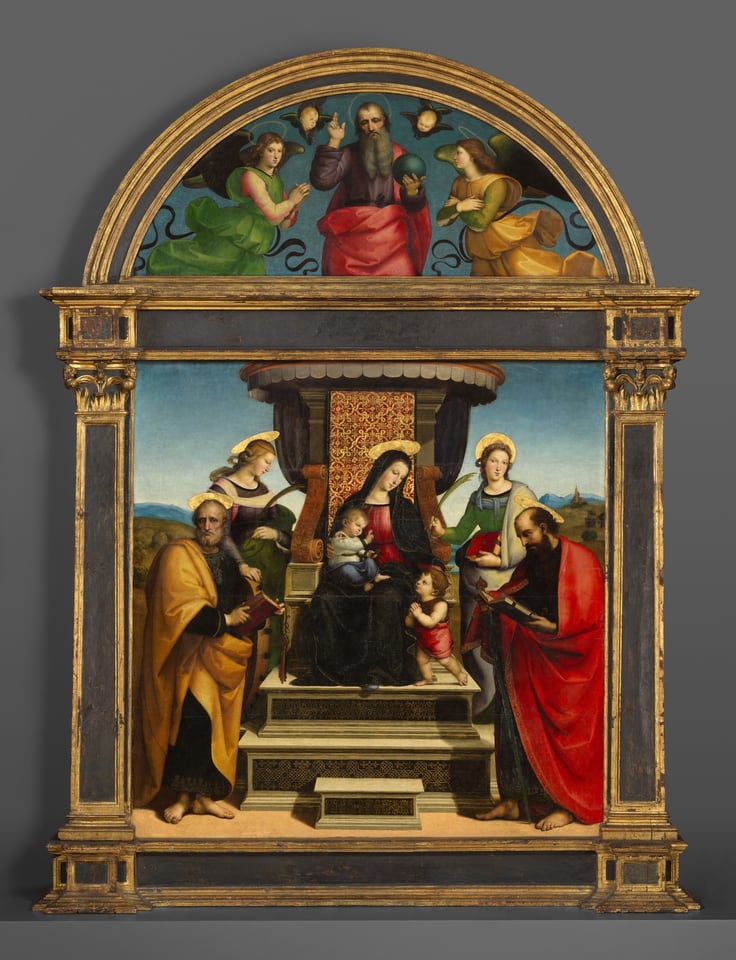
Madonna and Child Enthroned with Saintsca. 1504
The Virgin sits enthroned with the Christ Child and the infant John the Baptist, flanked by Saints Peter and Paul and two female saints, among them Catherine of Alexandria, while God the Father blesses from the lunette above, surrounded by angels. More about this work
About this work
The Virgin sits enthroned with the Christ Child and the infant John the Baptist, flanked by Saints Peter and Paul and two female saints, among them Catherine of Alexandria, while God the Father blesses from the lunette above, surrounded by angels. Raphael painted the altarpiece around 1504, when he was about twenty-one, for the nuns of Sant’Antonio da Padova in Perugia; according to Vasari, the Christ Child is clothed at the nuns’ request. It shows the young painter absorbing the calm symmetry of his teacher Perugino while already reaching towards the grandeur of his later work.
Written by Ochre Editions.
How it was made
- Oil paint
- Pigment ground in a drying oil, usually linseed. It dries slowly, so painters could blend on the canvas, build up thin translucent glazes, and rework a picture over weeks. Canvas replaced wooden panels in the 1500s because it is lighter and can be rolled.
Raphael
Italian, 1483–1520 · Born in Urbino; died in Rome.
Raphael trained in Urbino and in Perugino’s orbit, absorbed the lessons of Leonardo and Michelangelo in Florence from 1504, and in 1508 was called to Rome by Pope Julius II. There he painted the frescoes of the papal apartments, including The School of Athens, and under Leo X directed the decoration of the Vatican Loggia, designed tapestries for the Sistine Chapel and took charge of building St Peter’s. His balanced compositions became the model of classical art for centuries. He died at thirty-seven.
Written by Ochre Editions.
Rights and the museum’s record
Public domain. The Met has dedicated this image to the public domain under CC0, so anyone may copy, adapt and use it, for any purpose, without asking. Our prints and files are reproductions made from the museum’s image; the museum doesn’t endorse them.
- Object number
- 16.30ab
- Credit
- Courtesy of The Metropolitan Museum of Art
- Type
- Paintings
- Department
- European Paintings
- Licence
- CC0 1.0 Universal
- Museum record
- See it on the museum’s site