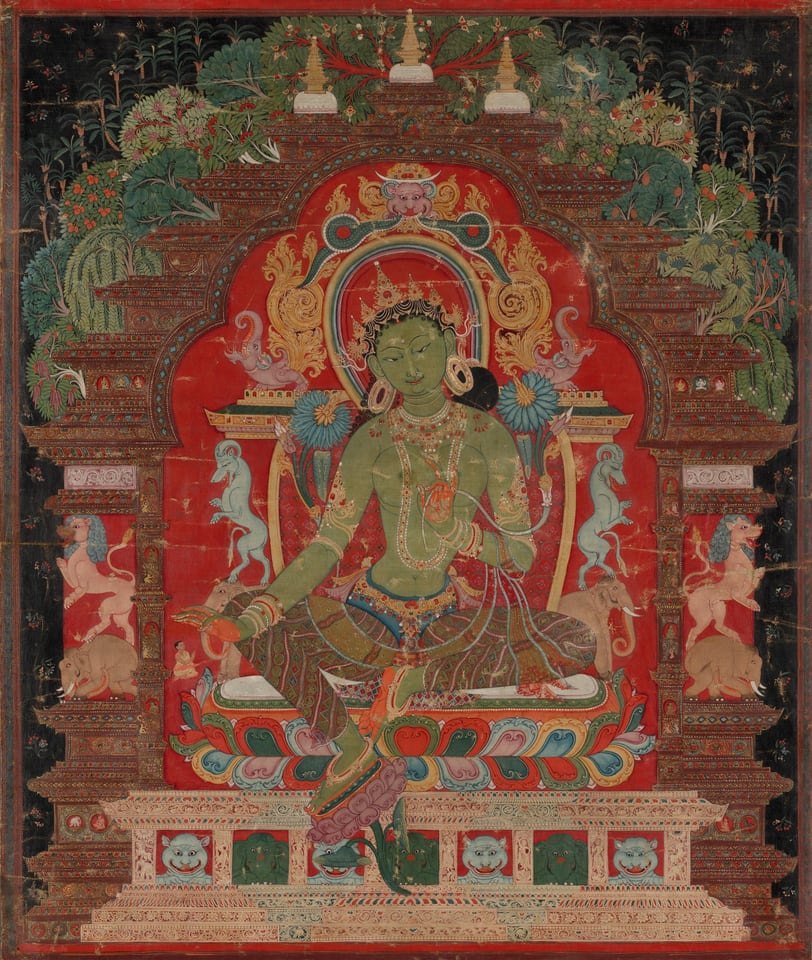
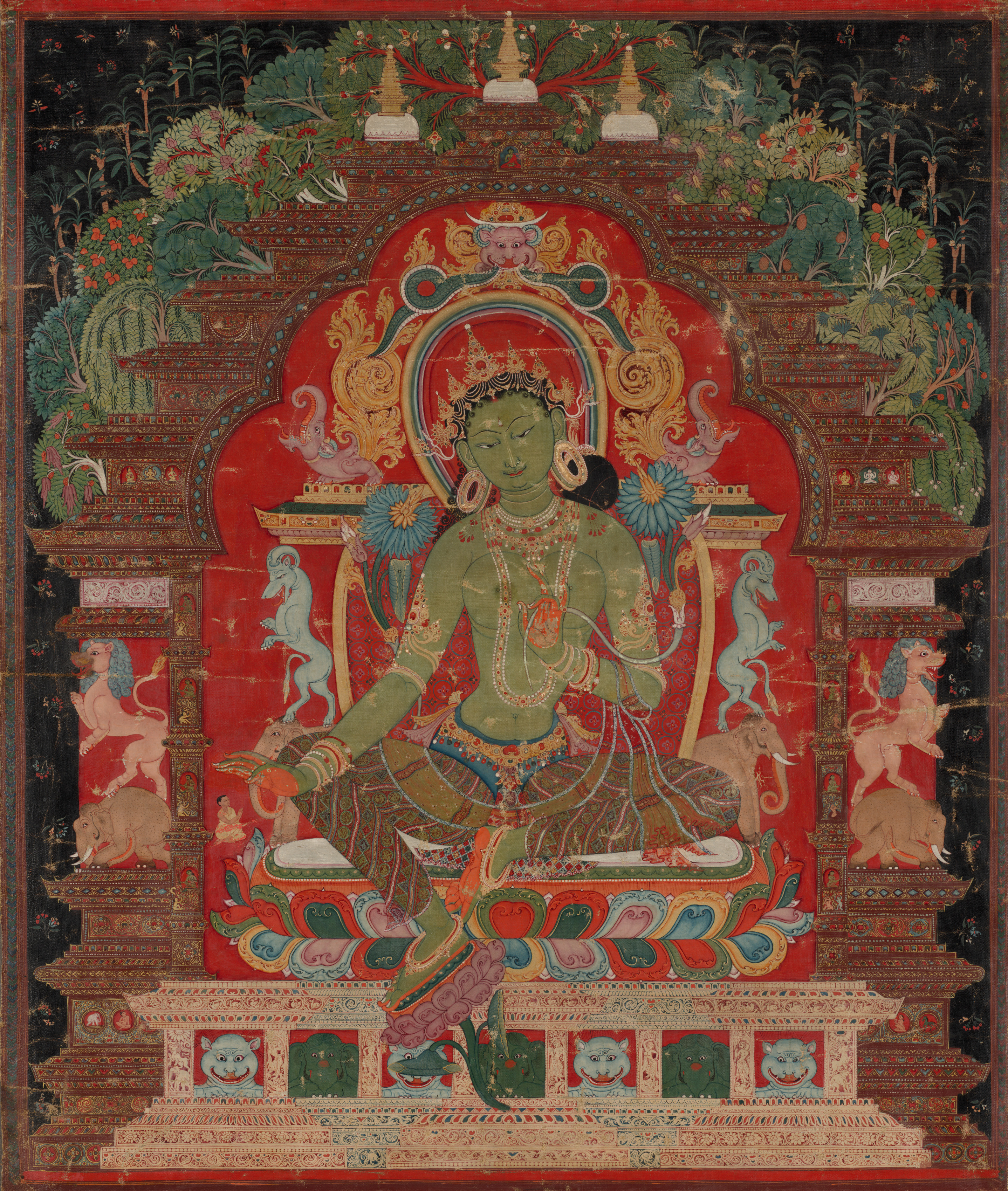
Green Tarac. 1260s, mounted 2020
For Tibetans, Green Tara is one of the preeminent figures of their Buddhist faith, a radiant savioress who embodies the female form of the perfect, enlightened mind. More about this work
About this work
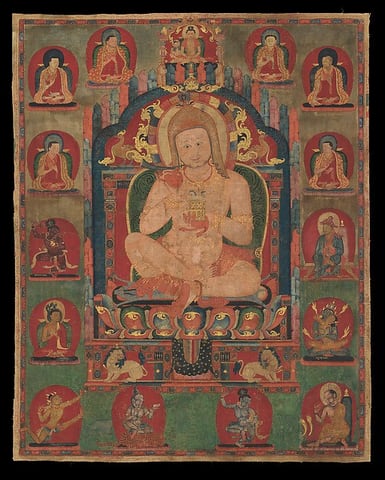
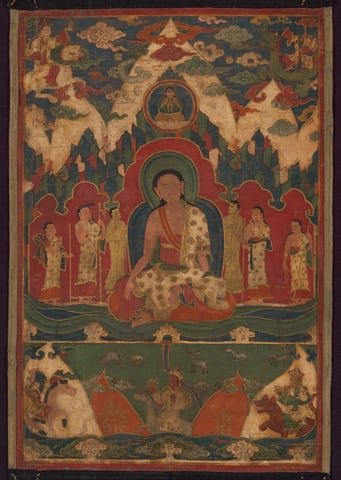
For Tibetans, Green Tara is one of the preeminent figures of their Buddhist faith, a radiant savioress who embodies the female form of the perfect, enlightened mind. The Green Tara in the Cleveland thangka— a Tibetan devotional painting on cloth—specifically dispels fear and provides protection, just like her mantra inscribed on the back side of the painting. Her green color and fear-not gesture link her to the cosmic Buddha of the North, enshrined above her head. Most scholars agree that this work was painted by the celebrated Nepalese artist known as Aniko.
Text from the Cleveland Museum of Art.
How it was made
- Opaque watercolour
- Watercolour made opaque with white or chalk and laid in flat, even layers. Persian and Indian painters ground their colours from minerals, applied them with the finest brushes and burnished the finished page.
- Tempera
- Pigment bound with egg yolk. It dries in minutes and can’t be blended wet, so painters built up form with fine, hatched strokes. It was Europe’s main panel technique before oil.
Aniko
Nepalese, active in Tibet mid- to late 1200s
Rights and the museum’s record
Public domain. The Cleveland Museum of Art has dedicated this image to the public domain under CC0, so anyone may copy, adapt and use it, for any purpose, without asking. Our prints and files are reproductions made from the museum’s image; the museum doesn’t endorse them.
- Object number
- 1970.156
- Credit
- Courtesy of the Cleveland Museum of Art
- Type
- Painting
- Department
- Indian and Southeast Asian Art
- Licence
- CC0 1.0 Universal
- Museum record
- See it on the museum’s site
Report this work
Close in colour