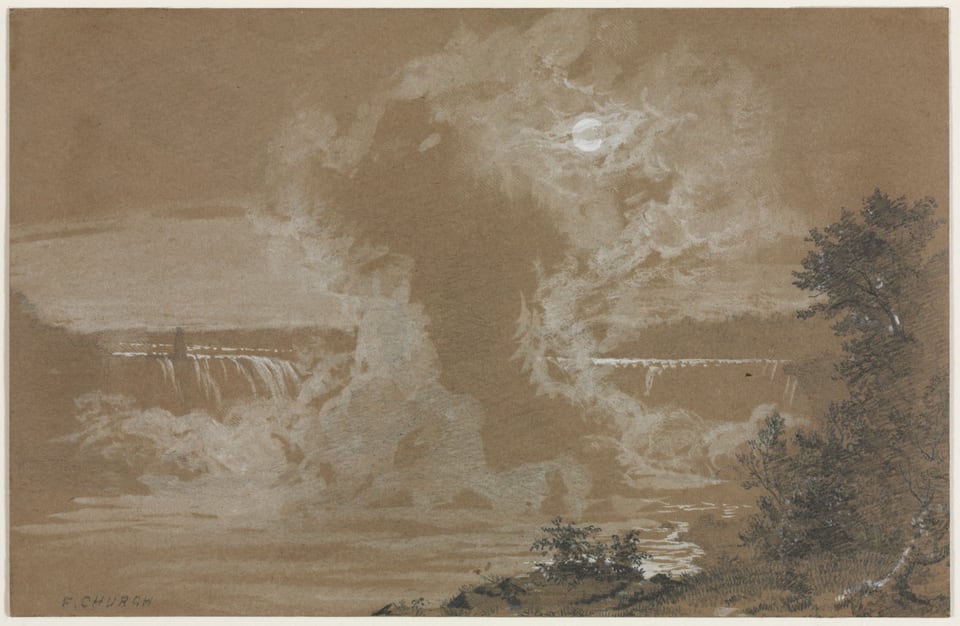
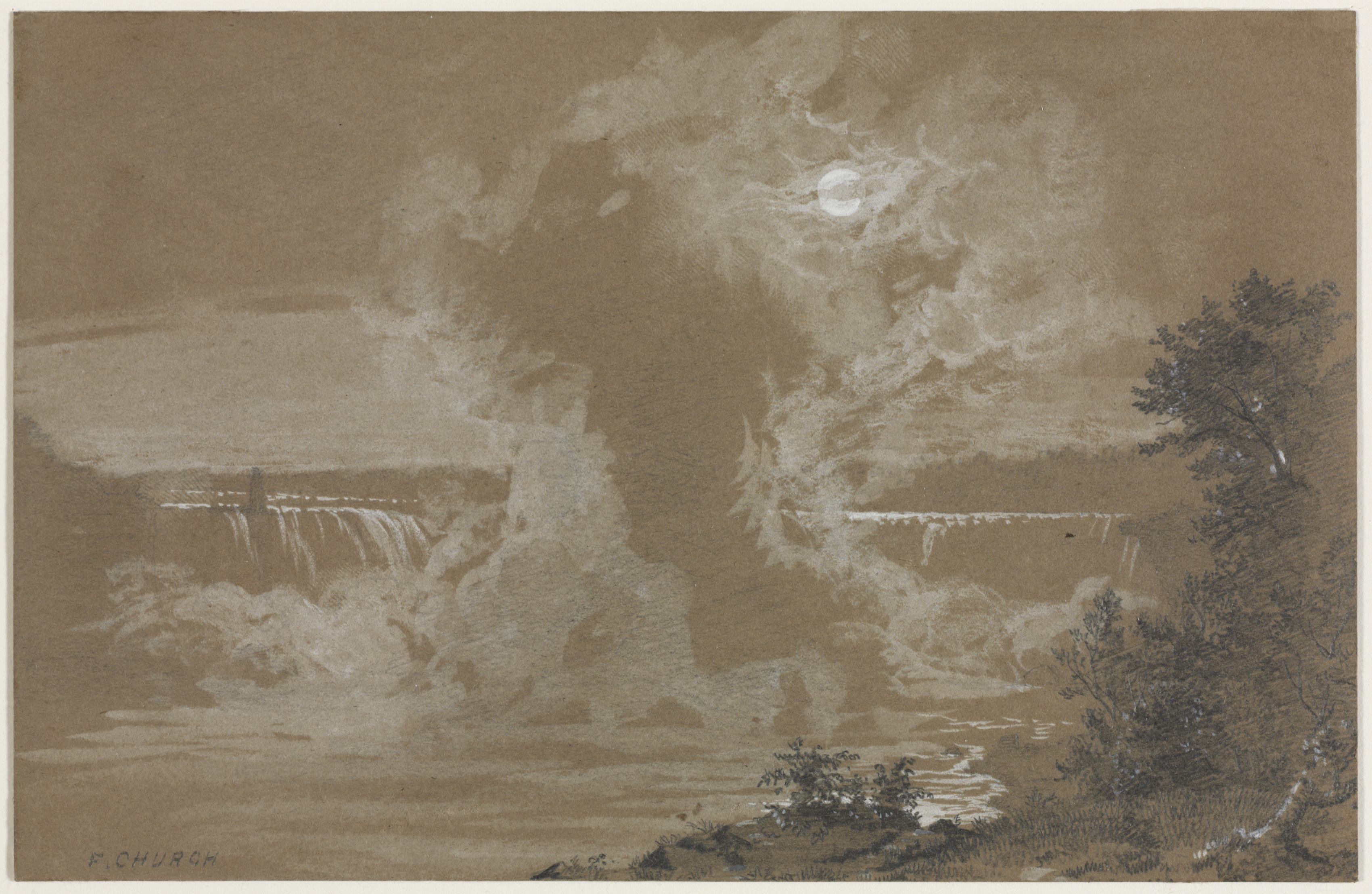
Niagara Falls by Moonlightprobably 1856
By the time Frederic E. Church executed this study of the Canadian side of Horseshoe Falls, Niagara Falls was already an icon of both American art and the American nation. More about this work
About this work
By the time Frederic E. Church executed this study of the Canadian side of Horseshoe Falls, Niagara Falls was already an icon of both American art and the American nation. Tourists and artists flocked to the falls in pursuit of a firsthand experience of the sublime, a sensation of elation and terror that portrayals of Niagara Falls had notorious difficulty reproducing. Church’s celebrated oil painting The Great Fall, Niagara (1857) was one of the few depictions believed to capture the fall’s power in pictorial terms. Like many artists of the Hudson River School, Church used drawings made on site to preserve the visual memory of the place he intended to paint in oil. Cleveland’s sheet was possibly executed during one of the four trips he took to the falls in 1856 to prepare for Niagara. As a night scene, this study in light and shadow is unusual among Church’s drawings. The dark brown paper enhances the image’s nocturnal quality and allowed Church to render the atmospheric effects of mist and clouds. He used white gouache not only as a highlight, but also to define the luminous forms of water and vapor, crafting the landscape’s substance out of negative and positive space. On the picture’s left-hand side, Church represented the man-made Terrapin Tower in shadowy miniature, a testament to his interest in site-specific details—and also, perhaps, a reminder of the diminutive status of human creation in the face of awesome natural forces.
Text from the Cleveland Museum of Art.
How it was made
- Opaque watercolour
- Watercolour made opaque with white or chalk and laid in flat, even layers. Persian and Indian painters ground their colours from minerals, applied them with the finest brushes and burnished the finished page.
- Graphite
- Pencil. Graphite has been used for drawing since the 1500s; in 1795 Nicolas-Jacques Conté mixed it with clay, so its hardness could be graded.
Frederic Edwin Church
American, 1826–1900 · Born in Hartford, Connecticut; died in New York.
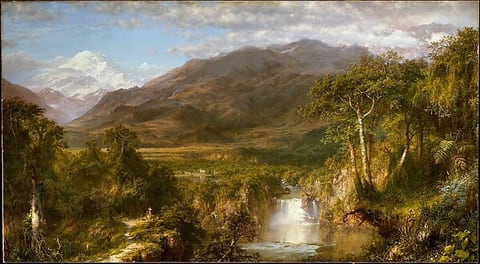
Church studied with Thomas Cole in the Catskills and became the most celebrated American landscape painter of the mid-nineteenth century. He travelled to South America, the Arctic, Europe and the Near East in search of grand subjects, and pictures such as Heart of the Andes drew paying crowds when exhibited on their own in New York. Twilight in the Wilderness of 1860 is among his most admired American views. He later designed his own house, Olana, overlooking the Hudson River.
Written by Ochre Editions.
Hudson River School
American landscape painters of the mid-1800s who made wilderness their grand subject.
Rights and the museum’s record
Public domain. The Cleveland Museum of Art has dedicated this image to the public domain under CC0, so anyone may copy, adapt and use it, for any purpose, without asking. Our prints and files are reproductions made from the museum’s image; the museum doesn’t endorse them.
- Object number
- 1976.30
- Credit
- Courtesy of the Cleveland Museum of Art
- Type
- Drawing
- Department
- Drawings
- Licence
- CC0 1.0 Universal
- Museum record
- See it on the museum’s site
Report this work
More by Frederic Edwin Church
All their works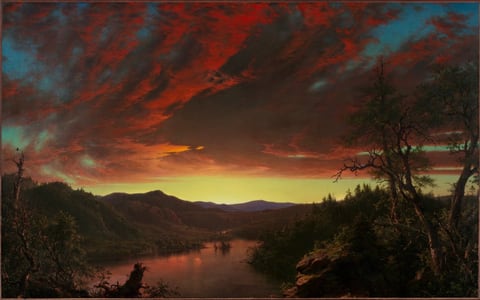
Close in colour