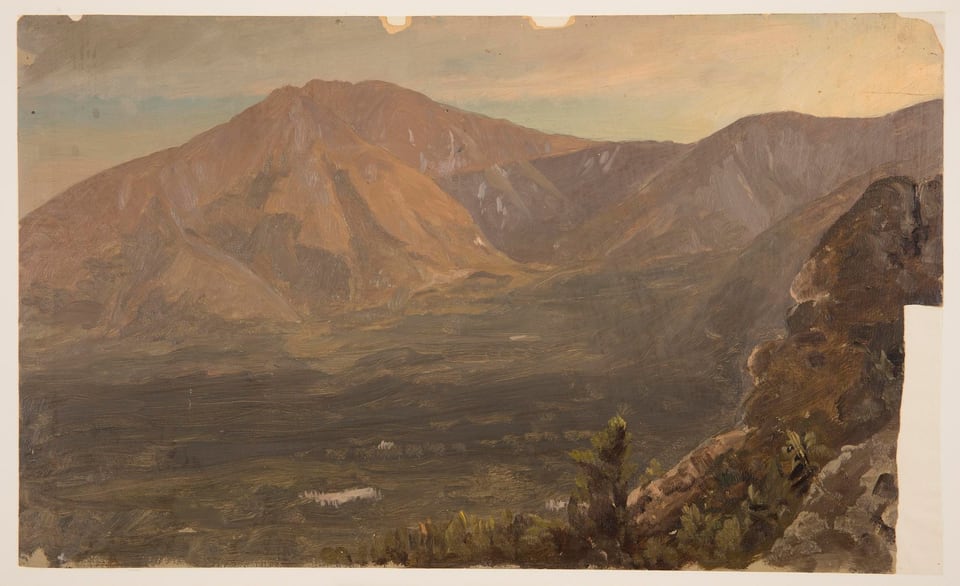
Mt. Katahdin from South Turner Mountain, Maine1877–78
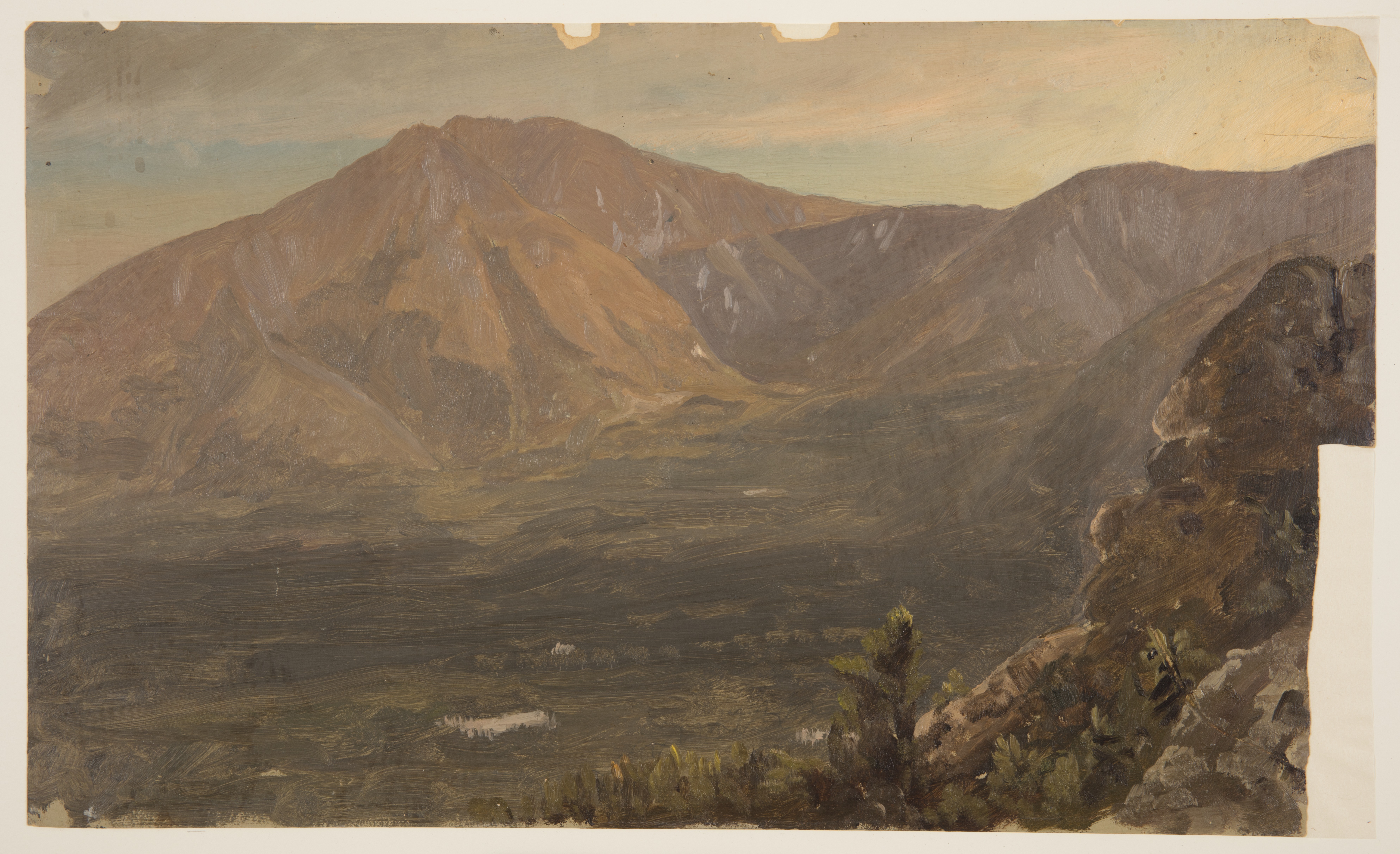
Landscape study showing a view of Mt. Katahdin in Maine from Turner Mountain to the east. Trees and a nearby rocky prominence are visible in the immediate foreground at right. More about this work
About this work
Landscape study showing a view of Mt. Katahdin in Maine from Turner Mountain to the east. Trees and a nearby rocky prominence are visible in the immediate foreground at right. Across a loosely-rendered and heavily wooded valley with a pond (likely Whidden Ponds) in the middle distance, the rugged and steep eastern face of Mt. Katahdin rises into the sky. Possibly shown at sunrise, the mountain is bathed in the bright light of the rising sun, which pours over the darkened ridge at right, casting Katahdin's peak in hues of orange and yellow. Above, the blue sky is filled with wispy cirri clouds, variously illuminated by the sun at right.
Text from Cooper Hewitt, Smithsonian Design Museum.
What you’re looking at
MT. KATAHDIN FROM SOUTH TURNER MOUNTAIN, MAINE
Description from Cooper Hewitt, Smithsonian Design Museum.
How it was made
- Oil paint
- Pigment ground in a drying oil, usually linseed. It dries slowly, so painters could blend on the canvas, build up thin translucent glazes, and rework a picture over weeks. Canvas replaced wooden panels in the 1500s because it is lighter and can be rolled.
- Graphite
- Pencil. Graphite has been used for drawing since the 1500s; in 1795 Nicolas-Jacques Conté mixed it with clay, so its hardness could be graded.
Frederic Edwin Church
American, 1826–1900 · Born in Hartford, Connecticut; died in New York.
Church studied with Thomas Cole in the Catskills and became the most celebrated American landscape painter of the mid-nineteenth century. He travelled to South America, the Arctic, Europe and the Near East in search of grand subjects, and pictures such as Heart of the Andes drew paying crowds when exhibited on their own in New York. Twilight in the Wilderness of 1860 is among his most admired American views. He later designed his own house, Olana, overlooking the Hudson River.
Written by Ochre Editions.
Hudson River School
American landscape painters of the mid-1800s who made wilderness their grand subject.
Rights and the museum’s record
Public domain. Cooper Hewitt, Smithsonian Design Museum has dedicated this image to the public domain under CC0, so anyone may copy, adapt and use it, for any purpose, without asking. Our prints and files are reproductions made from the museum’s image; the museum doesn’t endorse them.
- Object number
- 1917-4-630-a
- Credit
- Courtesy of Cooper Hewitt, Smithsonian Design Museum
- Type
- Drawing
- Department
- Cooper Hewitt, Smithsonian Design Museum
- Licence
- CC0 1.0 Universal
- Museum record
- See it on the museum’s site
Report this work
More by Frederic Edwin Church
All their works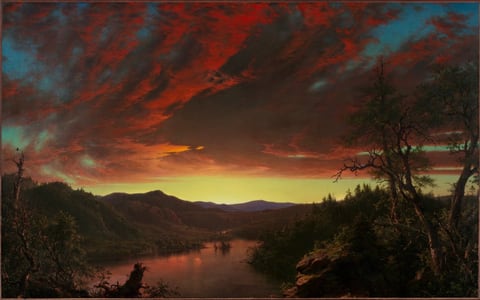
Close in colour