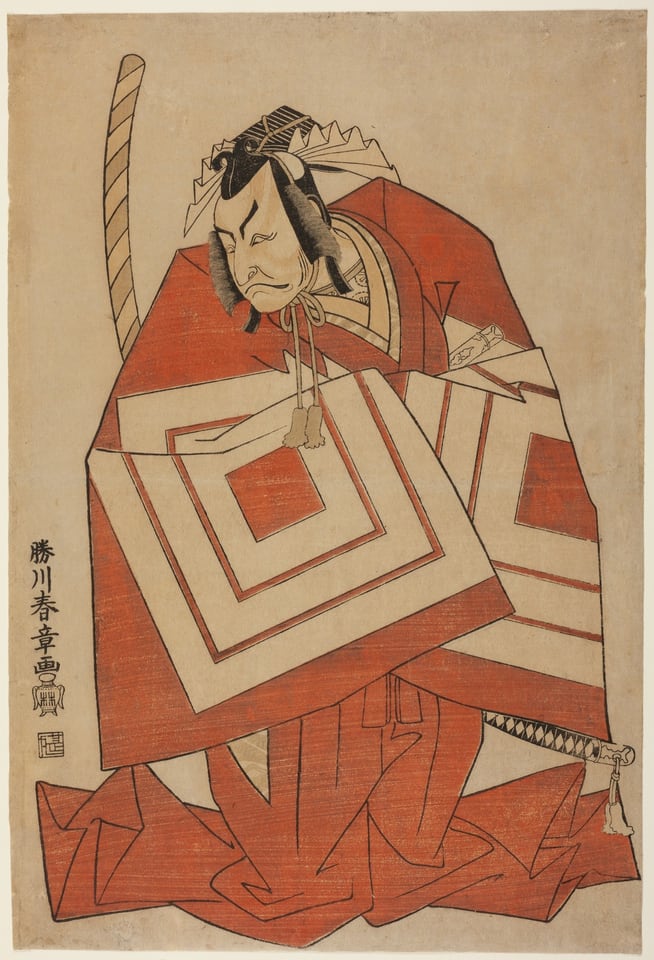
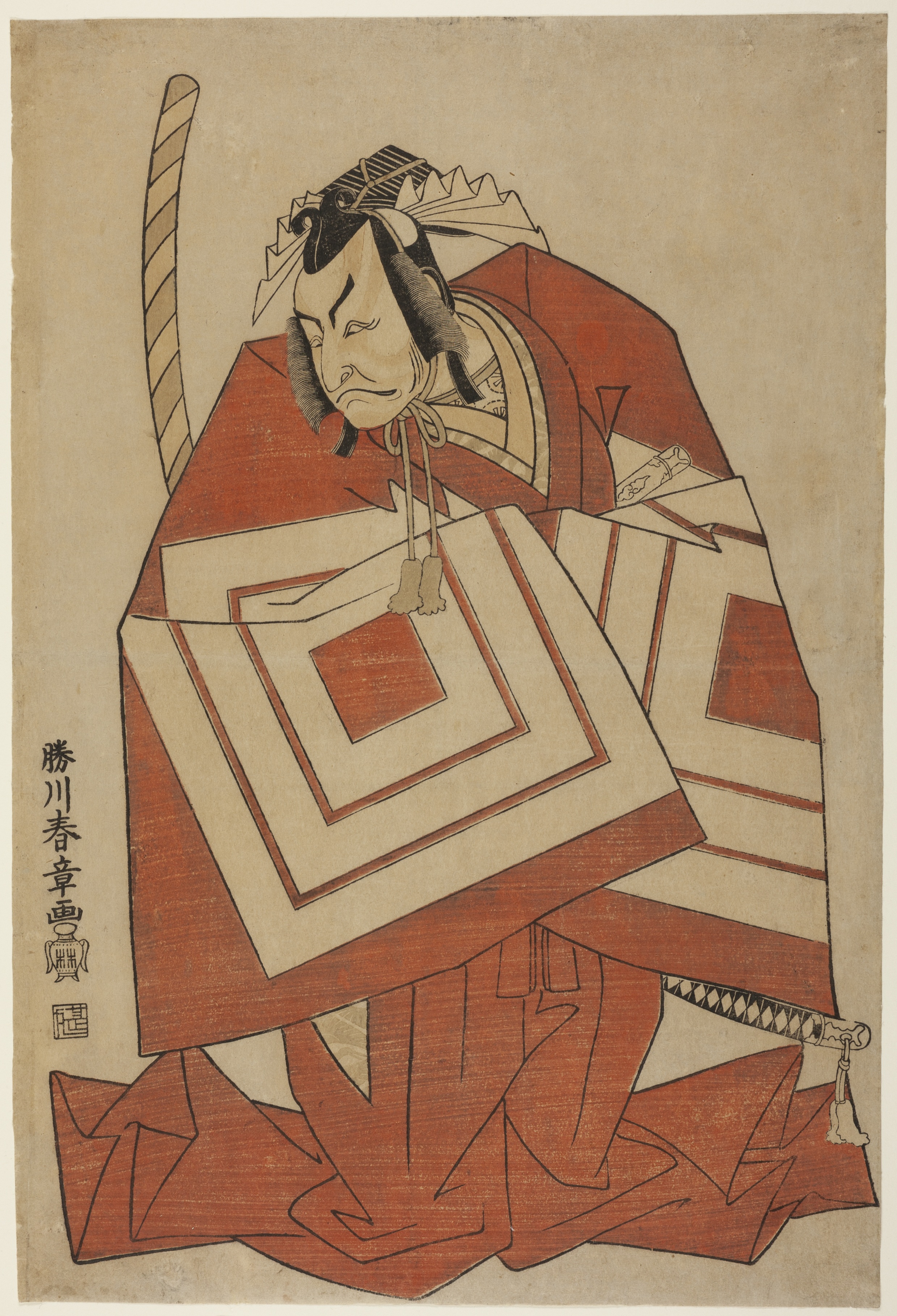
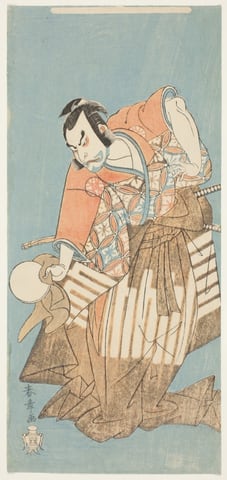
The Actor Ichikawa Danjuro IV in a "Shibaraku" Role, Possibly from the Play Ima o Sakari Suehiro Genji (The Genji Clan Now at Its Zenith), Performed at the Nakamura Theater from the First Day of the Eleventh Month, 1768c. 1768
Ichikawa Danjūrō IV appears in Shibaraku, the showpiece of his family’s aragoto, or ‘rough style’, of acting: a superhuman hero in an enormous costume who halts the villains with a thunderous cry. More about this work
About this work
Ichikawa Danjūrō IV appears in Shibaraku, the showpiece of his family’s aragoto, or ‘rough style’, of acting: a superhuman hero in an enormous costume who halts the villains with a thunderous cry. The scene was traditionally inserted into the season-opening programmes staged by the Edo theatres in the eleventh month. Katsukawa Shunshō was among the first print designers to give each actor a recognisable likeness, and his prints served fans as souvenirs of particular performances, as the long title, recording play, theatre and date, makes clear.
Written by Ochre Editions.
What you’re looking at
A work made of color woodblock print; oban.
Description from the Art Institute of Chicago.
How it was made
- Colour woodblock print
- In Japan these were a team effort. The artist drew the design, a carver cut it into cherry-wood blocks, one block for each colour, and a printer brushed on the pigment and rubbed each sheet by hand. Full-colour prints of this kind were called nishiki-e, “brocade pictures”, from the 1760s on.
- Ōban
- The standard large Japanese print size, about 38 × 25 cm.
Katsukawa Shunshō
Japanese, 1726–1792
Shunshō founded the Katsukawa school and changed the way kabuki actors were portrayed, giving them recognisable individual features rather than standard types. From the late 1760s his actor designs, often in the narrow hosoban format, dominated the field. He was also a refined painter of beautiful women, and the young Hokusai spent his early years in his studio under the name Shunrō.
Written by Ochre Editions.
Ukiyo-e
Japanese woodblock prints of the floating world: actors, courtesans, landscapes and the sea.
Rights and the museum’s record
Public domain. The Art Institute of Chicago has dedicated this image to the public domain under CC0, so anyone may copy, adapt and use it, for any purpose, without asking. Our prints and files are reproductions made from the museum’s image; the museum doesn’t endorse them.
- Object number
- 1925.2365
- Credit
- Courtesy of the Art Institute of Chicago
- Type
- Department
- Arts of Asia
- Licence
- CC0 1.0 Universal
- Museum record
- See it on the museum’s site
Report this work
More by Katsukawa Shunshō
All their works
Close in colour