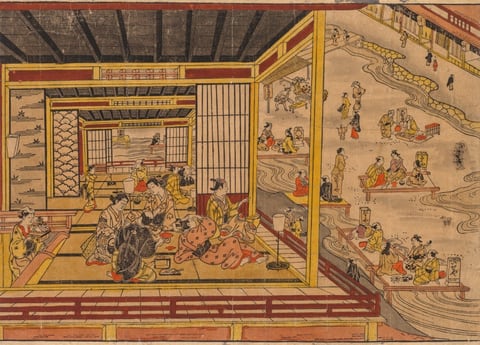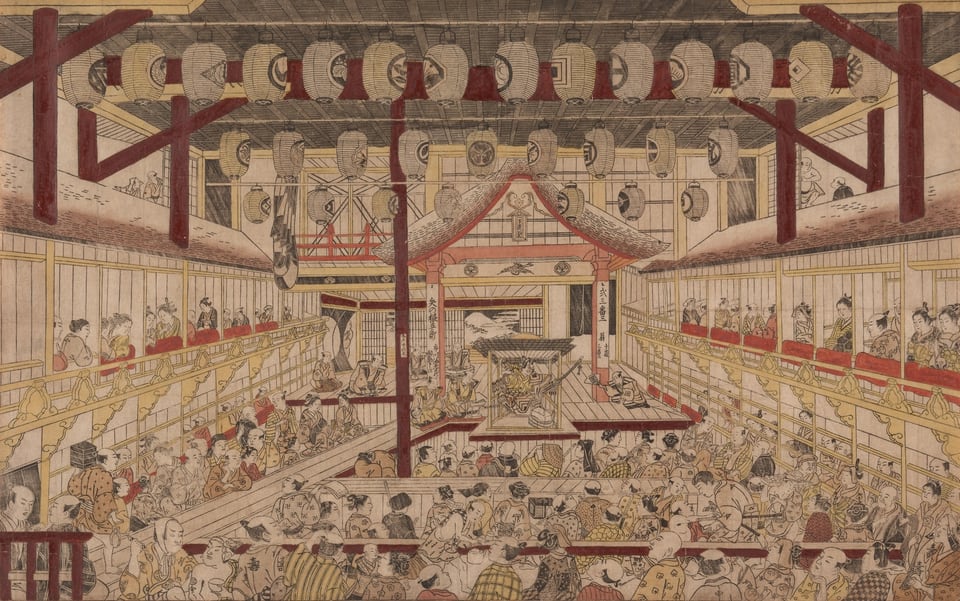
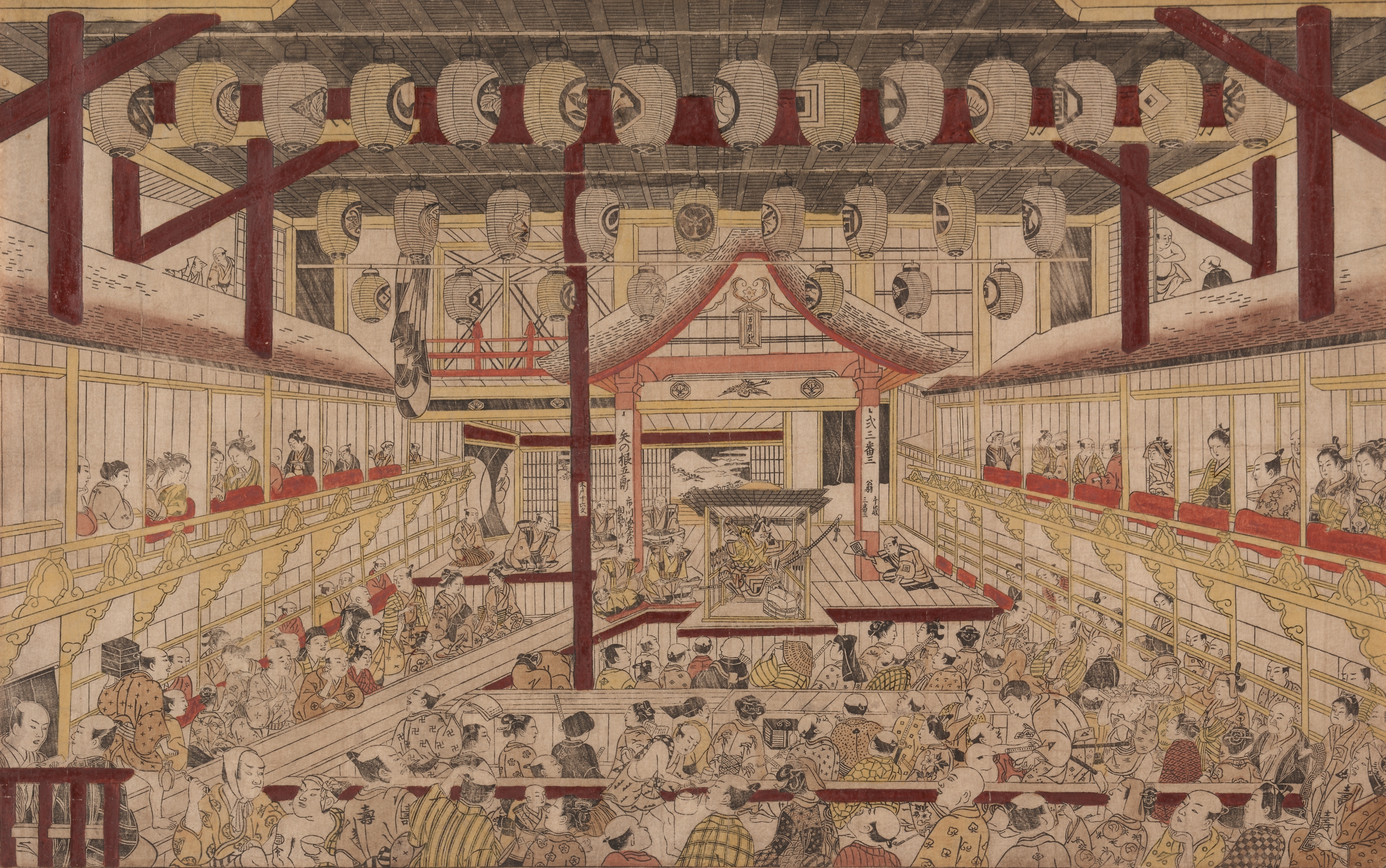
Perspective View of the Interior of the Nakamura Theater with Ichikawa Ebizo II as Yanone Goro1740
The print illustrates the typical interior of a Kabuki theater. More about this work
About this work
The print illustrates the typical interior of a Kabuki theater. The stage was connected to the audience by the hanamichi , the ramp or runway extending from the stage to the rear of the theater over which the actors would strut in dramatic roles. Patrons often stayed all day for the plays. Unlike quiet Western audiences, Kabuki fans were spirited, buying food from vendors and even shouting praises to their favorite actors as they came onto the stage. In 1734, the first Japanese manual on perspective was printed. Masanobu was probably the first printmaker to use this method of describing three-dimensional space on a two-dimensional support. He helped popularize the perspective print, and he introduced other innovations such as two-color printing and hand-coloring—this print is hand-colored using yellow, red (tan), and red-brown.
Text from the Cleveland Museum of Art.
How it was made
- Hand-coloured
- Printed in black, then coloured by hand in watercolour, one sheet at a time.
Okumura Masanobu
Japanese, 1686–1764
Masanobu was a largely self-taught artist of early ukiyo-e who also ran his own publishing house in Edo. Over a long career he worked through the major developments of the period, from black-ink sheets to hand-coloured designs and early two-colour pictures. He was among the first to adapt Western linear perspective in uki-e, deep views of theatre interiors and streets, and he popularised the tall, narrow pillar picture.
Written by Ochre Editions.
Ukiyo-e
Japanese woodblock prints of the floating world: actors, courtesans, landscapes and the sea.
Rights and the museum’s record
Public domain. The Cleveland Museum of Art has dedicated this image to the public domain under CC0, so anyone may copy, adapt and use it, for any purpose, without asking. Our prints and files are reproductions made from the museum’s image; the museum doesn’t endorse them.
- Object number
- 1916.1154
- Credit
- Courtesy of the Cleveland Museum of Art
- Type
- Department
- Japanese Art
- Licence
- CC0 1.0 Universal
- Museum record
- See it on the museum’s site
Report this work
More by Okumura Masanobu
All their works
Close in colour