Saint Christopher1506
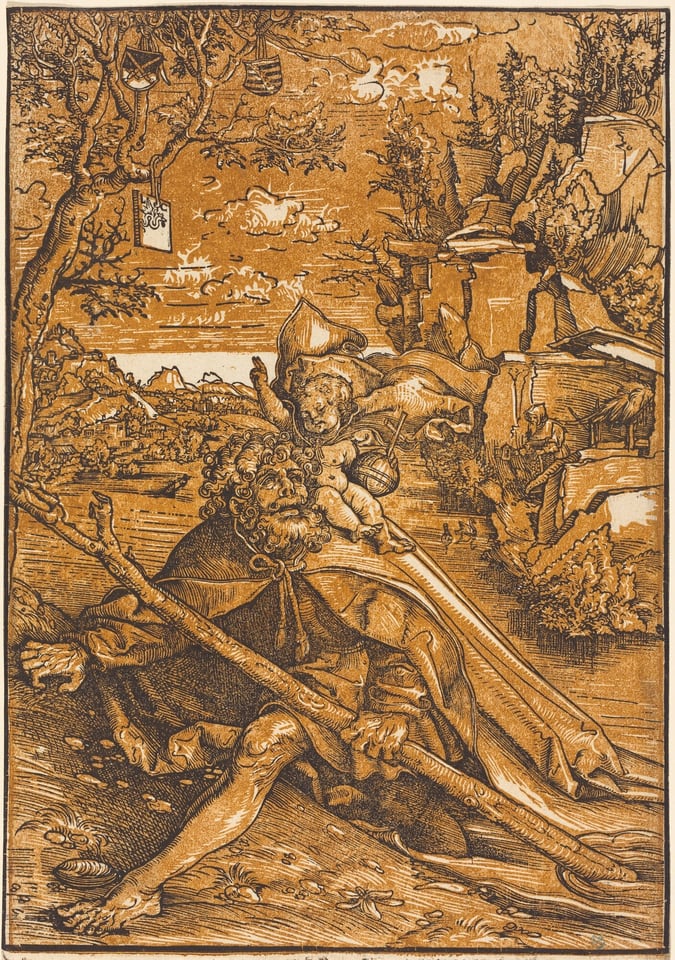
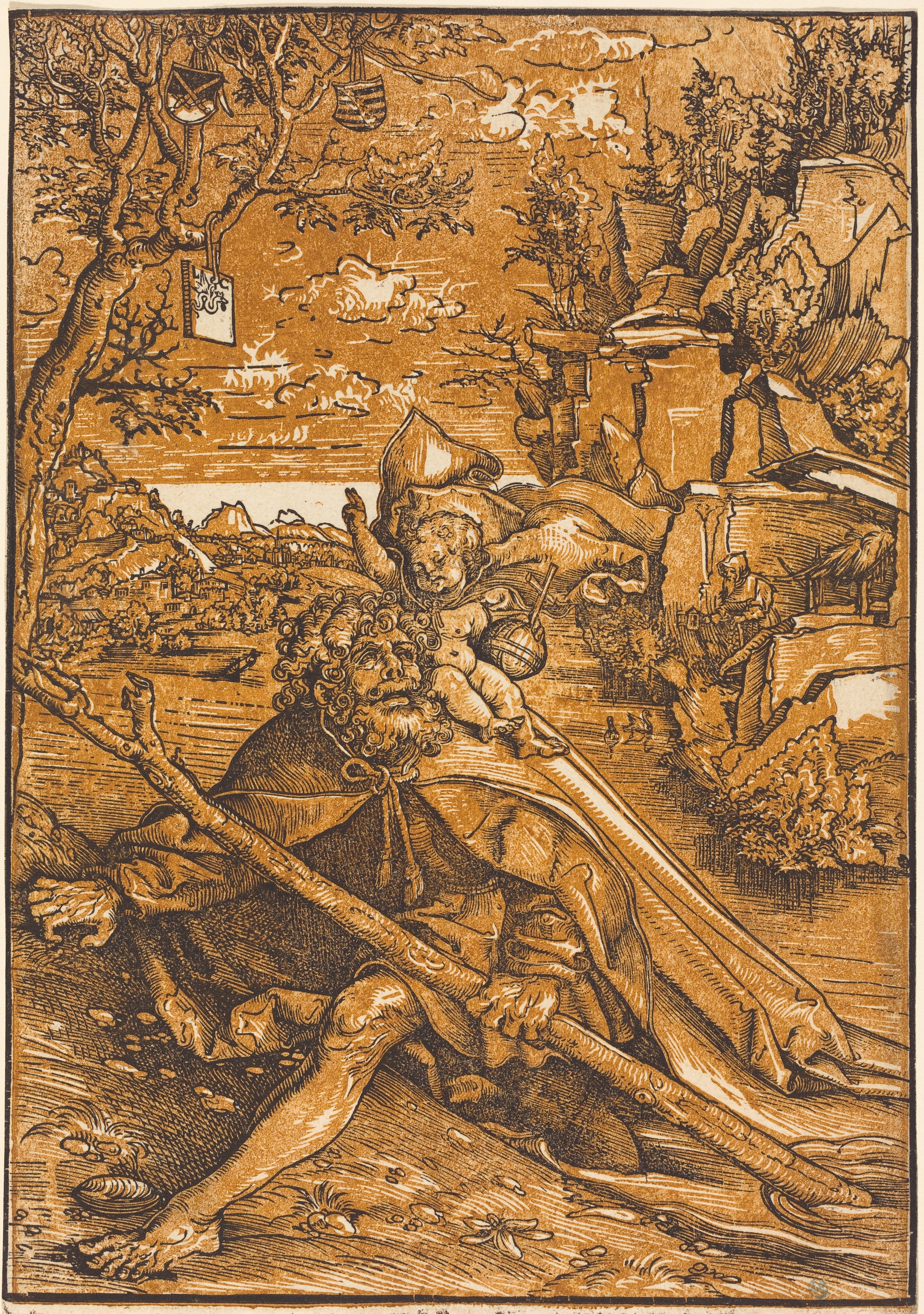
The giant Christopher wades through a river with the Christ Child, leaning on his staff, while a village and mountains rise in the background. More about this work
About this work
The giant Christopher wades through a river with the Christ Child, leaning on his staff, while a village and mountains rise in the background. Cranach dated this woodcut 1506, which would make it one of the earliest chiaroscuro woodcuts, a technique in which a second block printed in a coloured tone adds a middle value, with highlights left in the colour of the paper. The method imitated drawings on tinted paper and was eagerly pursued in Germany at the time; scholars have debated whether the tone block was in fact added a few years after the date suggests.
Written by Ochre Editions.
What you’re looking at
This is a drawing of a wilderness setting by a river. The scene features rocky cliffs, lush vegetation, a large bearded figure holding a staff, and a small cherubic figure beside them. In the background, there is a village against a mountainous backdrop. The drawing has rich texture and intricate details, with a contrast of dark lines and lighter hues.
Description from the National Gallery of Art.
How it was made
- Woodcut
- A relief print. The block is cut away around the lines, so the lines stand up to take the ink, and the sheet is pressed onto them.
Lucas Cranach the Elder
German, 1472–1553 · Born in Kronach; died in Weimar.
Cranach worked in Vienna before becoming court painter to the Electors of Saxony at Wittenberg in 1505, a post he held for decades. A close friend of Martin Luther, he painted the reformer and his circle many times and designed woodcuts for Protestant publications, while running a large, productive studio that turned out portraits, altarpieces and slender mythological nudes, including many versions of The Judgment of Paris. He followed the deposed Elector John Frederick into exile and died at Weimar.
Written by Ochre Editions.
Rights and the museum’s record
Public domain. The National Gallery of Art has dedicated this image to the public domain under CC0, so anyone may copy, adapt and use it, for any purpose, without asking. Our prints and files are reproductions made from the museum’s image; the museum doesn’t endorse them.
- Object number
- 1943.3.2858
- Credit
- Courtesy National Gallery of Art, Washington
- Type
- Licence
- CC0 1.0 Universal
- Museum record
- See it on the museum’s site
Report this work
More by Lucas Cranach the Elder
All their works
Close in colour