Marcus Curtius Plunging into the Chasm
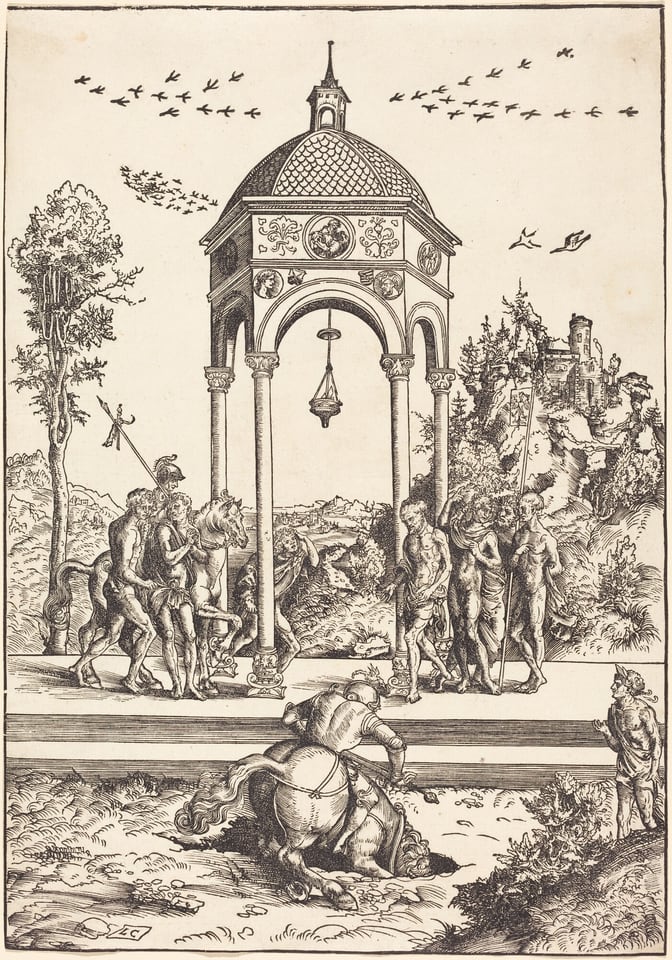
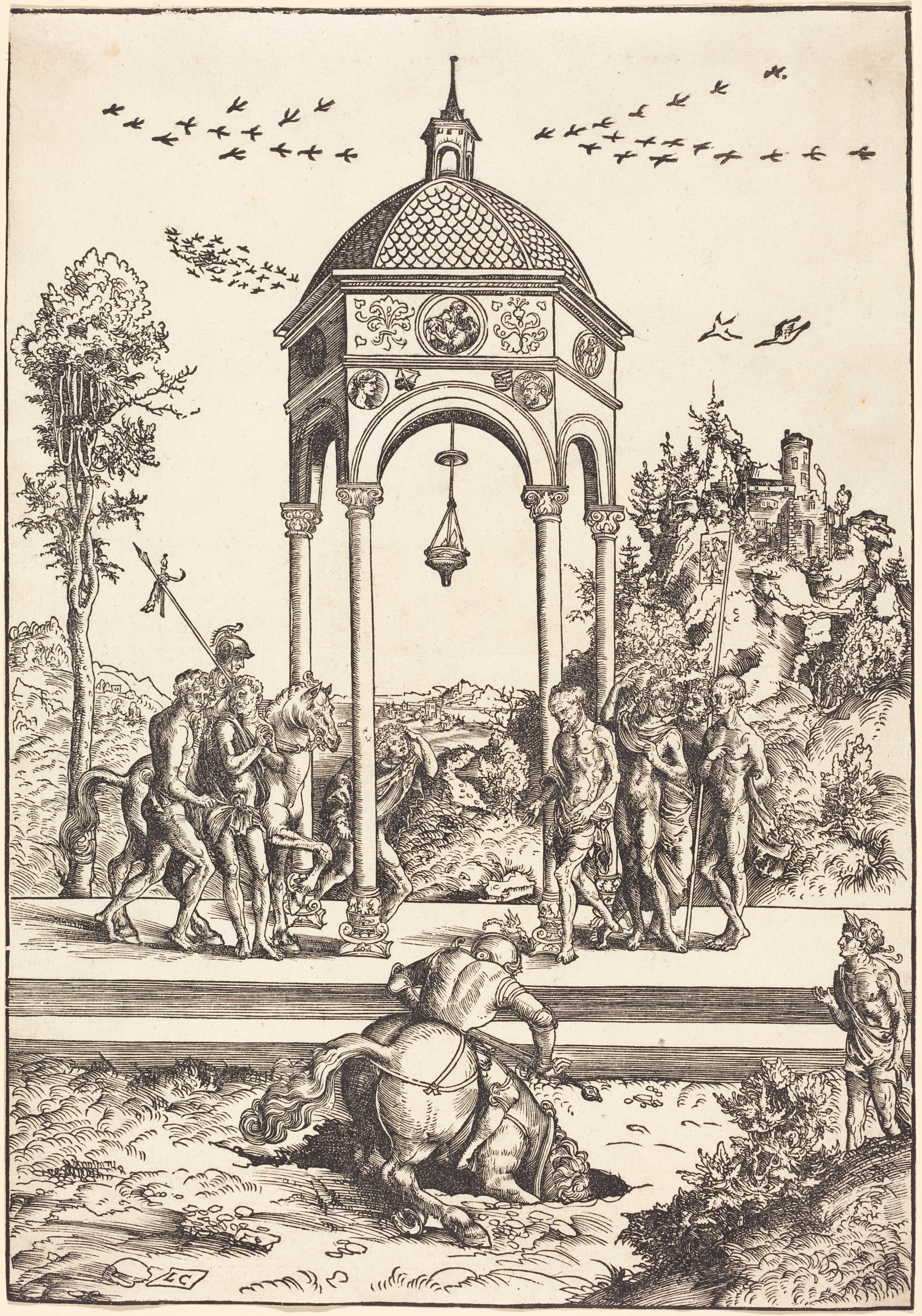
A Roman knight on horseback plunges into a dark chasm that has opened in the ground before a domed pavilion, while onlookers, some nude in the classical manner, crowd around. More about this work
About this work
A Roman knight on horseback plunges into a dark chasm that has opened in the ground before a domed pavilion, while onlookers, some nude in the classical manner, crowd around. According to Livy, a great pit appeared in the Roman Forum, and seers declared it would close only when Rome sacrificed its greatest treasure; the young Marcus Curtius, declaring that nothing was more precious than a brave citizen, rode into it fully armed. Lucas Cranach the Elder, court painter in Wittenberg, sets the ancient legend in a German landscape, complete with a castle on a distant crag.
Written by Ochre Editions.
What you’re looking at
This print features a detailed scene. In the center is a classical-style pavilion with arched openings and a domed roof adorned with intricate designs. A group of mostly-nude people is gathered around the pavilion, with one on horseback, holding a spear, and another holding a flag. In front of the pavilion, a knight on horseback appears to be falling into a dark hole in the ground. Vegetation, including trees and shrubs, is scattered throughout the landscape, and birds are seen flying in the sky above the pavilion. The horizon shows hills leading to a distant castle on a rocky formation on the right.
Description from the National Gallery of Art.
How it was made
- Woodcut
- A relief print. The block is cut away around the lines, so the lines stand up to take the ink, and the sheet is pressed onto them.
Lucas Cranach the Elder
German, 1472–1553 · Born in Kronach; died in Weimar.
Cranach worked in Vienna before becoming court painter to the Electors of Saxony at Wittenberg in 1505, a post he held for decades. A close friend of Martin Luther, he painted the reformer and his circle many times and designed woodcuts for Protestant publications, while running a large, productive studio that turned out portraits, altarpieces and slender mythological nudes, including many versions of The Judgment of Paris. He followed the deposed Elector John Frederick into exile and died at Weimar.
Written by Ochre Editions.
Rights and the museum’s record
Public domain. The National Gallery of Art has dedicated this image to the public domain under CC0, so anyone may copy, adapt and use it, for any purpose, without asking. Our prints and files are reproductions made from the museum’s image; the museum doesn’t endorse them.
- Object number
- 1943.3.2844
- Credit
- Courtesy National Gallery of Art, Washington
- Type
- Licence
- CC0 1.0 Universal
- Museum record
- See it on the museum’s site
Report this work
More by Lucas Cranach the Elder
All their works
Close in colour