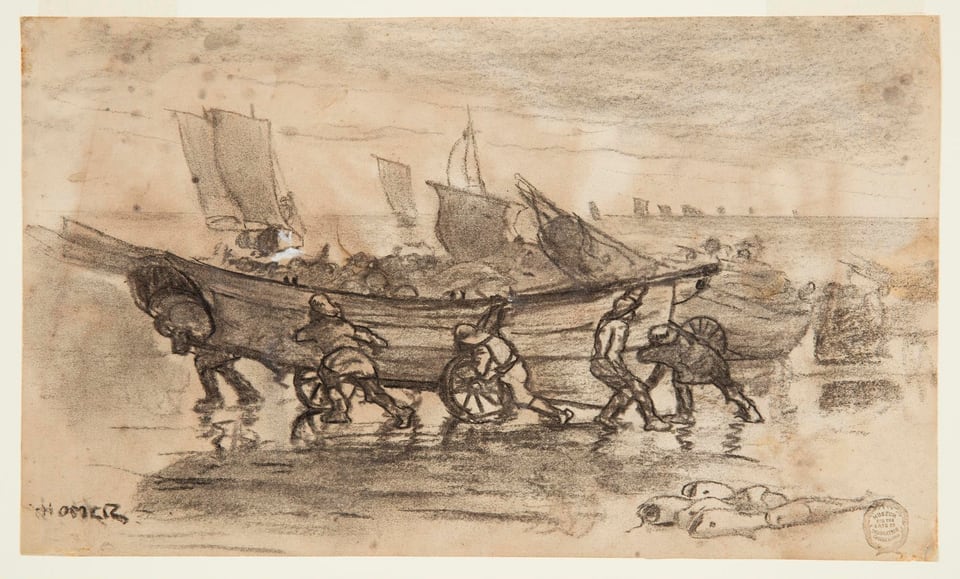
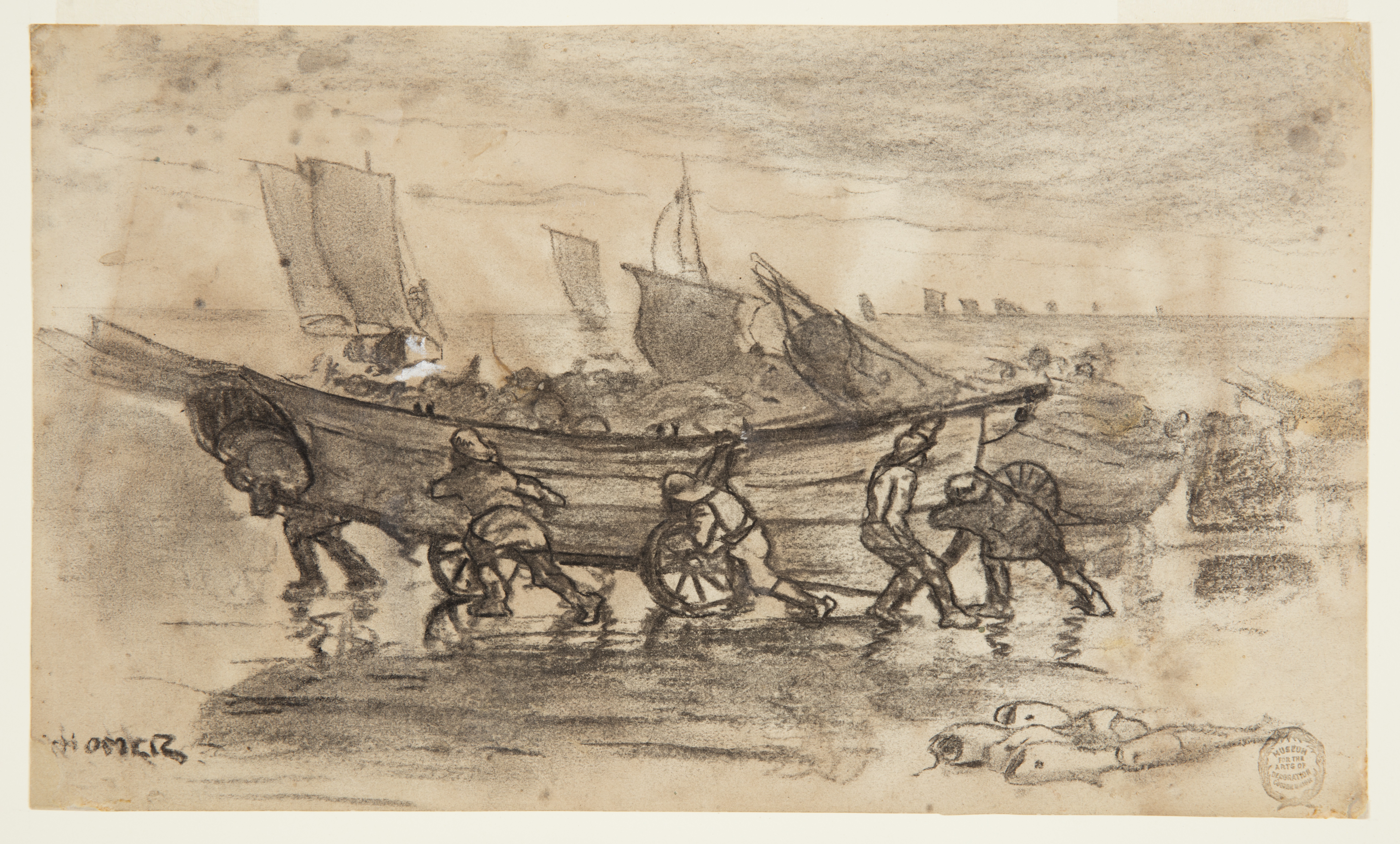
Fishermen Beaching a Dory, Cullercoats, England1881
Horizontal view of five fishermen shown beaching a boat on a four- wheeled truck, in the foreground, with sailboats on the sea indicated in the background. More about this work
About this work
Horizontal view of five fishermen shown beaching a boat on a four- wheeled truck, in the foreground, with sailboats on the sea indicated in the background.
Text from Cooper Hewitt, Smithsonian Design Museum.
What you’re looking at
FISHERMEN BEACHING A DORY, CULLERCOATS, ENGLAND
Description from Cooper Hewitt, Smithsonian Design Museum.
How it was made
- Chalk
- Natural black, red and white chalks. Used together on toned paper they could give the warmth of flesh with very little effort, and they were favourites for studies from life.
- Charcoal
- Burnt willow or vine. It smudges and wipes away easily, which made it the natural tool for working out a composition.
Winslow Homer
American, 1836–1910 · Born in Boston, Massachusetts; died in Prouts Neck, Maine.
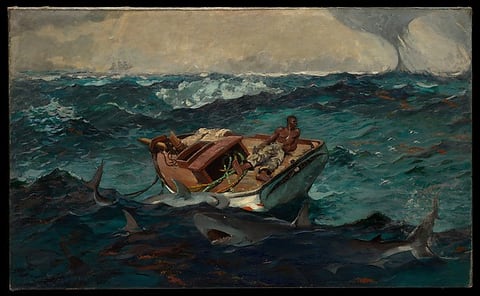
Homer began as an illustrator, covering the Civil War for Harper’s Weekly, and first made his name in painting with scenes of soldiers and country life. A stay at the fishing village of Cullercoats on the English coast in 1881–82 turned him towards the sea, and from 1883 he lived at Prouts Neck, Maine, painting the Atlantic in all weathers. He was also a fluent watercolourist in the Adirondacks, Canada and the Caribbean, and The Gulf Stream draws on those southern journeys.
Written by Ochre Editions.
Rights and the museum’s record
Public domain. Cooper Hewitt, Smithsonian Design Museum has dedicated this image to the public domain under CC0, so anyone may copy, adapt and use it, for any purpose, without asking. Our prints and files are reproductions made from the museum’s image; the museum doesn’t endorse them.
- Object number
- 1912-12-41
- Credit
- Courtesy of Cooper Hewitt, Smithsonian Design Museum
- Type
- Drawing
- Department
- Cooper Hewitt, Smithsonian Design Museum
- Licence
- CC0 1.0 Universal
- Museum record
- See it on the museum’s site
Report this work
More by Winslow Homer
All their works
Close in colour