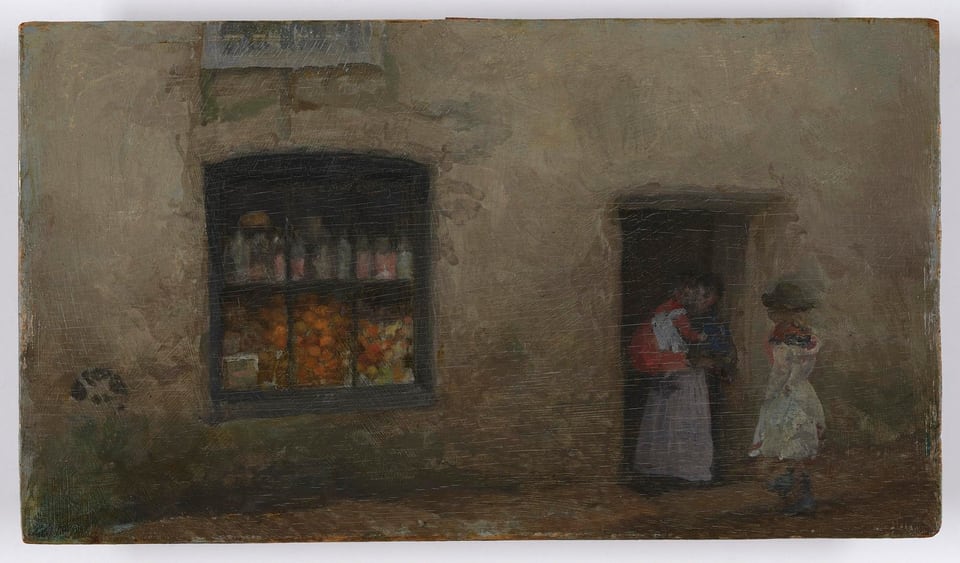
An Orange Note: Sweet Shop1883 or 1884
This is one of several paintings of shop fronts that Whistler completed while in St. Ives. Sympathetic critics singled it out for enthusiastic praise when Whistler exhibited it in London in 1884. More about this work
About this work
This is one of several paintings of shop fronts that Whistler completed while in St. Ives. Sympathetic critics singled it out for enthusiastic praise when Whistler exhibited it in London in 1884. One declared, it "is probably the most perfect little thing of its kind that was ever wrought by an artist who has learnt how to see….It is without detail, without apparent labour, without dramatic interest; but it is exquisite in colour, faultless in tone, and its well-considered mystery has, at least, the interest of suggestiveness."
Text from the National Museum of Asian Art.
How it was made
- Oil on panel
- Oil paint on prepared wooden boards, usually oak in the north and poplar in Italy. The rigid, smooth surface suits fine detail and thin, glowing glazes.
- Oil paint
- Pigment ground in a drying oil, usually linseed. It dries slowly, so painters could blend on the canvas, build up thin translucent glazes, and rework a picture over weeks. Canvas replaced wooden panels in the 1500s because it is lighter and can be rolled.
James McNeill Whistler
American, 1834–1903 · Born in Lowell, Massachusetts; died in London.
Whistler spent part of his boyhood in Russia, left West Point without graduating and trained as a painter in Paris before settling in London in 1859. He held that a picture was an arrangement of colour and form, and named his works symphonies, harmonies and nocturnes; a hostile review of one nocturne led to his 1878 libel suit against John Ruskin. He was equally committed to etching, and in his Venice plates of 1879–80 he left films of ink on the copper to suggest water and dusk.
Written by Ochre Editions.
Rights and the museum’s record
Public domain. The National Museum of Asian Art has dedicated this image to the public domain under CC0, so anyone may copy, adapt and use it, for any purpose, without asking. Our prints and files are reproductions made from the museum’s image; the museum doesn’t endorse them.
- Object number
- F1904.315a-c
- Credit
- Courtesy of the National Museum of Asian Art, Smithsonian Institution
- Type
- Painting
- Department
- National Museum of Asian Art
- Licence
- CC0 1.0 Universal
- Museum record
- See it on the museum’s site
Report this work
More by James McNeill Whistler
All their works