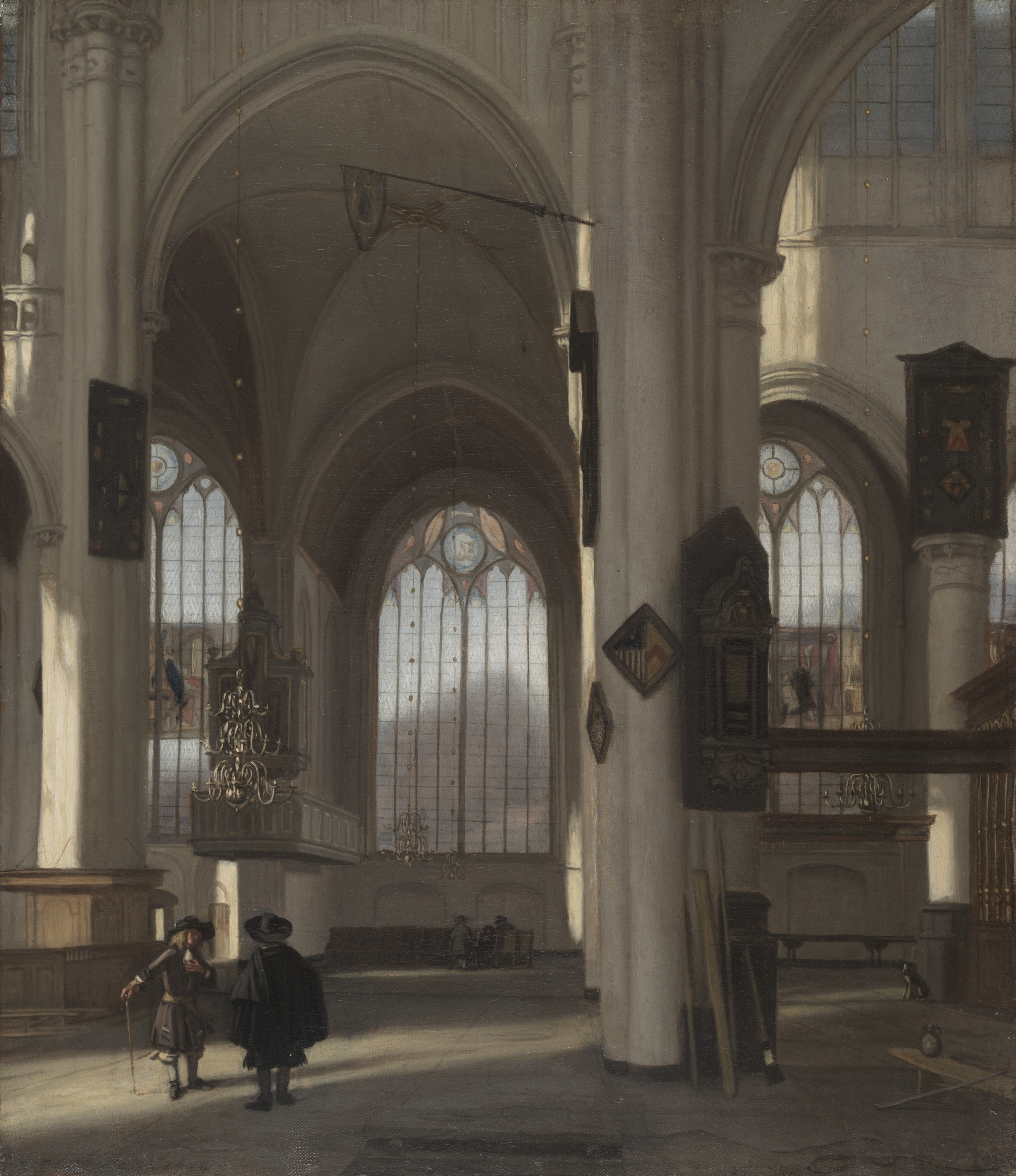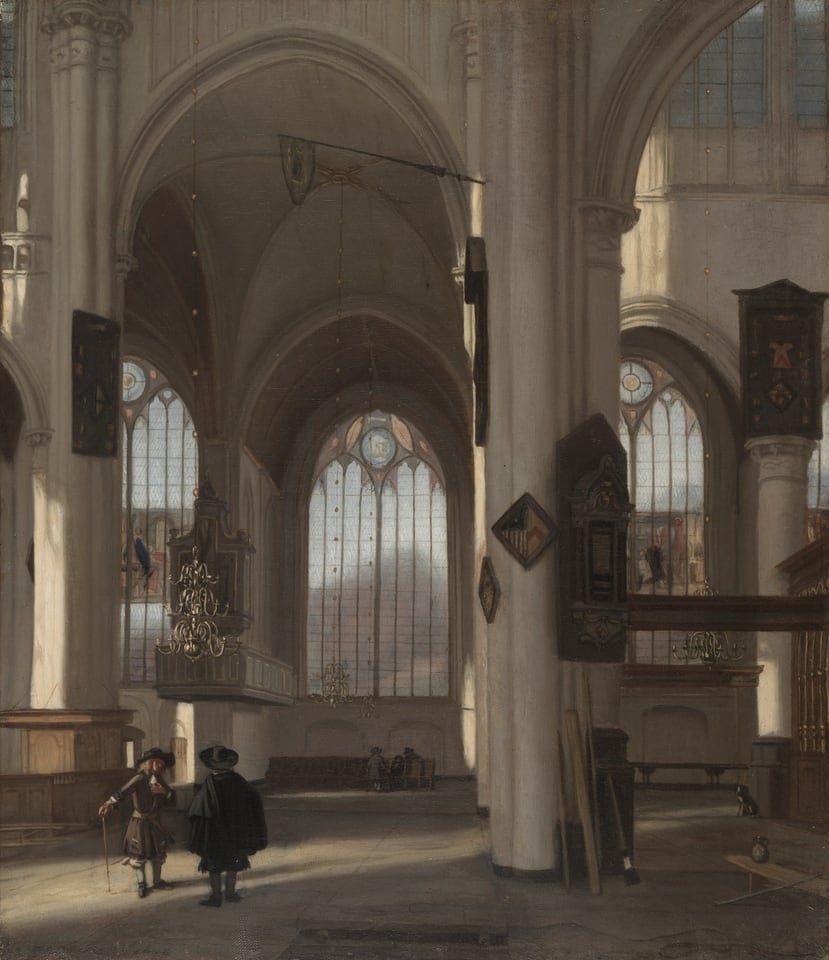
Interior of a Churchc. 1680
Although this spacious church interior is largely imaginary, Emanuel de Witte’s precise description of architectural forms convinces us that he depicted an actual place. More about this work
About this work
Although this spacious church interior is largely imaginary, Emanuel de Witte’s precise description of architectural forms convinces us that he depicted an actual place. To create a sense of familiarity, he included some specific architectural features from the Oude Kerk (Old Church) in Amsterdam. In the late 1500s, militant Protestant sects occupied Catholic churches in the Netherlands and stripped them of rich decorations and “idolatrous” images. The resulting spare, whitewashed interiors became a favorite subject of Dutch artists, who were intrigued by the interplay of light and shadow over the unadorned walls, and by the challenge of depicting perspectival space.
Text from the Cleveland Museum of Art.
How it was made
- Oil paint
- Pigment ground in a drying oil, usually linseed. It dries slowly, so painters could blend on the canvas, build up thin translucent glazes, and rework a picture over weeks. Canvas replaced wooden panels in the 1500s because it is lighter and can be rolled.
Emanuel de Witte
Dutch, c. 1617–1692
Dutch Golden Age
Seventeenth-century painting from the Dutch Republic: still lifes, interiors, portraits and flat, wide skies.
Rights and the museum’s record
Public domain. The Cleveland Museum of Art has dedicated this image to the public domain under CC0, so anyone may copy, adapt and use it, for any purpose, without asking. Our prints and files are reproductions made from the museum’s image; the museum doesn’t endorse them.
- Object number
- 1971.1
- Credit
- Courtesy of the Cleveland Museum of Art
- Type
- Painting
- Department
- European Painting and Sculpture
- Licence
- CC0 1.0 Universal
- Museum record
- See it on the museum’s site