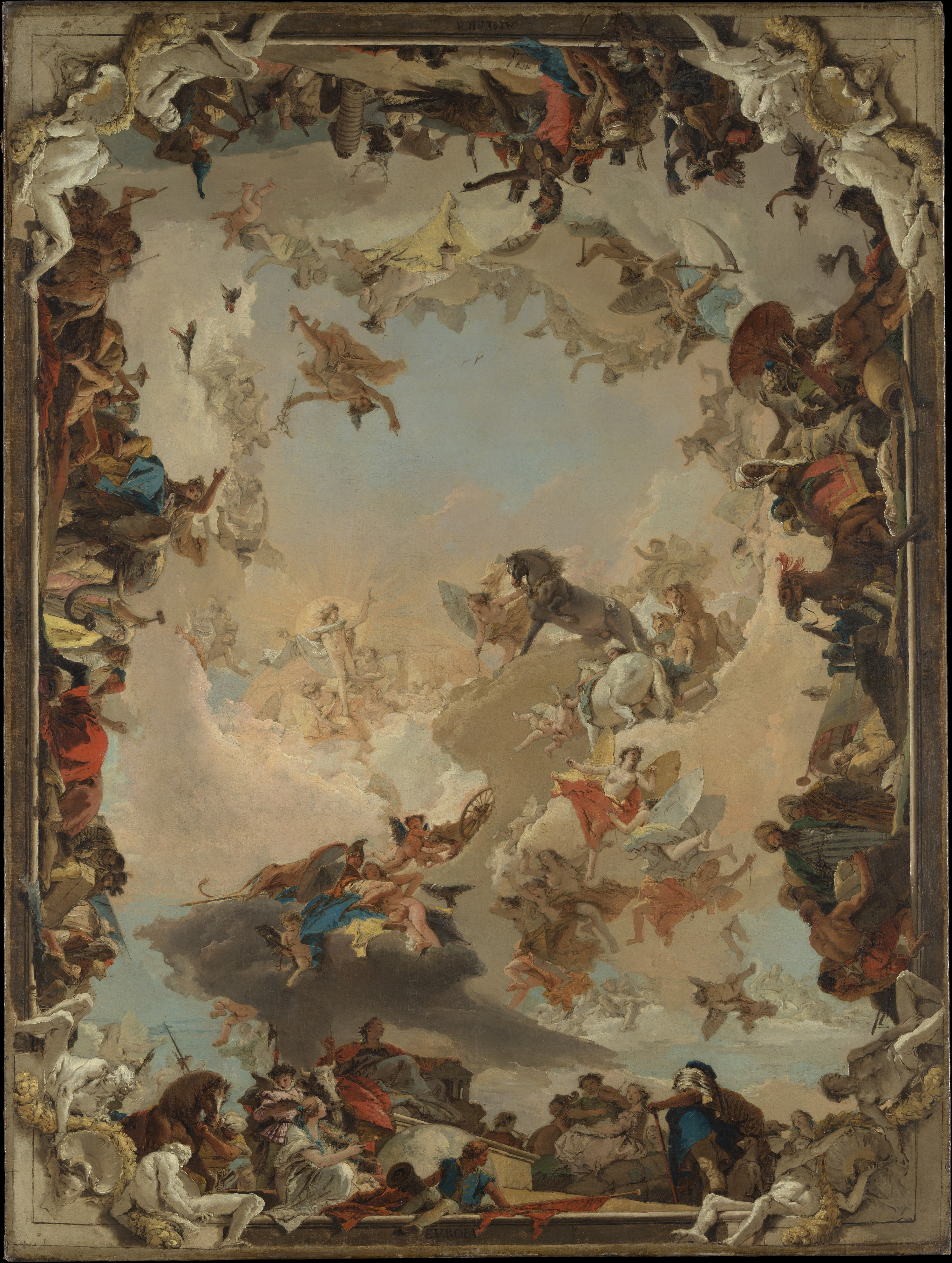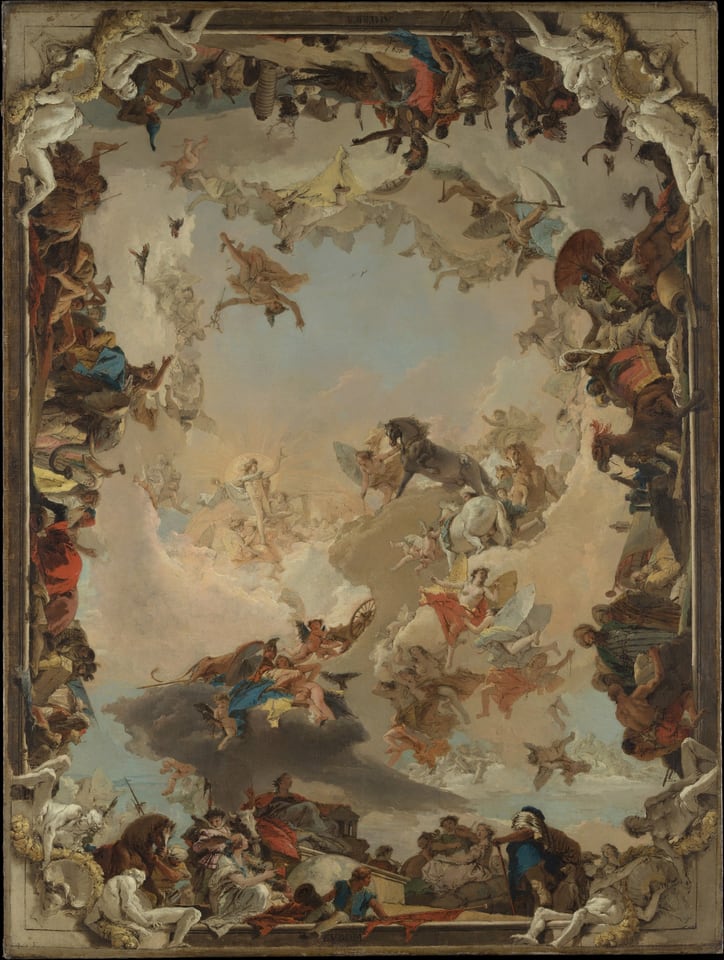
Allegory of the Planets and Continents1752
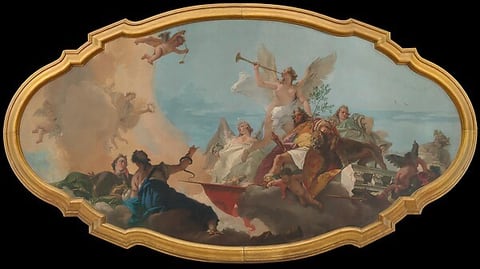
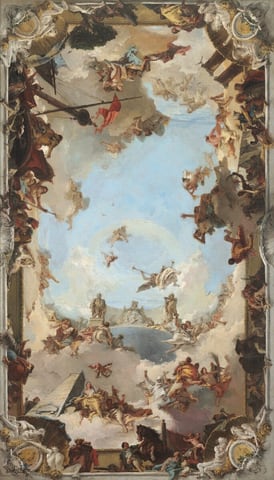
This is Tiepolo’s oil sketch for the vast ceiling fresco over the staircase of the Residenz in Würzburg, made in 1752 for his patron, the prince-bishop Carl Philipp von Greiffenklau. More about this work
About this work
This is Tiepolo’s oil sketch for the vast ceiling fresco over the staircase of the Residenz in Würzburg, made in 1752 for his patron, the prince-bishop Carl Philipp von Greiffenklau. Apollo rises at the summit of the sky among the gods of the planets, while along the edges personifications of the four continents, Europe, Asia, Africa and America, gather with their attributes, among them an elephant and a horse. Though only a sketch, it captures the luminous colour and airy, spiralling space of what became one of the largest ceiling paintings ever made.
Written by Ochre Editions.
How it was made
- Oil paint
- Pigment ground in a drying oil, usually linseed. It dries slowly, so painters could blend on the canvas, build up thin translucent glazes, and rework a picture over weeks. Canvas replaced wooden panels in the 1500s because it is lighter and can be rolled.
Giovanni Battista Tiepolo
Italian, 1696–1770 · Born in Venice; died in Madrid.
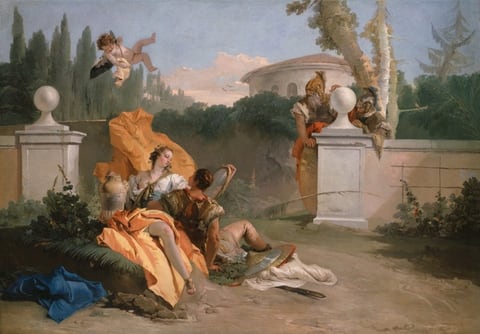
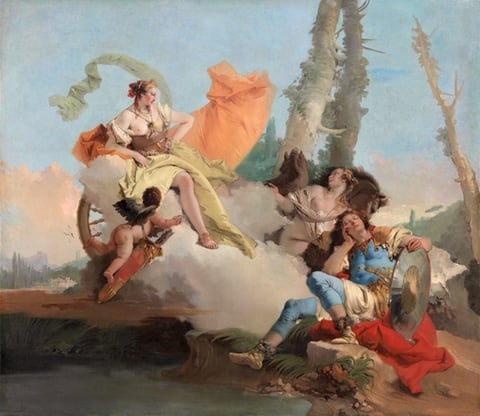
Tiepolo was the leading decorative painter of eighteenth-century Europe, covering ceilings and walls with airy skies, foreshortened figures and luminous colour. After establishing himself in Venice, he worked with his sons Giandomenico and Lorenzo on the frescoes of the Residenz at Würzburg in 1750–53, and in 1762 he went to Madrid to decorate the Royal Palace for Charles III, remaining there until his death. Rinaldo and Armida, the lovers of Tasso’s epic Jerusalem Delivered, were subjects he painted more than once.
Written by Ochre Editions.
Rights and the museum’s record
Public domain. The Met has dedicated this image to the public domain under CC0, so anyone may copy, adapt and use it, for any purpose, without asking. Our prints and files are reproductions made from the museum’s image; the museum doesn’t endorse them.
- Object number
- 1977.1.3
- Credit
- Courtesy of The Metropolitan Museum of Art
- Type
- Paintings
- Department
- European Paintings
- Licence
- CC0 1.0 Universal
- Museum record
- See it on the museum’s site
Report this work
More by Giovanni Battista Tiepolo
All their works