Abraham Jansz. van Diepenbeeck
The Flight into Egyptc. 1650
The flight into Egypt—a common subject in European art—refers to an episode in the life of Christ when his family fled King Herod, who sought to kill the infant Jesus. More about this work
About this work
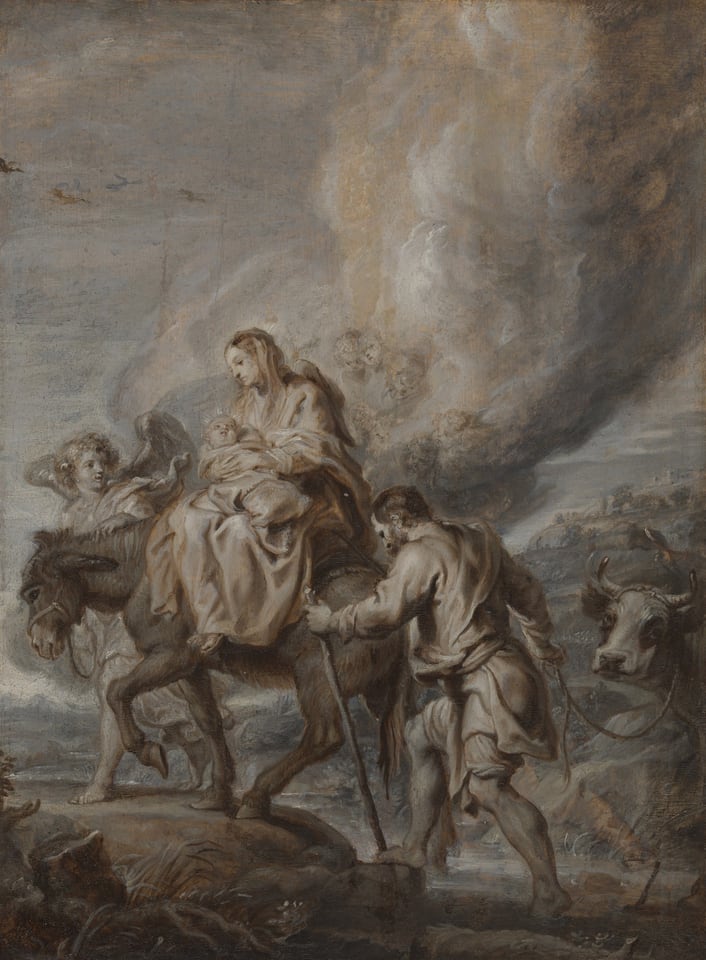
The flight into Egypt—a common subject in European art—refers to an episode in the life of Christ when his family fled King Herod, who sought to kill the infant Jesus. Abraham van Diepenbeeck made the theme his own by including an angel and the inquisitive cow at bottom right. This panel was not intended to be a finished painting; it is instead a grisaille (monochrome grey) oil sketch, which could then translated into an engraving.
Text from the Art Institute of Chicago.
What you’re looking at
A work made of oil on panel.
Description from the Art Institute of Chicago.
How it was made
- Oil on panel
- Oil paint on prepared wooden boards, usually oak in the north and poplar in Italy. The rigid, smooth surface suits fine detail and thin, glowing glazes.
- Oil paint
- Pigment ground in a drying oil, usually linseed. It dries slowly, so painters could blend on the canvas, build up thin translucent glazes, and rework a picture over weeks. Canvas replaced wooden panels in the 1500s because it is lighter and can be rolled.
Abraham Jansz. van Diepenbeeck
Flemish, 1596–1675
Rights and the museum’s record
Public domain. The Art Institute of Chicago has dedicated this image to the public domain under CC0, so anyone may copy, adapt and use it, for any purpose, without asking. Our prints and files are reproductions made from the museum’s image; the museum doesn’t endorse them.
- Object number
- 1963.44
- Credit
- Courtesy of the Art Institute of Chicago
- Type
- Painting
- Department
- Painting and Sculpture of Europe
- Licence
- CC0 1.0 Universal
- Museum record
- See it on the museum’s site