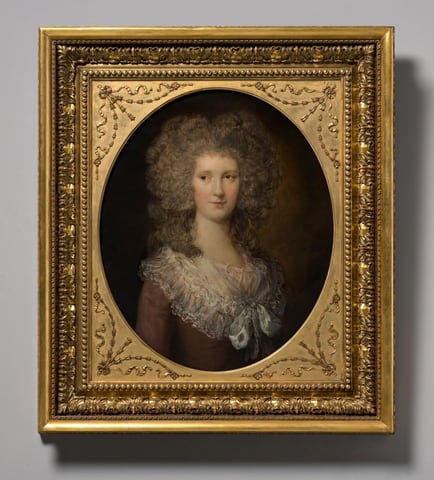
Georgiana, Duchess of Devonshirec. 1787/1796
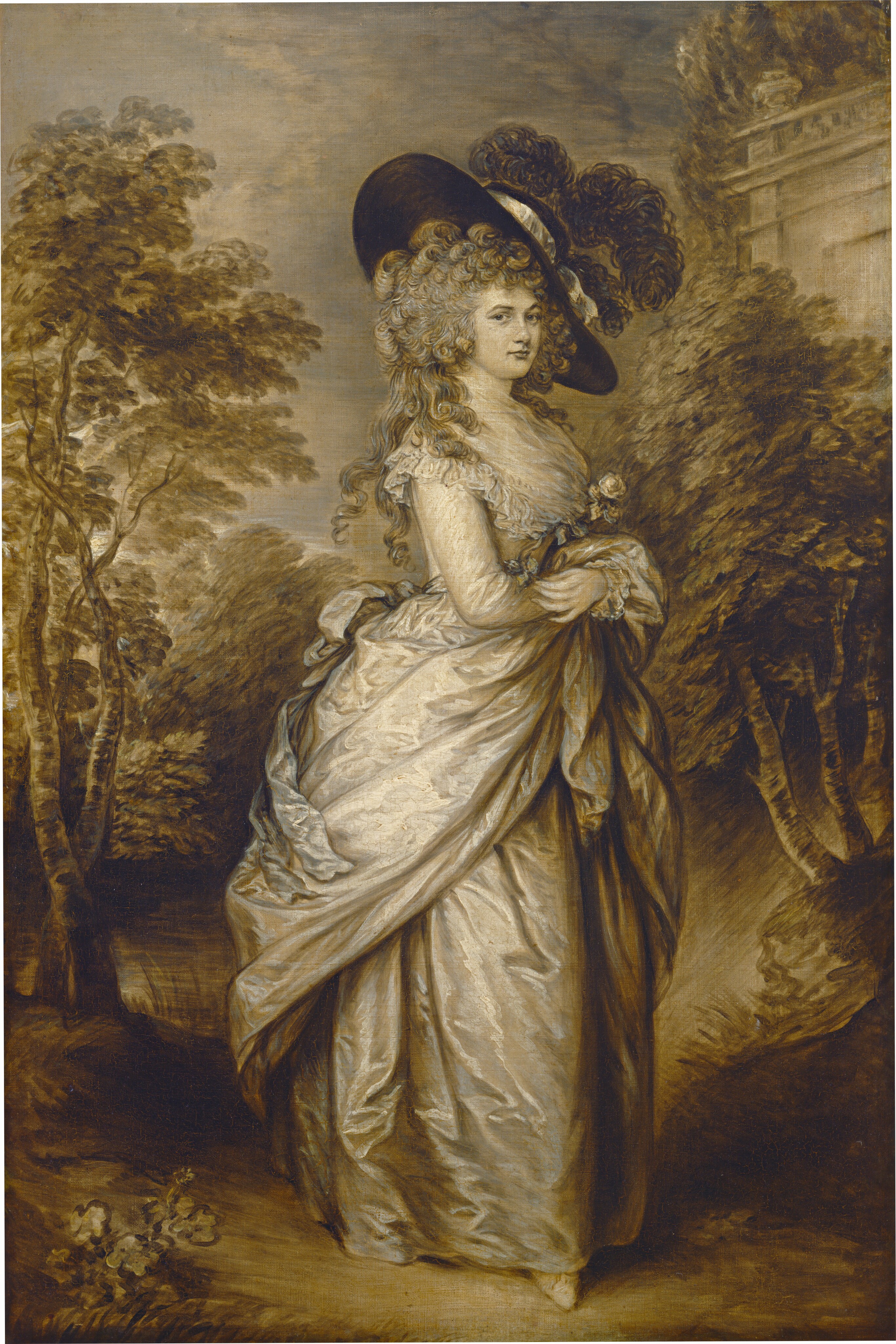
Georgiana, Duchess of Devonshire, political hostess and leader of fashion in Georgian society, stands at full length in a light silk dress and a large dark feathered hat, gathering her skirts in her arms beside tall trees. More about this work
About this work
Georgiana, Duchess of Devonshire, political hostess and leader of fashion in Georgian society, stands at full length in a light silk dress and a large dark feathered hat, gathering her skirts in her arms beside tall trees. Gainsborough Dupont was the nephew and assistant of Thomas Gainsborough, and after his uncle’s death in 1788 he continued to paint in his manner, often repeating his designs. The olive-green tonality and feathery handling of the landscape echo Gainsborough’s own late style.
Written by Ochre Editions.
What you’re looking at
This painting is a full-length portrait of a woman with her body facing the right and her head turned toward us. She has light skin, curly gray hair, arched eyebrows, and a small mouth in a neutral expression. She wears an elegant light-colored dress with a large bow on the back and a large, dark, feathered hat, and she has a flower tucked in her arms, which also gather up some of her skirts. The background shows tall trees, with the edge of a wall visible in the upper-right corner. The color scheme of the painting is mostly olive-green, and everything has a green tint.
Description from the National Gallery of Art.
How it was made
- Oil paint
- Pigment ground in a drying oil, usually linseed. It dries slowly, so painters could blend on the canvas, build up thin translucent glazes, and rework a picture over weeks. Canvas replaced wooden panels in the 1500s because it is lighter and can be rolled.
Gainsborough Dupont
British, 1754–1797
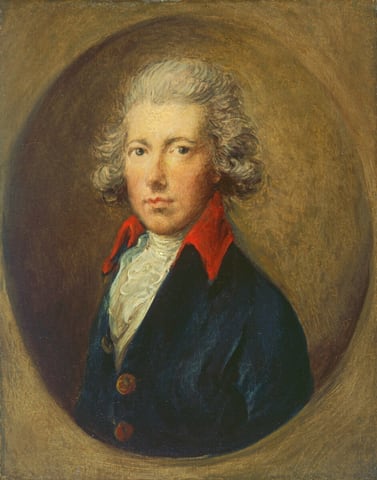
Gainsborough Dupont was the nephew of Thomas Gainsborough and his only known apprentice, trained in his uncle’s studio in Bath and then London, where he absorbed his style closely. He made mezzotints after Gainsborough’s portraits and, after his uncle’s death in 1788, carried on the practice in a similar manner, painting William Pitt the Younger several times as well as many fashionable sitters.
Written by Ochre Editions.
Rights and the museum’s record
Public domain. The National Gallery of Art has dedicated this image to the public domain under CC0, so anyone may copy, adapt and use it, for any purpose, without asking. Our prints and files are reproductions made from the museum’s image; the museum doesn’t endorse them.
- Object number
- 1970.17.119
- Credit
- Courtesy National Gallery of Art, Washington
- Type
- Painting
- Licence
- CC0 1.0 Universal
- Museum record
- See it on the museum’s site