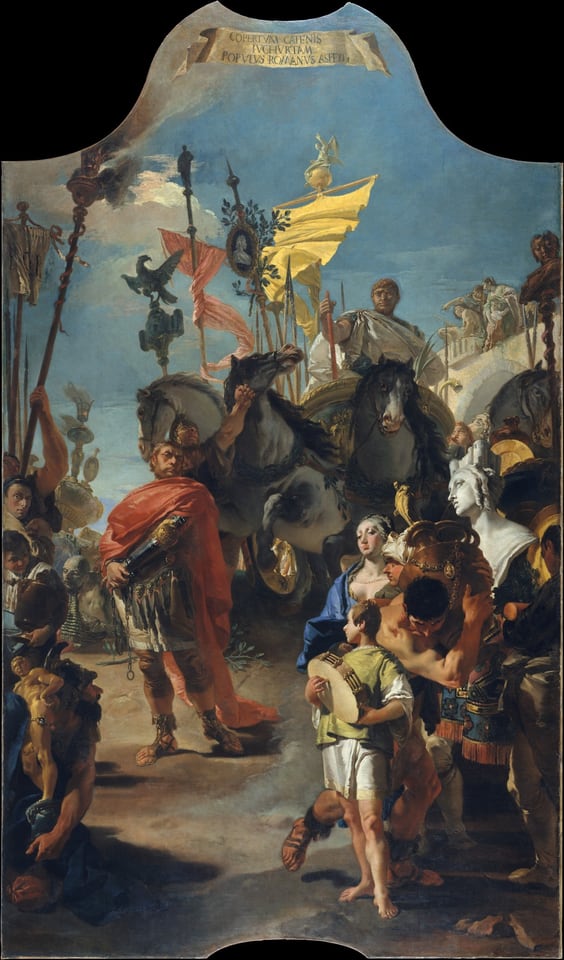
The Triumph of Marius1729
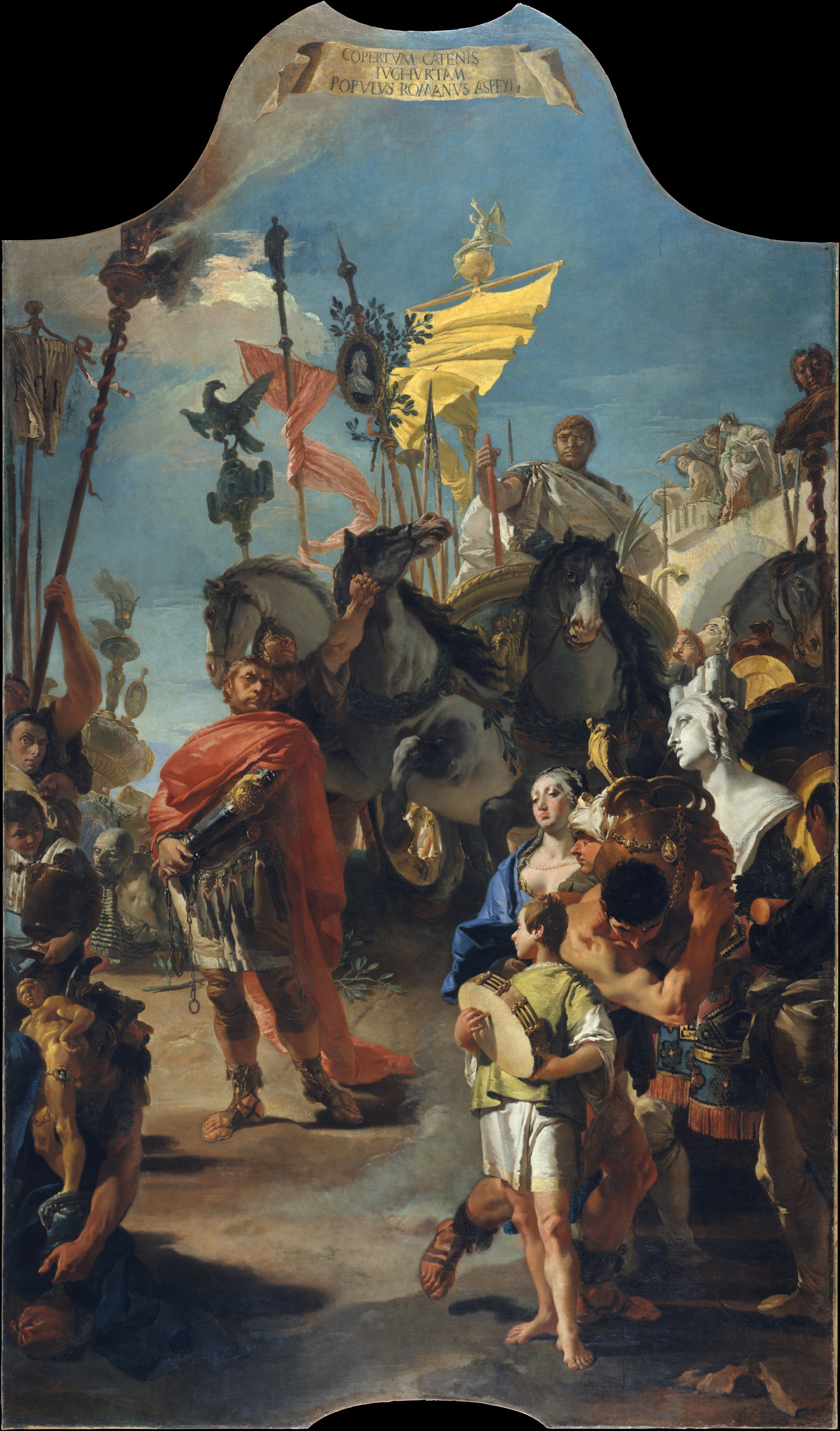
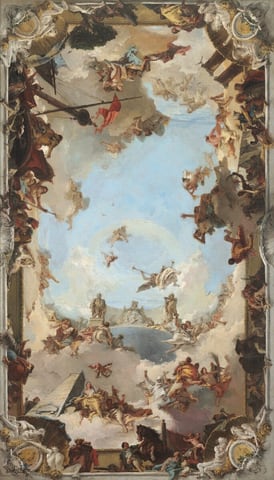
The Roman general Gaius Marius rides in triumph in a chariot, while before him the defeated Numidian king Jugurtha walks in chains, surrounded by soldiers, spoils and onlookers. More about this work
About this work
The Roman general Gaius Marius rides in triumph in a chariot, while before him the defeated Numidian king Jugurtha walks in chains, surrounded by soldiers, spoils and onlookers. Tiepolo painted the huge canvas in 1729 as one of ten scenes from Roman history for the great hall of the Palazzo Dolfin in Venice. The theatrical sweep of the procession, set against a high architectural backdrop, shows the young Tiepolo emerging as the great decorative painter of his age.
Written by Ochre Editions.
How it was made
- Oil paint
- Pigment ground in a drying oil, usually linseed. It dries slowly, so painters could blend on the canvas, build up thin translucent glazes, and rework a picture over weeks. Canvas replaced wooden panels in the 1500s because it is lighter and can be rolled.
Giovanni Battista Tiepolo
Italian, 1696–1770 · Born in Venice; died in Madrid.
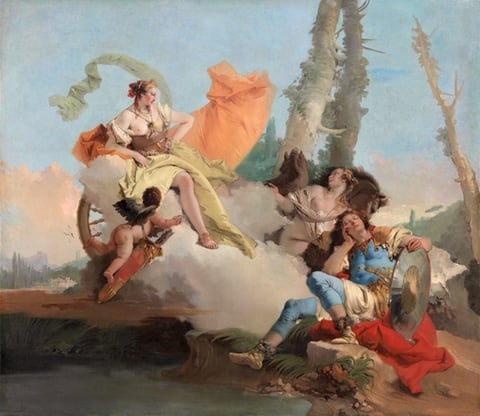
Tiepolo was the leading decorative painter of eighteenth-century Europe, covering ceilings and walls with airy skies, foreshortened figures and luminous colour. After establishing himself in Venice, he worked with his sons Giandomenico and Lorenzo on the frescoes of the Residenz at Würzburg in 1750–53, and in 1762 he went to Madrid to decorate the Royal Palace for Charles III, remaining there until his death. Rinaldo and Armida, the lovers of Tasso’s epic Jerusalem Delivered, were subjects he painted more than once.
Written by Ochre Editions.
Rights and the museum’s record
Public domain. The Met has dedicated this image to the public domain under CC0, so anyone may copy, adapt and use it, for any purpose, without asking. Our prints and files are reproductions made from the museum’s image; the museum doesn’t endorse them.
- Object number
- 65.183.1
- Credit
- Courtesy of The Metropolitan Museum of Art
- Type
- Paintings
- Department
- European Paintings
- Licence
- CC0 1.0 Universal
- Museum record
- See it on the museum’s site
Report this work
More by Giovanni Battista Tiepolo
All their works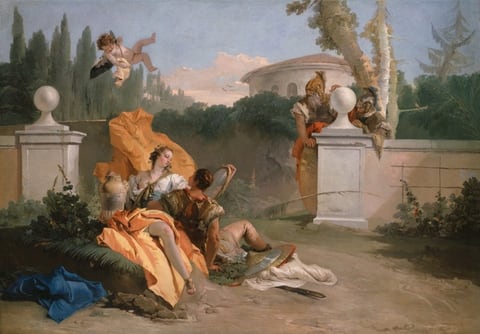
Close in colour