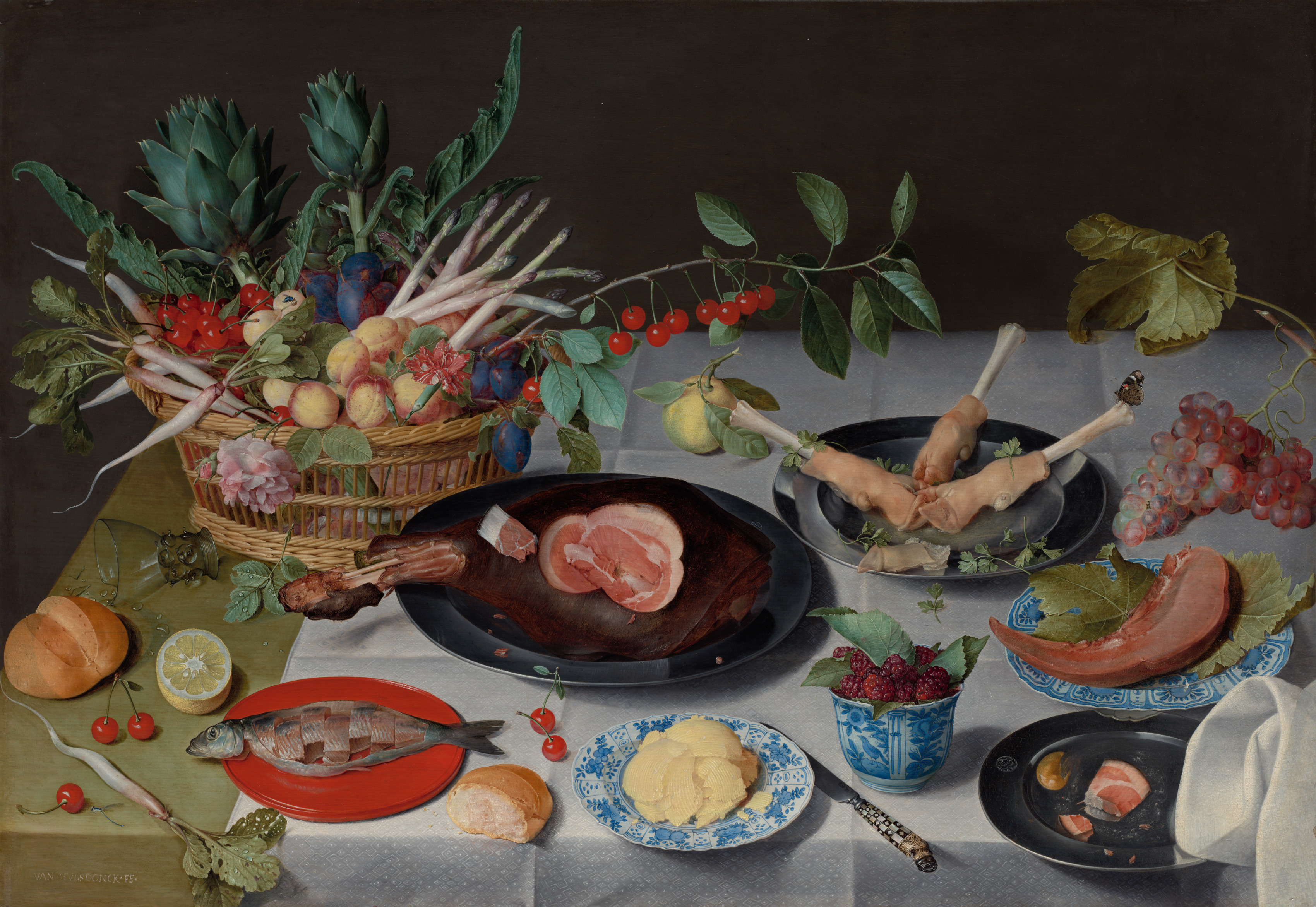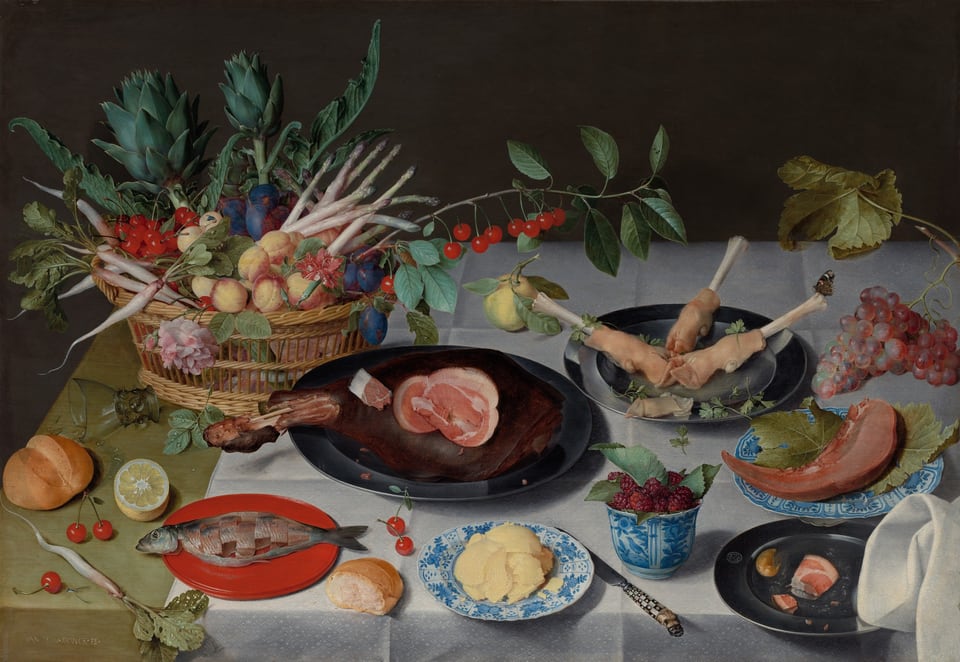
Still Life with Meat, Fish, Vegetables, and Fruitc. 1615–20
Jacob van Hulsdonck depicted a colorful array of foods, and tablewares ranging from an earthenware trencher to delicate Chinese porcelain—an expensive luxury made possible by international trade. More about this work
About this work
Jacob van Hulsdonck depicted a colorful array of foods, and tablewares ranging from an earthenware trencher to delicate Chinese porcelain—an expensive luxury made possible by international trade. For seventeenth-century viewers, the quantity and variety of foods would have represented a utopian world without scarcity or hunger. Partially eaten food and an overturned glass suggest that diners have just departed, leaving insects to explore the remains.
Text from the Cleveland Museum of Art.
How it was made
- Oil on panel
- Oil paint on prepared wooden boards, usually oak in the north and poplar in Italy. The rigid, smooth surface suits fine detail and thin, glowing glazes.
- Oil paint
- Pigment ground in a drying oil, usually linseed. It dries slowly, so painters could blend on the canvas, build up thin translucent glazes, and rework a picture over weeks. Canvas replaced wooden panels in the 1500s because it is lighter and can be rolled.
Jacob van Hulsdonck
Flemish, 1582–1647
Rights and the museum’s record
Public domain. The Cleveland Museum of Art has dedicated this image to the public domain under CC0, so anyone may copy, adapt and use it, for any purpose, without asking. Our prints and files are reproductions made from the museum’s image; the museum doesn’t endorse them.
- Object number
- 2018.258
- Credit
- Courtesy of the Cleveland Museum of Art
- Type
- Painting
- Department
- European Painting and Sculpture
- Licence
- CC0 1.0 Universal
- Museum record
- See it on the museum’s site