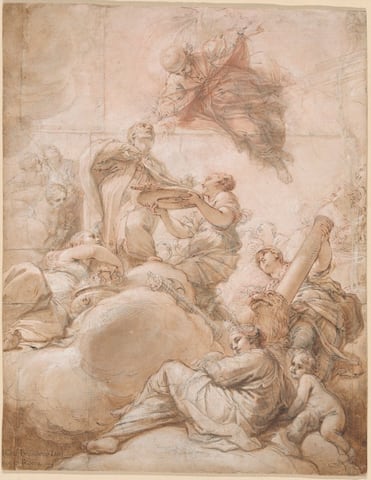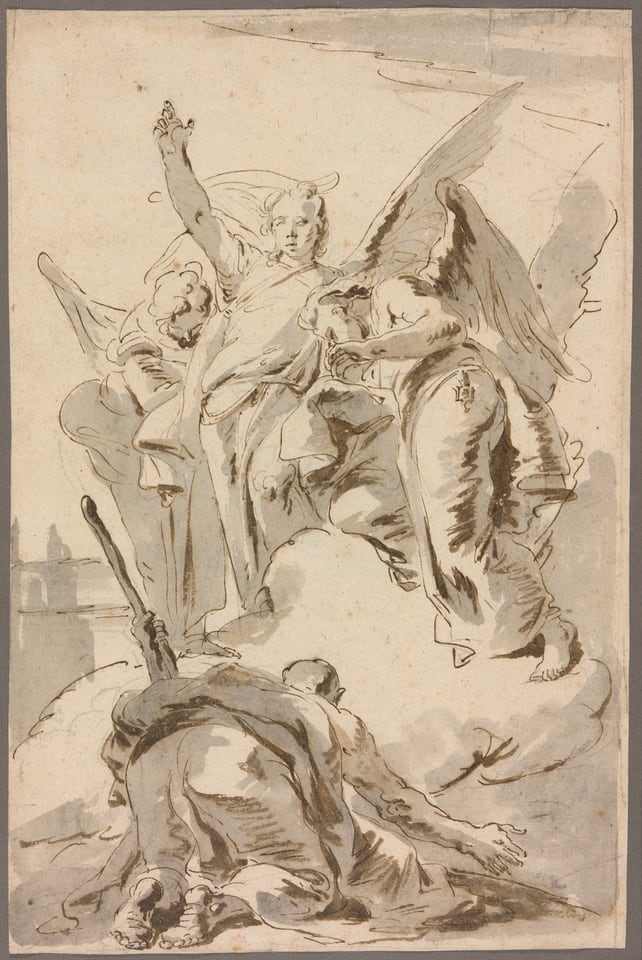
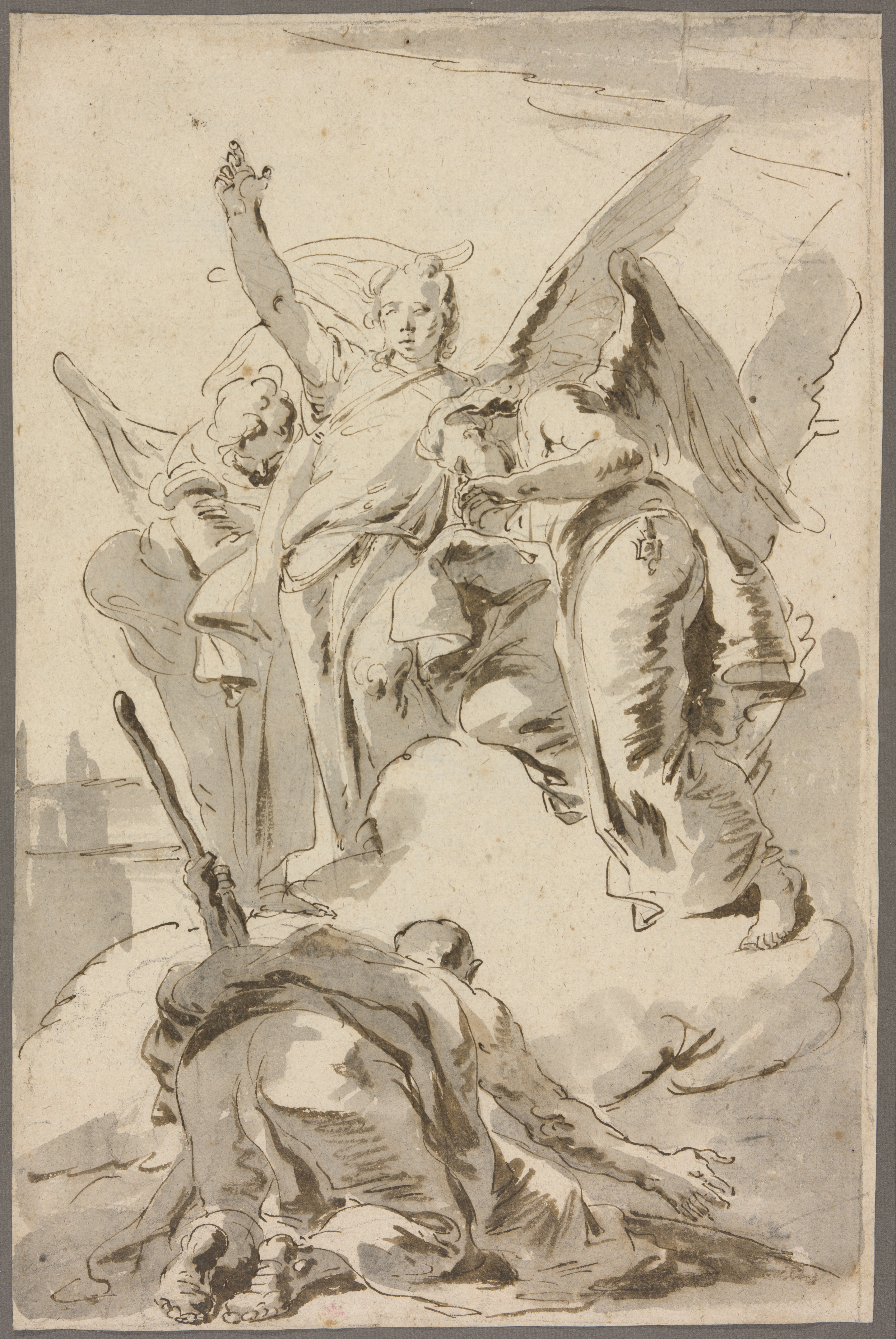
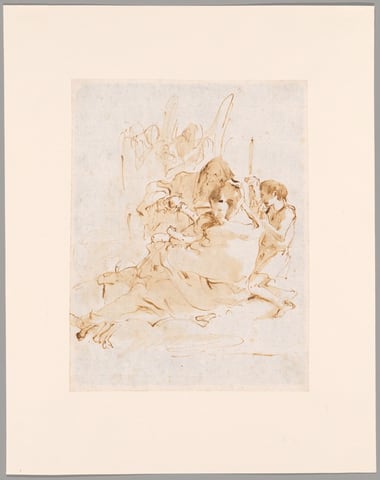
Three Angels Appearing to Abrahamc. 1726
Three angels appear to Abraham at Mamre to announce that his aged wife Sarah will bear a son, as told in Genesis. More about this work
About this work
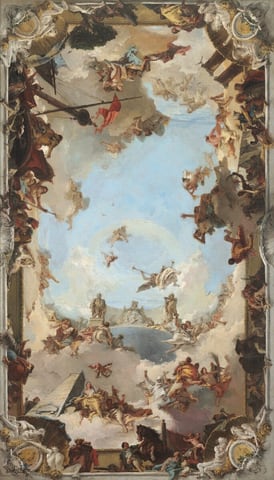
Three angels appear to Abraham at Mamre to announce that his aged wife Sarah will bear a son, as told in Genesis. Giovanni Battista Tiepolo drew the scene in pen and brown ink with washes over black chalk around 1726, the years in which he was painting frescoes of Old Testament subjects, this episode among them, in the archbishop’s palace at Udine. The luminous washes, left open in places so that the bare paper reads as light, show the speed and assurance of his draughtsmanship.
Written by Ochre Editions.
What you’re looking at
A work made of pen and brown ink and brush and brown and gray wash, over black chalk, on ivory laid paper.
Description from the Art Institute of Chicago.
How it was made
- Chalk
- Natural black, red and white chalks. Used together on toned paper they could give the warmth of flesh with very little effort, and they were favourites for studies from life.
- Pen and ink
- Drawn with a quill or reed pen, often with wash added by brush to model light and shadow.
- Laid paper
- Handmade on a mould of close-set wires, which leave fine parallel lines you can see when the sheet is held to the light.
Giovanni Battista Tiepolo
Italian, 1696–1770 · Born in Venice; died in Madrid.
Tiepolo was the leading decorative painter of eighteenth-century Europe, covering ceilings and walls with airy skies, foreshortened figures and luminous colour. After establishing himself in Venice, he worked with his sons Giandomenico and Lorenzo on the frescoes of the Residenz at Würzburg in 1750–53, and in 1762 he went to Madrid to decorate the Royal Palace for Charles III, remaining there until his death. Rinaldo and Armida, the lovers of Tasso’s epic Jerusalem Delivered, were subjects he painted more than once.
Written by Ochre Editions.
Rights and the museum’s record
Public domain. The Art Institute of Chicago has dedicated this image to the public domain under CC0, so anyone may copy, adapt and use it, for any purpose, without asking. Our prints and files are reproductions made from the museum’s image; the museum doesn’t endorse them.
- Object number
- 1970.41
- Credit
- Courtesy of the Art Institute of Chicago
- Type
- Drawing and Watercolor
- Department
- Prints and Drawings
- Licence
- CC0 1.0 Universal
- Museum record
- See it on the museum’s site
Report this work
More by Giovanni Battista Tiepolo
All their works
Close in colour