Skip to content
Ochre Editions
ArtArtistsCollectionsGalleriesDrops
SearchSign inCart (0)
The galleries · Style galleries

The Etching Revival

Artists who took up the etching needle again, from Whistler to the Paris printmakers.

50 works · hang 9628 ·

Share The Etching Revival, in the galleries

The rooms are imagined; every work on their walls is real.

Walk this roomRehang this room

Section 1, north wall

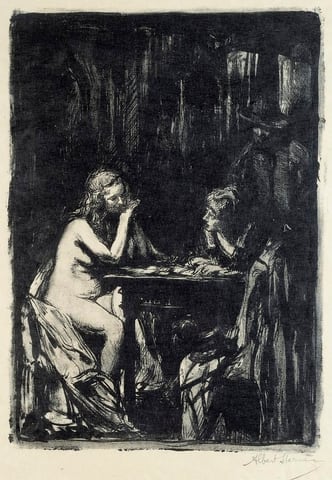
  1. The Stranger, by Albert Sterner, 1916
    The StrangerAlbert Sterner, 1916Courtesy of the Smithsonian American Art Museum
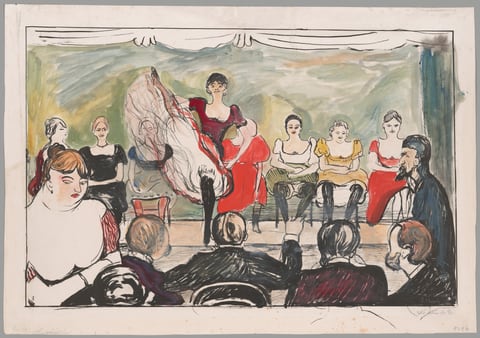
  2. A work made of lithograph in black ink, with additions in brush and red, blue, yellow, green, orange-brown and gray watercolor on ivory wove paper.
    TingletangleEdvard Munch, 1895Courtesy of the Art Institute of Chicago

Section 1, south wall
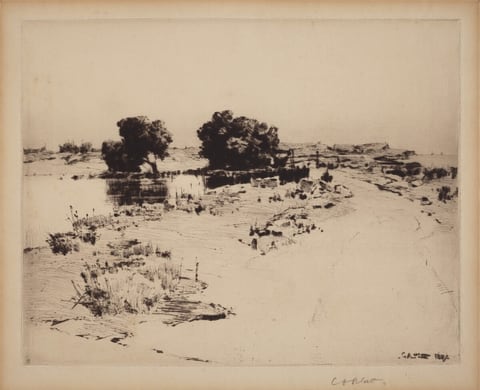
  1. The image depicts a landscape seen from a slightly elevated perspective, with a tranquil scene. The horizon is high in the composition, showing a vast view. There are a few distant trees and silhouettes blending into the sky. The brushstrokes are expressive and fluid, with a sketch-like quality depicting texture and movement in the trees and ground. The color palette is primarily monochrome, using shades of black and grey. Near the viewer, there are low plants and shrubs on sandy ground, leading to a small body of water reflecting dense trees. In the distance, the landscape becomes more open and sparse towards the horizon.
    Cape Ann WillowsCharles A. Platt, 1887Courtesy National Gallery of Art, Washington
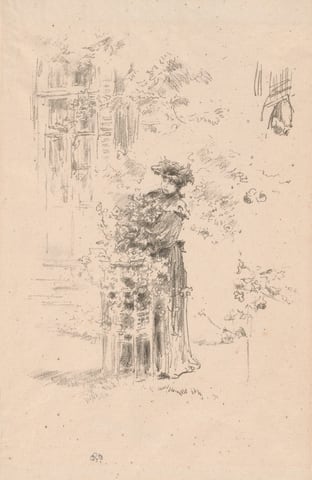
  2. A work made of transfer lithograph in black, with stumping and scraping, on cream laid paper, laid down on a heavy backing sheet.
    La Belle JardinièreJames McNeill Whistler, 1894Courtesy of the Art Institute of Chicago
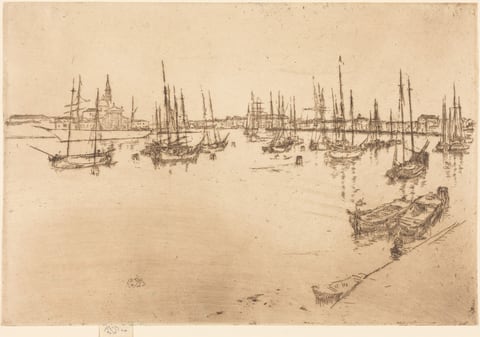
  3. The image displays a harbor filled with boats and ships. The perspective is slightly elevated, likely from a dock, with a partially visible boat and dock at the forefront. The horizon is in the upper third of the image, showing a distant cityscape with spires and structures. The brushwork is delicate, with fine, linear strokes typical of etching. The color palette is monochromatic, sepia tones creating a vintage and serene mood. The ships with tall masts populate the water, with reflections giving a sense of stillness. In the distance, faint impressions of buildings line the harbor, blending into the horizon.
    San GiorgioJames McNeill Whistler, 1880Courtesy National Gallery of Art, Washington

Section 2, south wall
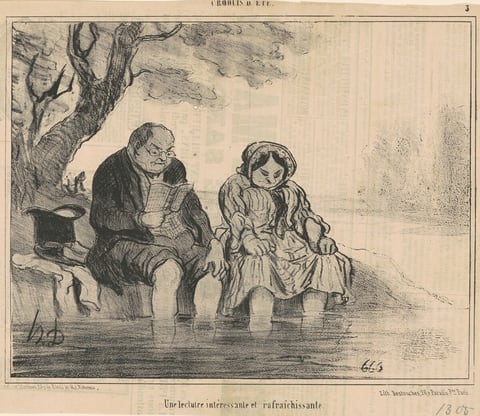
  1. The image shows two individuals seated outdoors near a body of water with their feet submerged. Both individuals are seen from head to toe. The person on the left is seated with a slightly hunched posture, reading a document or a book. They have a balding head, wear glasses, a dark suit with the coat draped over their knees, and a top hat placed on the ground. The individual on the right is sitting upright with a scarf over their hair. They wear a long dress with a shawl, and their hands rest on their lap. The background features a bare tree and a rough, sketched environment. The sky and landscape are depicted in shades of light and dark.
    Une lecture intéressante et rafraichissanteHonoré Daumier, 1854Courtesy National Gallery of Art, Washington
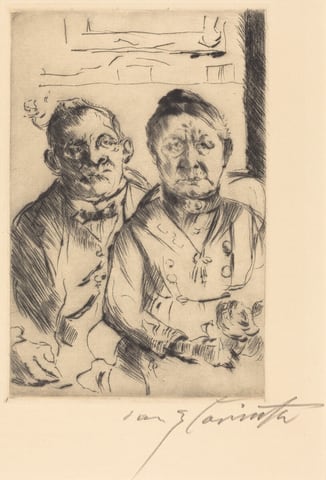
  2. The image depicts two individuals from the waist up. The person on the left has a round face and is slightly behind the person on the right who has a slightly elongated face. Both individuals appear to be seated and have short, neatly combed hair. They have neutral facial expressions and their features are indistinct. The person on the left wears a suit with a bow tie, while the person on the right is dressed in clothing with detailed patterns and holds a flower-like object in their left hand. The background shows simple line sketches that suggest an interior setting.
    Ostpreussisches Ehepaar (Couple from East Prussia)Lovis Corinth, 1916Courtesy National Gallery of Art, Washington
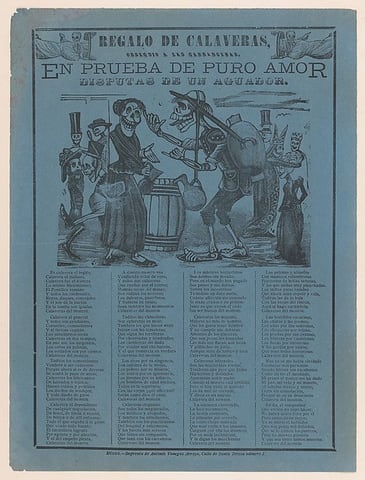
  3. In proof of true love, a watercarrier skeleton arguing with a woman (Posada); two skeleton angels in upper corners (Manilla), by José Guadalupe Posada, ca. 1890–96
    In proof of true love, a watercarrier skeleton arguing with a woman (Posada); two skeleton angels in upper corners (Manilla)José Guadalupe Posada, ca. 1890–96Courtesy of The Metropolitan Museum of Art

Section 2, north wall
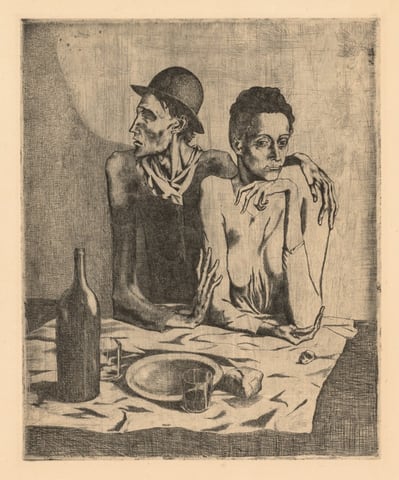
  1. The Frugal Meal, by Pablo Picasso, September 1904, printed 1913
    The Frugal MealPablo Picasso, September 1904, printed 1913Courtesy of the Cleveland Museum of Art
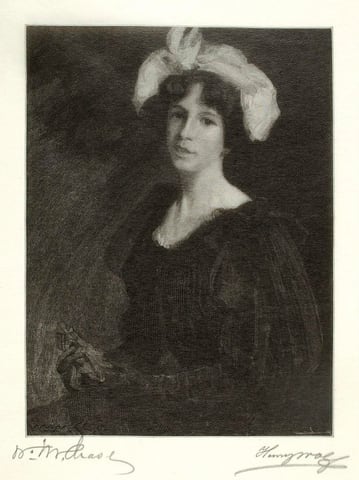
  2. Portrait of Mrs. C--, by Henry Wolf, 1894
    Portrait of Mrs. C--Henry Wolf, 1894Courtesy of the Smithsonian American Art Museum

Section 3, north wall
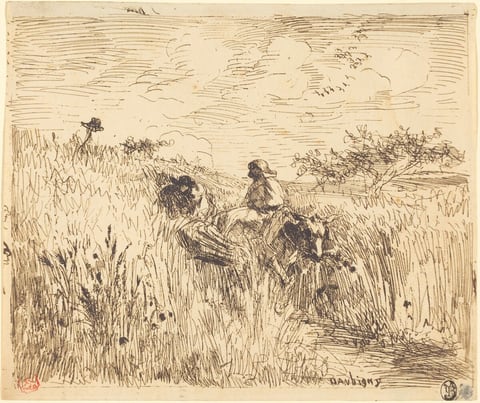
  1. This image shows an elevated view of a grassy landscape with sparse trees and vegetation at the horizon. The linear brushstrokes create texture and movement in the grass and sky. The color palette is monochromatic with sepia tones. In the foreground, a figure is on a horse amidst tall grasses, while in the distance, another figure stands on the left and a cluster of trees is on the right. The sky has wisps of clouds.
    Path through a Wheat Field (Sentier dans les bles)Charles-François Daubigny, 1862Courtesy National Gallery of Art, Washington
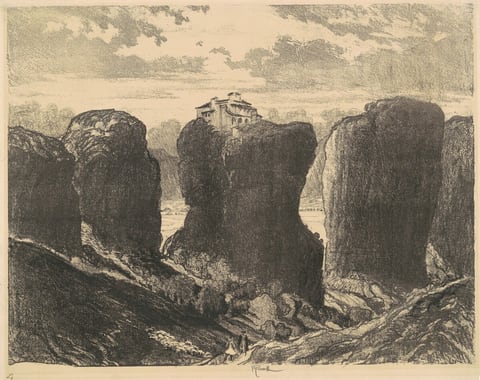
  2. The image depicts a landscape with towering rock formations dominating the scene. The ground is rugged and textured, leading the eye towards the rock pillars in the center. A structure or building is perched atop one of these rocks. The background shows the horizon above the structure, with clouds and sky stretching out beyond. The artwork features detailed brushstrokes adding texture to the rocks. The color palette is monochromatic with varying shades of charcoal or ink, emphasizing the contrast between the rocks and the sky.
    The Cliffs of the TrinityJoseph Pennell, 1913Courtesy National Gallery of Art, Washington

Section 3, south wall
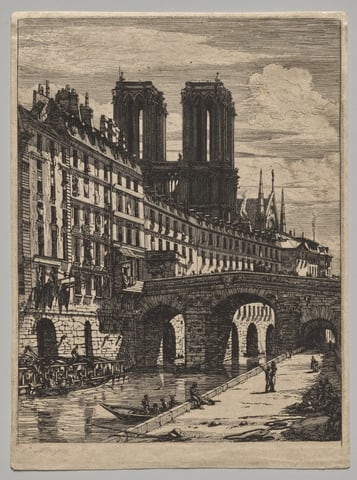
  1. The Petit Pont, by Charles Meryon, 1850
    The Petit PontCharles Meryon, 1850Courtesy of the Cleveland Museum of Art
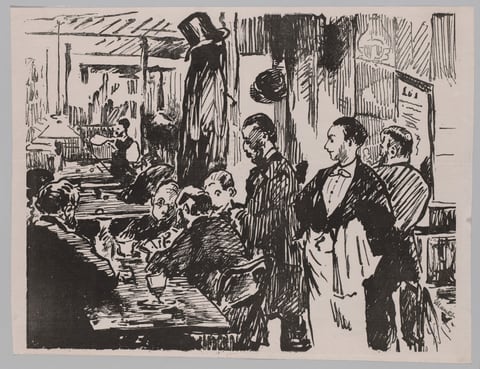
  2. At the Café, by Édouard Manet, 1874
    At the CaféÉdouard Manet, 1874Courtesy of the Cleveland Museum of Art

Section 4, south wall
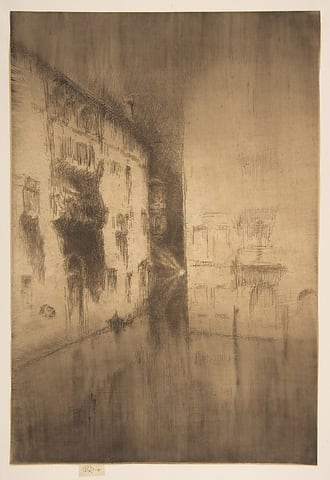
  1. Nocturne: Palaces, by James McNeill Whistler, 1879–80
    Nocturne: PalacesJames McNeill Whistler, 1879–80Courtesy of The Metropolitan Museum of Art
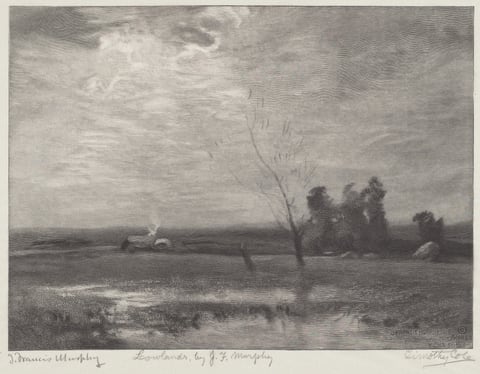
  2. This print displays a landscape with a wide view of flat land stretching towards the horizon. The ground is covered in small black dots, with some bare patches in the bottom center. A few silhouetted trees and a hint of smoke coming up from behind some rocks are visible in the distance. The gray sky dominates the scene with soft, swirling clouds.
    LowlandsTimothy Cole, 1918Courtesy National Gallery of Art, Washington

Walk on

  • The Etching Revival, room 2
  • Timothy Cole's contemporaries 8 works
  • 20th-century United States 124 works
Ochre Editions

The world's museums, on your wall. Every work here is a reproduction of a public-domain original, credited to the museum that holds it.

Shop

All artCollectionsLimited dropsPrints and framing

Help

Find an orderShippingReturnsVerify a certificate

About

About Ochre EditionsMuseum creditsFor agentsDevelopers

Legal

Terms of UseTerms of SaleLimited Editions and CertificatesPrivacy PolicyCookie PolicyAcceptable Use PolicyAgent & API TermsCopyright and DMCA PolicyPrinting Your Own PhotoVulnerability Disclosure PolicyAccessibility StatementOpen-Access Credits
© 2026 Ochre EditionsPrices in US dollars. Prints ship within the United States.