Skip to content
Ochre Editions
ArtArtistsCollectionsGalleriesDrops
SearchSign inCart (0)
The galleries · Style galleries

Drawings of the 18th century

Drawings made in the 18th century, from every museum.

31 works · hang 9309 ·

Share Drawings of the 18th century, in the galleries

The rooms are imagined; every work on their walls is real.

Walk this roomRehang this room

Section 1, north wall

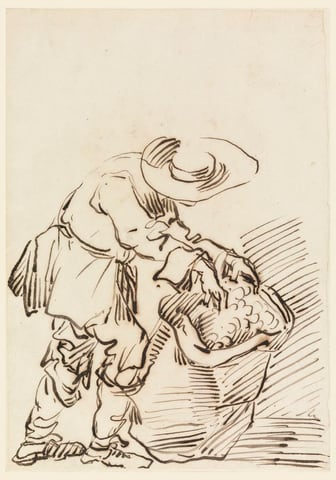
  1. WORKING PEASANT
    Working PeasantCarlo Marchionni, 1728–78Courtesy of Cooper Hewitt, Smithsonian Design Museum
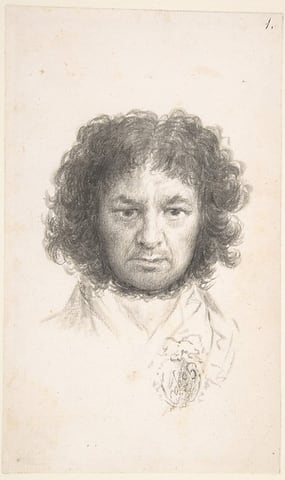
  2. Self-Portrait, by Francisco Goya, ca. 1796
    Self-PortraitFrancisco Goya, ca. 1796Courtesy of The Metropolitan Museum of Art
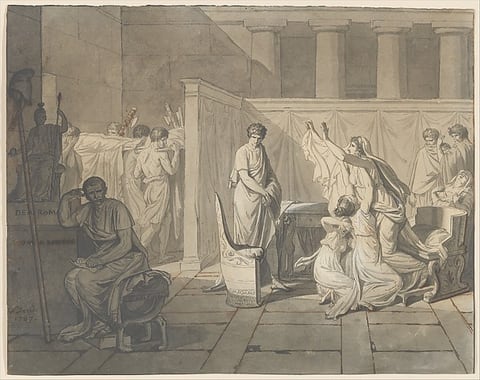
  3. The Lictors Bringing Brutus the Bodies of his Sons, by Jacques-Louis David, 1787
    The Lictors Bringing Brutus the Bodies of his SonsJacques-Louis David, 1787Courtesy of The Metropolitan Museum of Art

Section 1, south wall
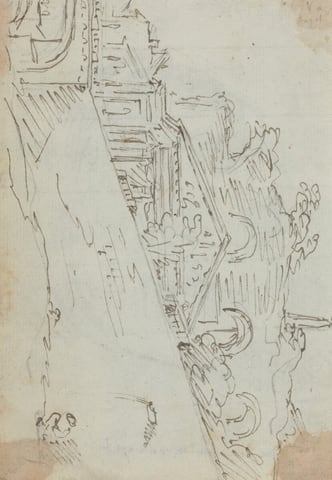
  1. The image shows a sketch of an architectural scene with structures lining a road or pathway. The horizon is not clearly defined, and the sketch focuses on architectural details. The drawing features loose, freehand lines outlining buildings and trees, with classical elements like columns and entablatures. The color palette is monochromatic, with light parchment and dark ink strokes creating contrast. Close-up details are lightly shaded for depth, while distant details are less defined. The composition is open and airy, emphasizing architectural features over precision.
    Ancient Ruins on the Bank of the TiberAugustin Pajou, 1752/1756Courtesy National Gallery of Art, Washington
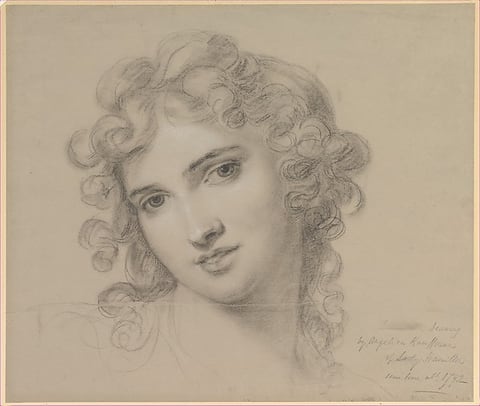
  2. Portrait of Emma Hamilton, by Angelica Kauffmann, 1791
    Portrait of Emma HamiltonAngelica Kauffmann, 1791Courtesy of The Metropolitan Museum of Art
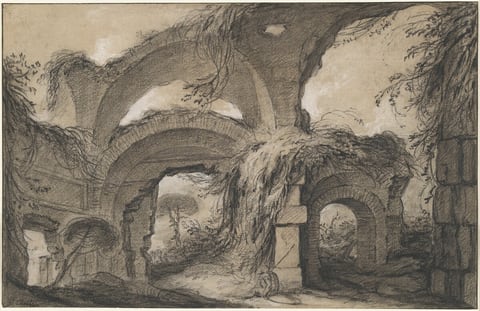
  3. The image shows an ancient ruin with arches and crumbling stonework surrounded by overgrown vegetation. The horizon is slightly elevated, emphasizing the towering remnants of the architecture. Expressive brushstrokes and textures are notable, especially in the vines and leaves on the stone. The color palette is subdued, mainly earthy tones and black, creating contrast and suggesting openings into the distance, enhancing the old, abandoned feel of the ruins.
    Arches of the Larger Baths at Hadrian's VillaCharles Michel-Ange Challe, c. 1748Courtesy National Gallery of Art, Washington

Section 2, south wall
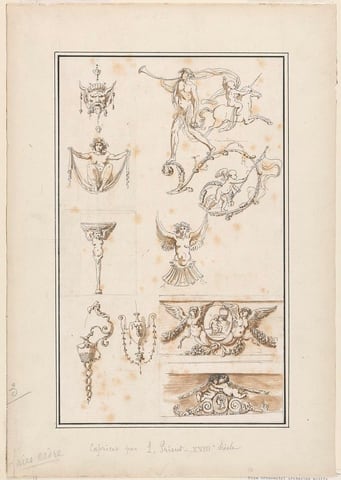
  1. DESIGNS FOR ORNAMENTAL ARABESQUE MOTIFS
    Designs for Ornamental Arabesque MotifsEtienne de Lavallée-Poussin, 1770Courtesy of Cooper Hewitt, Smithsonian Design Museum
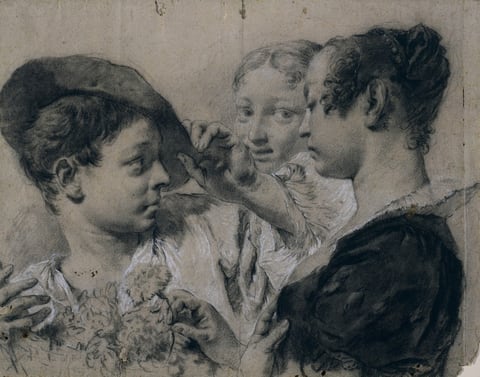
  2. A Young Woman Buying a Pink from a Young Man, by Giovanni Battista Piazzetta, c. 1740
    A Young Woman Buying a Pink from a Young ManGiovanni Battista Piazzetta, c. 1740Courtesy of the Cleveland Museum of Art
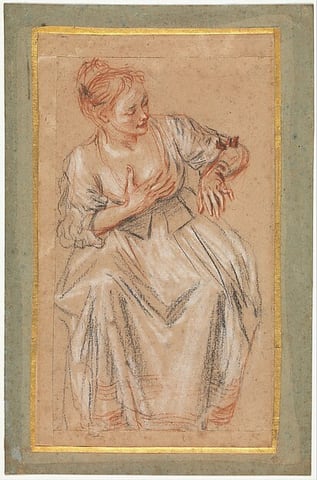
  3. Seated Woman, by Antoine Watteau, 1716–17
    Seated WomanAntoine Watteau, 1716–17Courtesy of The Metropolitan Museum of Art

Section 2, north wall
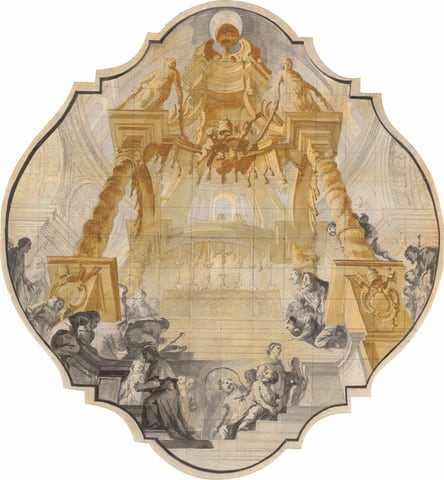
  1. This is a painting of an architectural scene with decorative and religious elements. The painting features a grand interior setting, possibly a church or cathedral, dominated by ornate columns and a ceiling structure. Figures appear on pedestals atop the columns. In the background, there is a depiction of a religious or ceremonial space with detailed balustrades and steps, where figures are shown in dynamic poses. The color palette consists of warm golden hues contrasted with cooler grey tones, highlighting the intricate details of the architecture and figures. This is in the style of Giovanni Battista Tiepolo.
    Worshippers at the Tomb of Saint PeterMatthäus Günther, 1740/1741Courtesy National Gallery of Art, Washington
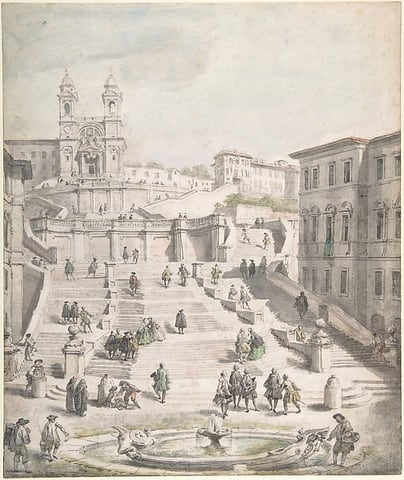
  2. Scalinata della Trinità dei Monti, by Giovanni Paolo Panini, ca. 1756–58
    Scalinata della Trinità dei MontiGiovanni Paolo Panini, ca. 1756–58Courtesy of The Metropolitan Museum of Art

Section 3, north wall
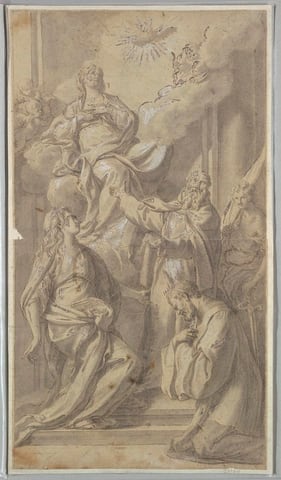
  1. MADONNA AND SAINTS
    Madonna and SaintsSebastiano Conca, ca. 1730Courtesy of Cooper Hewitt, Smithsonian Design Museum
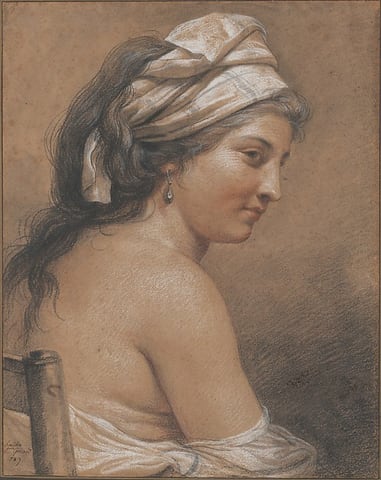
  2. Study of a Seated Woman Seen from Behind (Marie-Gabrielle Capet), by Adélaïde Labille-Guiard, 1789
    Study of a Seated Woman Seen from Behind (Marie-Gabrielle Capet)Adélaïde Labille-Guiard, 1789Courtesy of The Metropolitan Museum of Art
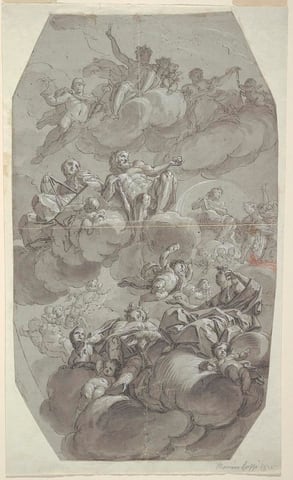
  3. STUDY FOR PAINTING, MOUNT OLYMPUS
    Study for Painting, Mount OlympusVito D'Anna, 1750–60Courtesy of Cooper Hewitt, Smithsonian Design Museum

Section 3, south wall
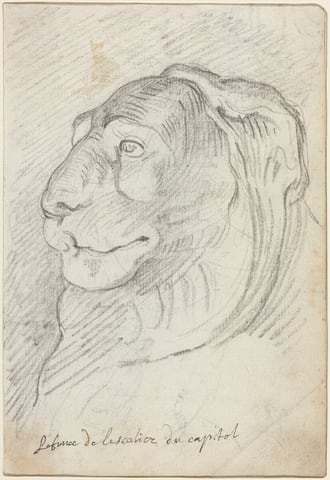
  1. This is a detailed sketch of a lion's head, positioned to show its profile. The drawing features the lion's broad nose, rounded mouth, large eye, and flowing mane. The facial features are depicted with various curves and lines. The sketch is on textured paper with pencil shading creating variations in the background. Handwritten text at the bottom reads "Leone de l'Escalier du capitol."
    Lion's Head from the Capitoline StaircaseAugustin Pajou, 1752/1756Courtesy National Gallery of Art, Washington
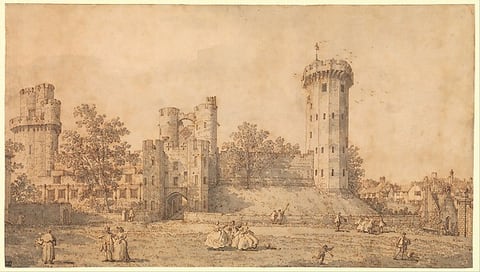
  2. Warwick Castle: The East Front, by Canaletto, 1752
    Warwick Castle: The East FrontCanaletto, 1752Courtesy of The Metropolitan Museum of Art

Walk on

  • Drawings of the 18th century, room 2
  • More by Canaletto 6 works
  • 18th-century Italy 49 works
Ochre Editions

The world's museums, on your wall. Every work here is a reproduction of a public-domain original, credited to the museum that holds it.

Shop

All artCollectionsLimited dropsPrints and framing

Help

Find an orderShippingReturnsVerify a certificate

About

About Ochre EditionsMuseum creditsFor agentsDevelopers

Legal

Terms of UseTerms of SaleLimited Editions and CertificatesPrivacy PolicyCookie PolicyAcceptable Use PolicyAgent & API TermsCopyright and DMCA PolicyPrinting Your Own PhotoVulnerability Disclosure PolicyAccessibility StatementOpen-Access Credits
© 2026 Ochre EditionsPrices in US dollars. Prints ship within the United States.