Skip to content
Ochre Editions
ArtArtistsCollectionsGalleriesDrops
SearchSign inCart (0)
The galleries · Time and place

Flanders

Works made in Flanders, from every century in the collection.

53 works · hang 1553 ·

Share Flanders, in the galleries

The rooms are imagined; every work on their walls is real.

Walk this roomRehang this room

First room, north wall

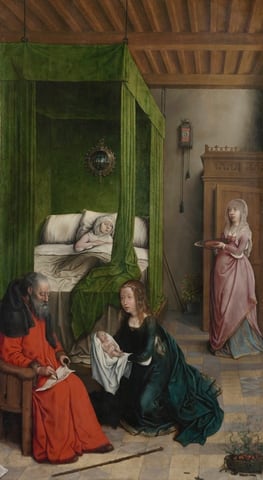
  1. The Birth and Naming of John the Baptist, by Juan de Flandes, 1496–99
    The Birth and Naming of John the BaptistJuan de Flandes, 1496–99Courtesy of the Cleveland Museum of Art
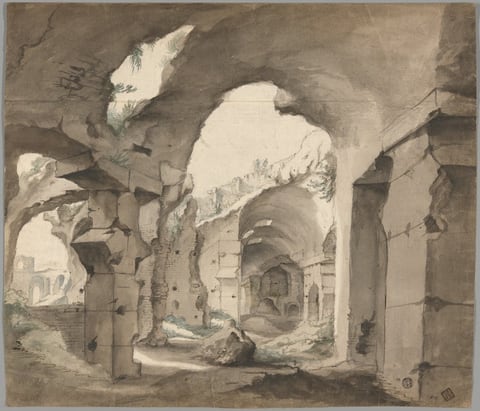
  2. A work made of pen and brown ink and brush and black and green washes, over black chalk, on cream laid paper.
    Interior View of the ColiseumLodewijk Toeput, c. 1580Courtesy of the Art Institute of Chicago
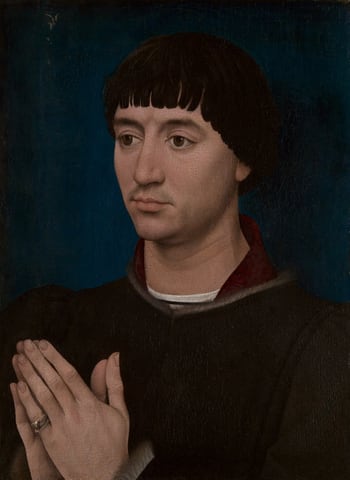
  3. Painted dark colored portrait of man, hands in prayer.
    Portrait of Jean Gros (recto); Coat of Arms of Jean Gros (verso)Rogier van der Weyden, 1460–64Courtesy of the Art Institute of Chicago
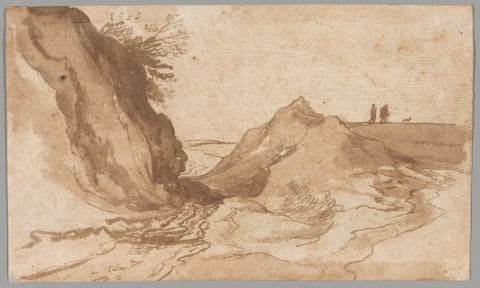
  4. A work made of pen and brush and brown ink and brush and brown wash on ivory laid paper.
    A Hilly Landscape with Figures Near a RavineJan Brueghel the Elder, 1595Courtesy of the Art Institute of Chicago

First room, south wall
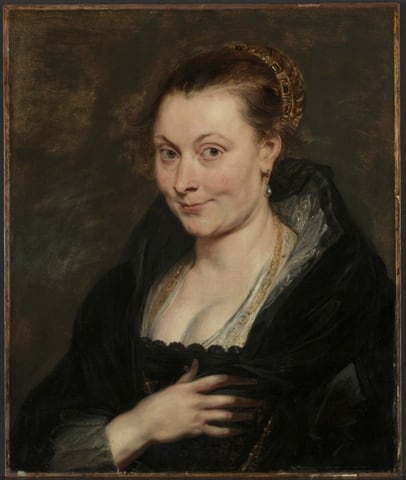
  1. Portrait of Isabella Brant, by Peter Paul Rubens, c. 1620–25
    Portrait of Isabella BrantPeter Paul Rubens, c. 1620–25Courtesy of the Cleveland Museum of Art
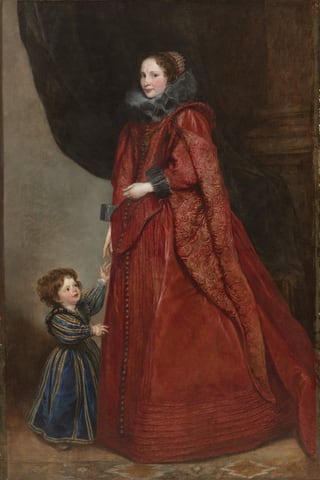
  2. A Genoese Lady with Her Child, by Anthony van Dyck, c. 1623–25
    A Genoese Lady with Her ChildAnthony van Dyck, c. 1623–25Courtesy of the Cleveland Museum of Art
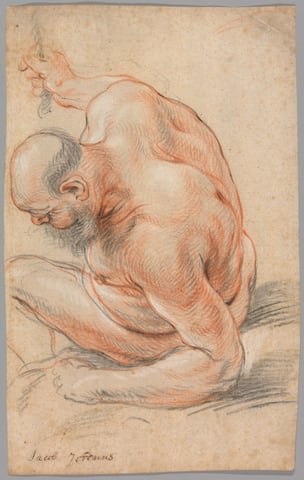
  3. A work made of red and black chalk, with touches of white chalk, on cream laid paper.
    Nude Old Man Seated, Leaning on His Forearm, Facing LeftJacob Jordaens, c. 1640Courtesy of the Art Institute of Chicago

Second room, south wall
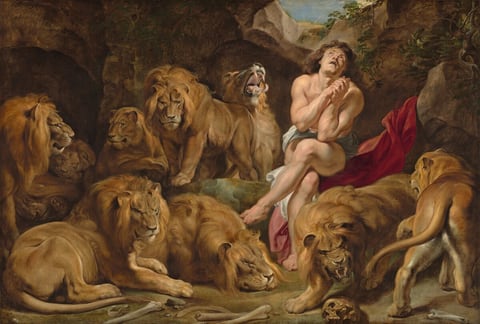
  1. A nearly nude, muscular man with pale, peachy skin sits in an underground cave among seven male and two female lions in this horizontal painting. The man sits to our right of center with his legs crossed, elbows close to his body with hands clasped by his chest. His head tips back to look up through a small opening above. He has long, wavy, chestnut-brown hair and dark eyes. A white cloth wraps across his hips, and he sits on a scarlet-red swath of fabric draped up over a rock next to him. The nine lions stalk, sit, or lie down around the man. One male lion next to the man, to our left, opens his mouth with his head thrown back, curling tongue extended beyond long fangs. A human skull and other bones are strewn on the dirt ground close to us. The rocky cave curves up around the animals and man to a narrow, round opening showing blue sky above.
    Daniel in the Lions' DenPeter Paul Rubens, c. 1614/1616Courtesy National Gallery of Art, Washington
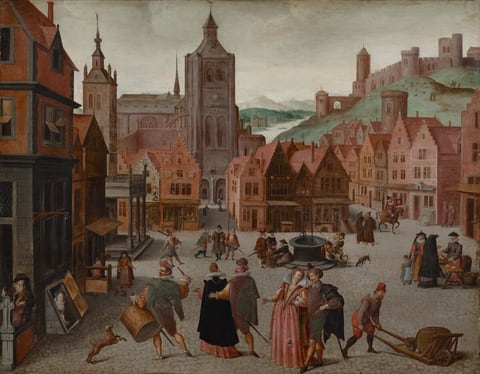
  2. We look slightly down onto a scene with people gathering in small groups in a cobblestone town square lined with rows of brick, wood, and stone buildings, many with stepped rooflines, in this horizontal painting. Singly or in pairs or trios, men, women, and children walk across the square, move goods around, or talk to merchants. All the people have light skin. Many of the men have mustaches and wear hats, and some carry swords. In tones of black, olive green, brick red, and plum purple, they wear hip-length cloaks over jackets, with white collars or ruffs and brass buttons, and knee-length breeches over yellow or black stockings. The women all wear long dresses in salmon pink, coral red, or golden yellow, with white collars or ruffs, and many wear black, ankle-length cloaks, some with hoods. Closest to us, a sumptuously dressed man and woman walk toward us while another similarly elegant couple walks away. Also facing away from us, to our left, a man wearing a large drum strapped around his waist raises one drumstick as he looks over his left shoulder. Nearby, a woman peers up out of a cellar door that opens on an angle to the street. More couples gather around a well across the square, and two women and a child talk to a third woman selling wares at a wooden table to our right. A pair of hooded priests or monks walk near a man blowing on a trumpet on horseback. The buildings are mostly shades of brick red and brown, and most have three or four stories with steeply pitched roofs. More people walk along side streets leading off the main square. One gap in the buildings across from us leads to a nickel-gray stone church with a pointed spire and square tower. A grassy, green hill rises steeply beyond the buildings to our right, leading down to a waterway that extends up and away into the distance. A few boats float in the water, which reflects the leaden-gray sky. Beyond the town square, a brown stone structure like a fortress with turret towers and crenellated walls looms along the ridge of the hill to our right. Tiny in scale, people on horseback and tending sheep dot the hillside below. The date “1590” is painted on the front of one of the buildings across from us while another date, “1597,” is painted on the end of a short wall near the lower left corner.
    The Marketplace in Bergen op ZoomAbel Grimmer, probably 1590 and 1597Courtesy National Gallery of Art, Washington

Second room, north wall
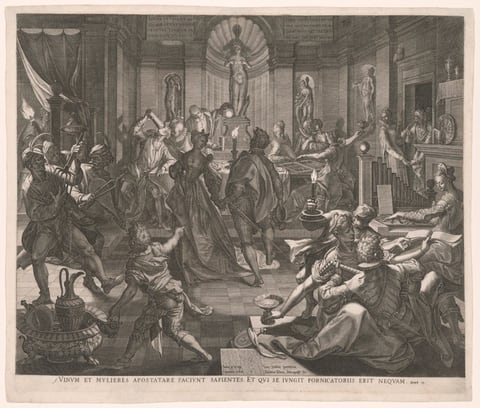
  1. A work made of engraving in black on cream laid paper.
    The Carnival (or the Prodigal Son)Jan Sadeler, I, 1588Courtesy of the Art Institute of Chicago
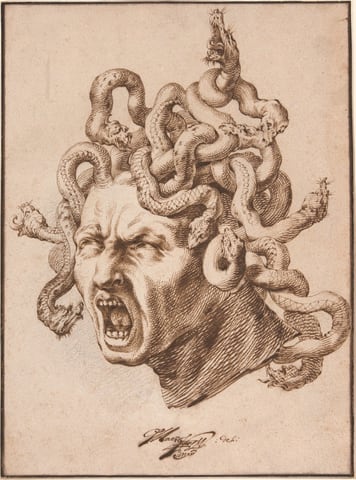
  2. A work made of pen and brown ink, with traces of black chalk, on cream laid paper.
    Head of MedusaGodfried Maes, 1680Courtesy of the Art Institute of Chicago
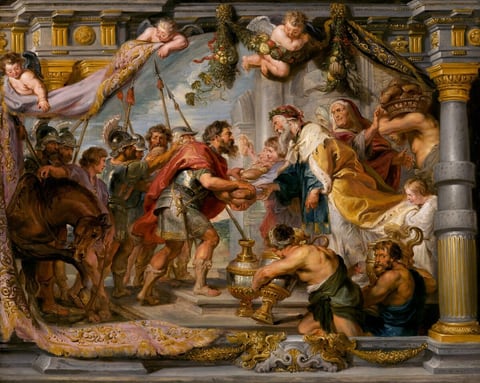
  3. This horizontal painting shows a tapestry being unfurled and held up by winged, baby-like putti against a structure with gray and gold columns, seen at the edges of the composition. Taking up most of the composition, the tapestry shows two ranks of men, women, and children gathered behind two central men, who meet at the center. All the people have light or tanned skin, and the bodies we can see are muscular. In the central pair of men, the one to our left, Abraham, faces our right in profile as he holds two loaves of bread. He has a brown beard and short, wavy hair, and dark brows over a prominent nose. He looks at the other man with dark eyes and leans toward him, to our right. Abraham wears an armored breastplate over silver chainmail edged with gold, which falls to mid-thigh. A crimson-red cape wraps around his shoulders and swirls around his back. A sword hangs by his hip, and tan sandals cover his heels and shins. Behind him are seven men and one brown horse, who gnaws at its foreleg. Most of the men are bearded and five wear armored helmets. A cleanshaven man wearing a lavender-purple tunic stands with his arm slung over the horse’s neck, holding the rein between thumb and forefinger. The man to our right, Melchizedek has a long white beard and short white hair. His red cap is encircled with a wreath of dark green leaves. He wears a long-sleeved, waist-length, aquamarine-blue garment over a white skirt. A heavy, golden-yellow cape with a broad, white fur collar and lining drapes over his shoulders, and is supported by at least one attendant. Behind and around Melchizedek are eight men, women, and children, standing near stone, gray ruins. Behind Melchizedek, one portly person wearing a dark pink mantle reaches into a basket of bread held across the shoulders of a blond, bearded, bare-chested man. Closer to us, in the lower right corner of the tapestry, one man wearing a green toga and another wearing blue kneel and sit, holding oversized silver and gold urns, the size of their torsos. The man in blue, to our right, turns to look at us over his shoulder. A third large urn sits near the other man. A view into the landscape with a low, green hill and a pale blue sky is glimpsed between the groups. The tapestry showing this scene curls over at the edges where the pudgy angels lift the top edge. The top right corner of the tapestry wraps around the edge of an unseen feature of the building, next to a gray column that rises the height of the painting up along the right edge. The border of the tapestry is rose pink with stylized gold designs. One putto with brown hair holds up the left corner, and one with light gray hair holds up the middle one arm slung over the front of the tapestry. The third putto, with blond hair, hooks an arm over a leafy garland with fruit that hangs from the cornice near the top center of the composition.
    The Meeting of Abraham and MelchizedekPeter Paul Rubens, c. 1626Courtesy National Gallery of Art, Washington
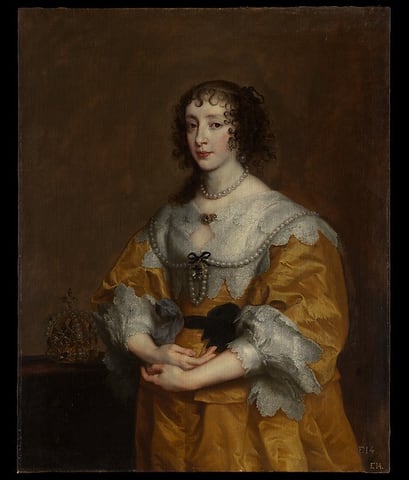
  4. Queen Henrietta Maria, by Anthony van Dyck, 1636
    Queen Henrietta MariaAnthony van Dyck, 1636Courtesy of The Metropolitan Museum of Art

Third room, north wall
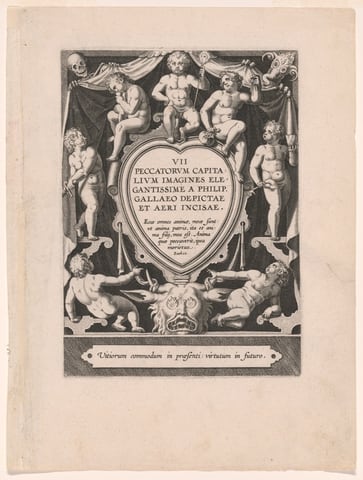
  1. A work made of engraving on paper.
    Title page, from The Seven VicesHieronymous Wierix, c. 1598Courtesy of the Art Institute of Chicago
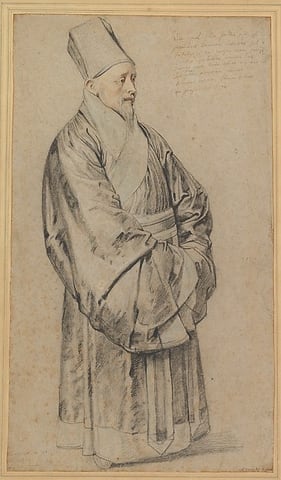
  2. Portrait of Nicolas Trigault in Chinese Costume, by Peter Paul Rubens, 1617
    Portrait of Nicolas Trigault in Chinese CostumePeter Paul Rubens, 1617Courtesy of The Metropolitan Museum of Art
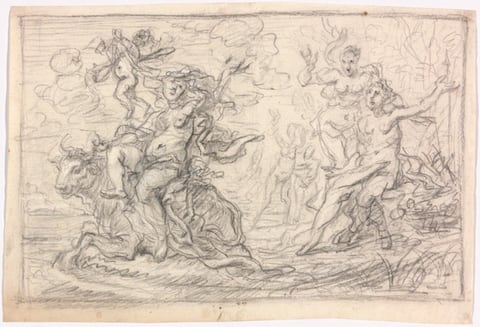
  3. A work made of black chalk, with touches of white chalk, on ivory laid paper.
    The Rape of EuropaCornelis Schut, I, 1635/40Courtesy of the Art Institute of Chicago

Walk on

  • Flanders, room 2
  • Cornelis Schut, I's contemporaries 8 works
  • More Dutch and Flemish Baroque 94 works
Ochre Editions

The world's museums, on your wall. Every work here is a reproduction of a public-domain original, credited to the museum that holds it.

Shop

All artCollectionsLimited dropsPrints and framing

Help

Find an orderShippingReturnsVerify a certificate

About

About Ochre EditionsMuseum creditsFor agentsDevelopers

Legal

Terms of UseTerms of SaleLimited Editions and CertificatesPrivacy PolicyCookie PolicyAcceptable Use PolicyAgent & API TermsCopyright and DMCA PolicyPrinting Your Own PhotoVulnerability Disclosure PolicyAccessibility StatementOpen-Access Credits
© 2026 Ochre EditionsPrices in US dollars. Prints ship within the United States.