The Birth and Naming of John the Baptist1496–99
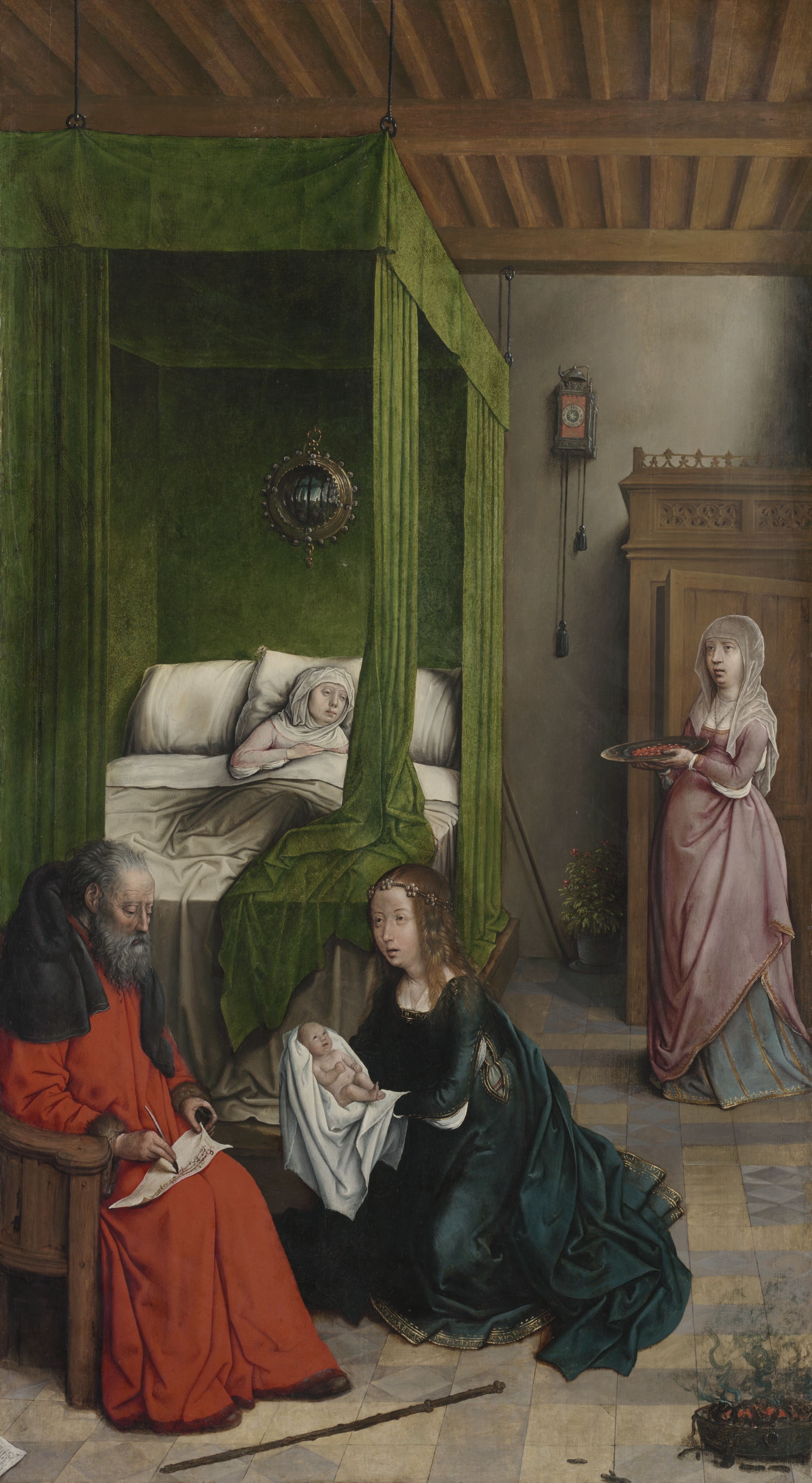
Typical of Flemish art of the period, this scene suggests a comfortable home of the late 1400s in the Netherlands to frame the story of a biblical birth. More about this work
About this work
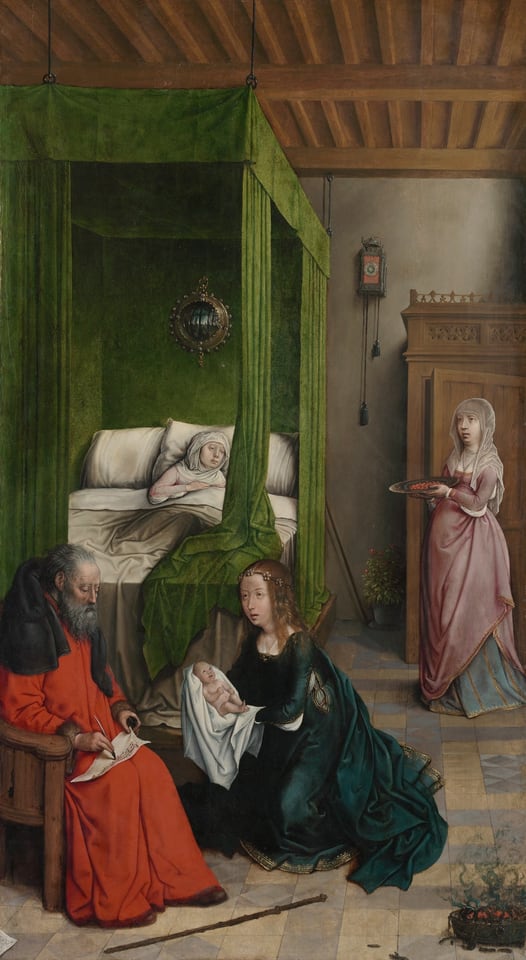
Typical of Flemish art of the period, this scene suggests a comfortable home of the late 1400s in the Netherlands to frame the story of a biblical birth. Elizabeth, mother of Saint John the Baptist, rests after her labor, while her cousin, the Virgin Mary, presents the newborn to his father, Zacharias. Having lost his ability to speak when he doubted an angel’s prophecy of the child’s birth, Zacharias writes down his son’s name. At this moment, his speech is restored. This painting was once part of an altarpiece commissioned by Queen Isabella I of Castile, known as the Catholic (1451–1504), for a monastery near Burgos.
Text from the Cleveland Museum of Art.
How it was made
- Oil on panel
- Oil paint on prepared wooden boards, usually oak in the north and poplar in Italy. The rigid, smooth surface suits fine detail and thin, glowing glazes.
- Oil paint
- Pigment ground in a drying oil, usually linseed. It dries slowly, so painters could blend on the canvas, build up thin translucent glazes, and rework a picture over weeks. Canvas replaced wooden panels in the 1500s because it is lighter and can be rolled.
Juan de Flandes
Netherlandish, c. 1460–1519
Rights and the museum’s record
Public domain. The Cleveland Museum of Art has dedicated this image to the public domain under CC0, so anyone may copy, adapt and use it, for any purpose, without asking. Our prints and files are reproductions made from the museum’s image; the museum doesn’t endorse them.
- Object number
- 1975.3
- Credit
- Courtesy of the Cleveland Museum of Art
- Type
- Painting
- Department
- Medieval Art
- Licence
- CC0 1.0 Universal
- Museum record
- See it on the museum’s site