The Westwood Childrenc. 1807
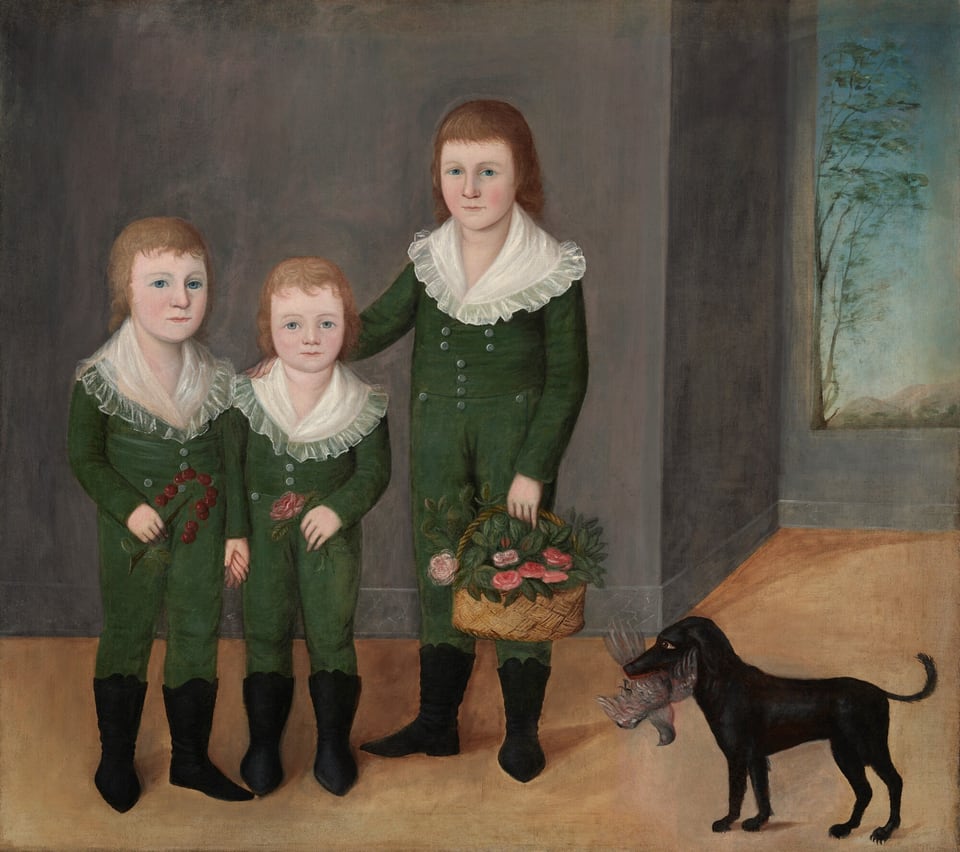
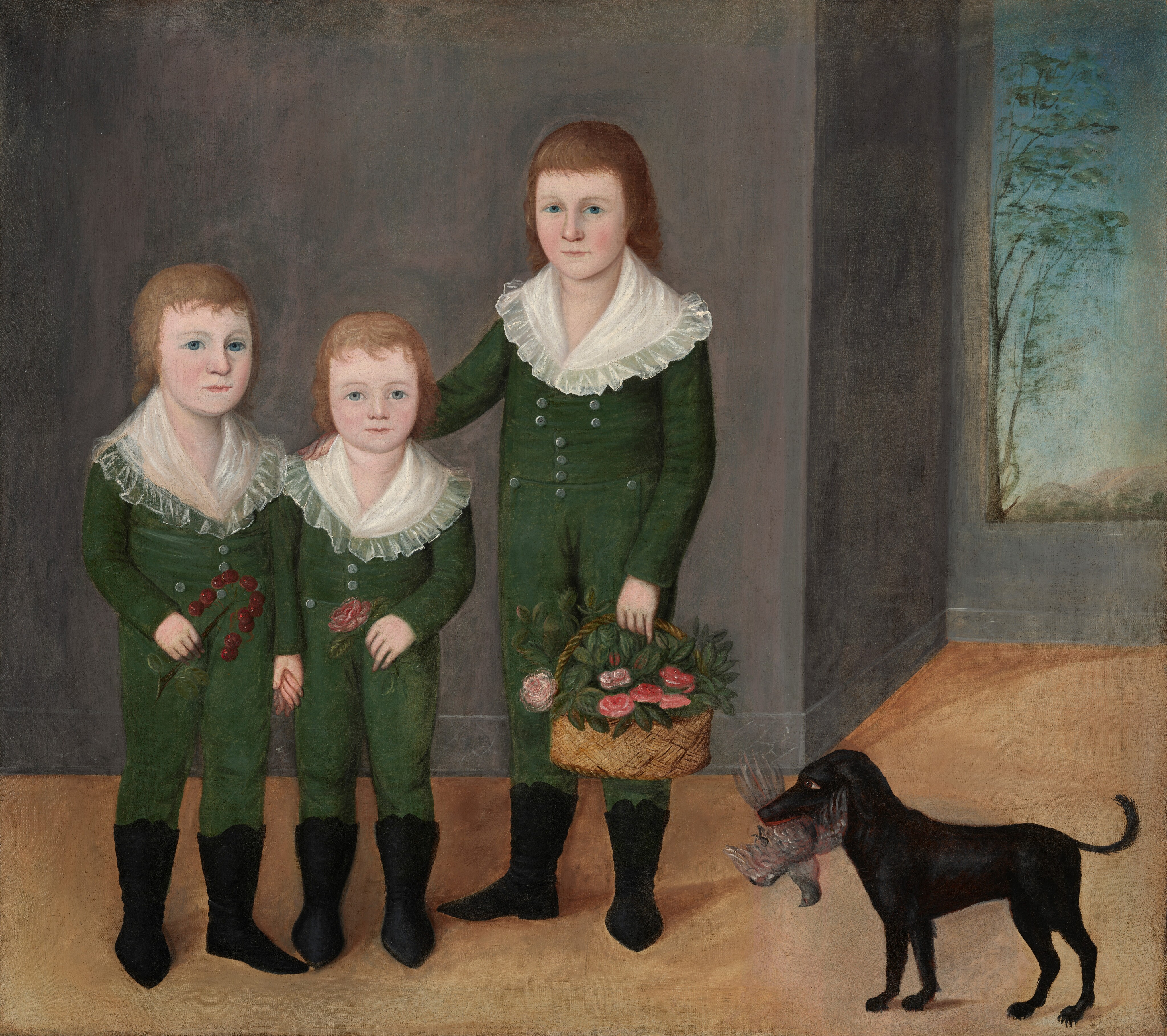
Three boys in matching green suits with wide ruffled collars stand hand in hand: one holds a sprig of cherries, the middle child a rose, and the eldest a basket of roses. More about this work
About this work
Three boys in matching green suits with wide ruffled collars stand hand in hand: one holds a sprig of cherries, the middle child a rose, and the eldest a basket of roses. At their feet a black dog carries a bird in its mouth, and a window opens onto a slender tree and distant pink-grey hills. The flat, patterned design, crisply outlined faces and careful repetition of pose are hallmarks of Joshua Johnson, a Baltimore portrait painter of African descent who is among the earliest known professional Black artists in the United States. The sitters are recorded as George, Henry and John Westwood.
Written by Ochre Editions.
What you’re looking at
Three pale-skinned, blue-eyed children wearing green suits stand in a row facing us in this horizontal portrait painting. They all have round faces and full, pink cheeks. The tallest child is to the right, and he has shoulder-length cinnamon-brown hair. The other two come up to his shoulder and have blond hair. The tallest puts one arm on the far shoulder of the middle child, and the two smaller children hold hands. Each wears a pine-green, one-piece outfit with pewter-gray buttons, a wide, ivory-white collar lined with ruffles, and black, shin-high boots. The boy on our left holds a branch of dark red cherries. The middle child holds a pink rose, and the tallest a basket filled with pink roses. A black dog holding a gray and mauve-pink bird in its mouth stands in profile facing our left in the lower right corner of the canvas. The room around them has a tan-colored floor and gray walls. The room opens onto an alcove to our right with a rectangular window. A slender tree is along the left edge of the opening and a few pale, pink-tinged gray mountains line the bottom edge. Clear blue sky fills the rest of the window.
Description from the National Gallery of Art.
How it was made
- Oil paint
- Pigment ground in a drying oil, usually linseed. It dries slowly, so painters could blend on the canvas, build up thin translucent glazes, and rework a picture over weeks. Canvas replaced wooden panels in the 1500s because it is lighter and can be rolled.
Rights and the museum’s record
Public domain. The National Gallery of Art has dedicated this image to the public domain under CC0, so anyone may copy, adapt and use it, for any purpose, without asking. Our prints and files are reproductions made from the museum’s image; the museum doesn’t endorse them.
- Object number
- 1959.11.1
- Credit
- Courtesy National Gallery of Art, Washington
- Type
- Painting
- Licence
- CC0 1.0 Universal
- Museum record
- See it on the museum’s site
Report this work
More by Joshua Johnson
All their works
Close in colour