Skip to content
Ochre Editions
ArtArtistsCollectionsGalleriesDrops
SearchSign inCart (0)
The galleries · Time and place

The 19th century

Works made in the 19th century, anywhere in the world.

731 works · hang 6587 ·

Share The 19th century, in the galleries

The rooms are imagined; every work on their walls is real.

Walk this roomRehang this room

Section 1, north wall

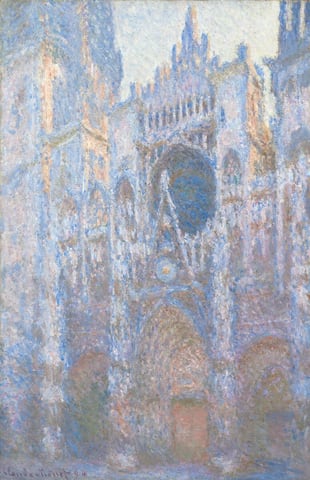
  1. We look up at the exterior of a church that soars the height of this vertical painting. The church is painted with visible dabs and strokes of azure blue, peach, lavender purple, and camel brown to create a blurred look, as if seeing a reflection in the rippling surface of a puddle. The church façade is angled to our left, away from us. The main door and its surround takes up the center of the composition, where a rectangular door is set within nested, pointed arches that lead up to a narrow, tall, triangular gable. The point of that gable overlaps the round, dark rose window, which is the same width as the portal surround below. Spires flank the central section and rise precipitously off the top edge of the painting. The sky above is painted with daubs of white and pale blue. The artist signed and dated the lower left, “Claude Monet 94.”
    Rouen Cathedral, West FaçadeClaude Monet, 1894Courtesy National Gallery of Art, Washington
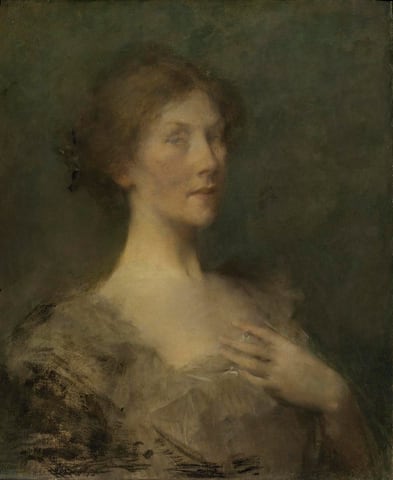
  2. Portrait of a Lady, by Thomas Wilmer Dewing, ca. 1895
    Portrait of a LadyThomas Wilmer Dewing, ca. 1895Courtesy of the Smithsonian American Art Museum
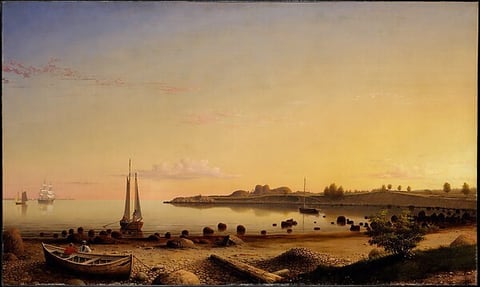
  3. Stage Fort across Gloucester Harbor, by Fitz Henry Lane, 1862
    Stage Fort across Gloucester HarborFitz Henry Lane, 1862Courtesy of The Metropolitan Museum of Art

Section 1, south wall
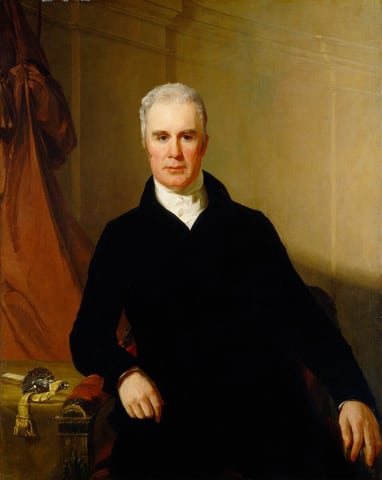
  1. The image shows an upper-body portrait of a man seated in a formal position. The man is depicted with a slight turn of his head, directly facing the viewer with a composed expression. He has short gray hair that is neatly styled. His facial features include a high forehead and firm jawline. He is dressed in a dark formal jacket with a high-collared white shirt visible at the neckline. His left hand rests on the arm of the chair, which is ornately carved with a scroll design. A fabric with an intricate pattern is draped over the back of the chair. There is no visible jewelry. In the background, there is a muted backdrop with a warm hue. On the left side of the image, a flowing drapery in a rich reddish tone adds depth to the setting.
    Charles Carnan RidgelyThomas Sully, 1820Courtesy National Gallery of Art, Washington
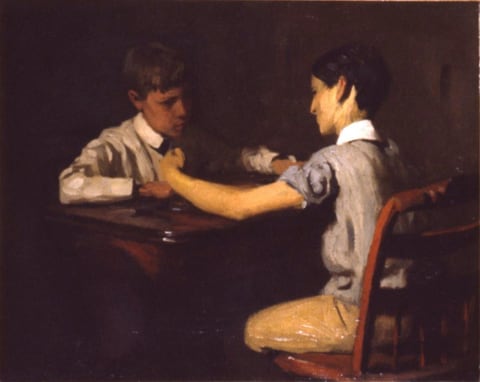
  2. Checker Players, by Thomas Anshutz, ca. 1895
    Checker PlayersThomas Anshutz, ca. 1895Courtesy of the Smithsonian American Art Museum
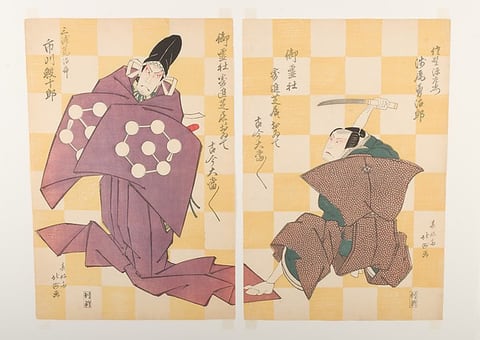
  3. Kabuki Actors Asao Yūjirō as Sano Genzaemon and Ichikawa Ebijūrō I as Miura Arajirō, in the play Keisei Sano no Funabashi, by Shunkōsai Hokushū, 1822
    Kabuki Actors Asao Yūjirō as Sano Genzaemon and Ichikawa Ebijūrō I as Miura Arajirō, in the play Keisei Sano no FunabashiShunkōsai Hokushū, 1822Courtesy of The Metropolitan Museum of Art
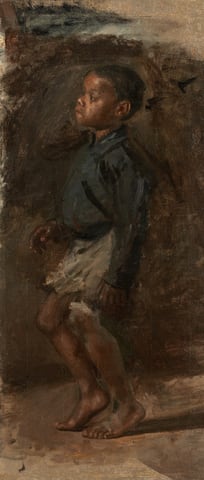
  4. Study for "The Dancing Lesson": The Boy, by Thomas Eakins, probably 1877
    Study for "The Dancing Lesson": The BoyThomas Eakins, probably 1877Courtesy National Gallery of Art, Washington

Section 2, south wall
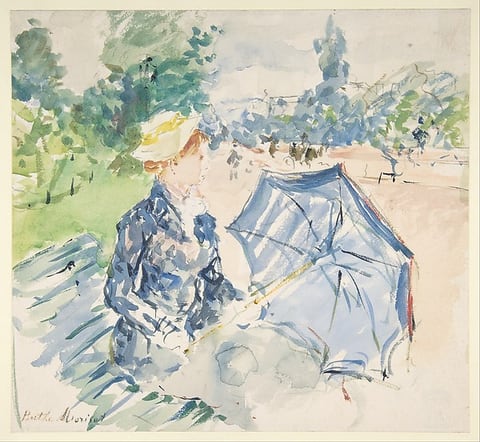
  1. A Woman Seated at a Bench on the Avenue du Bois, by Berthe Morisot, 1885
    A Woman Seated at a Bench on the Avenue du BoisBerthe Morisot, 1885Courtesy of The Metropolitan Museum of Art
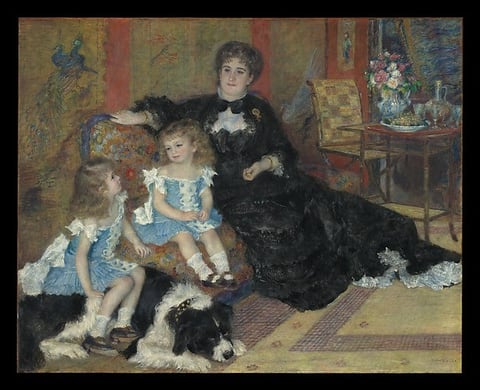
  2. Madame Georges Charpentier (Marguerite-Louise Lemonnier, 1848–1904) and Her Children, Georgette-Berthe (1872–1945) and Paul-Emile-Charles (1875–1895), by Pierre-Auguste Renoir, 1878
    Madame Georges Charpentier (Marguerite-Louise Lemonnier, 1848–1904) and Her Children, Georgette-Berthe (1872–1945) and Paul-Emile-Charles (1875–1895)Pierre-Auguste Renoir, 1878Courtesy of The Metropolitan Museum of Art
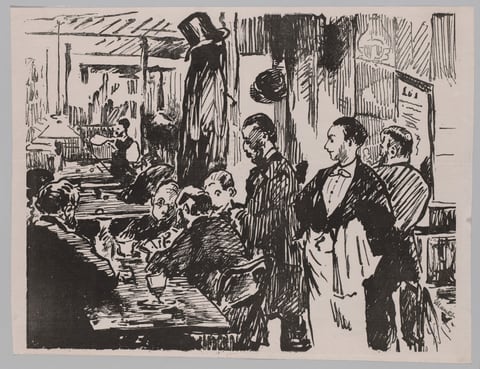
  3. At the Café, by Édouard Manet, 1874
    At the CaféÉdouard Manet, 1874Courtesy of the Cleveland Museum of Art

Section 2, north wall
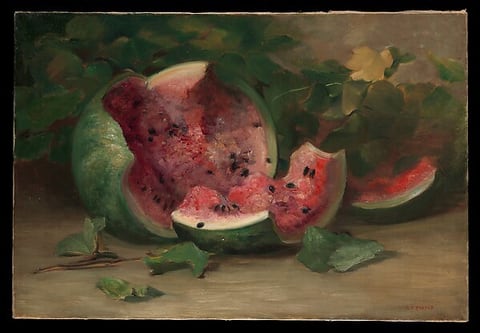
  1. Untitled (Cracked Watermelon), by Charles Ethan Porter, ca. 1890
    Untitled (Cracked Watermelon)Charles Ethan Porter, ca. 1890Courtesy of The Metropolitan Museum of Art
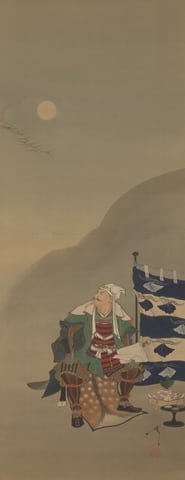
  2. A work made of hanging scroll; ink and colors on silk.
    Frost fills the air and the autumn air is still/lines of returning geese cross the moon in the third hour-Kenshin, from the series Twelve Aspects of the MoonTsukioka Yoshitoshi, 1885/92Courtesy of the Art Institute of Chicago
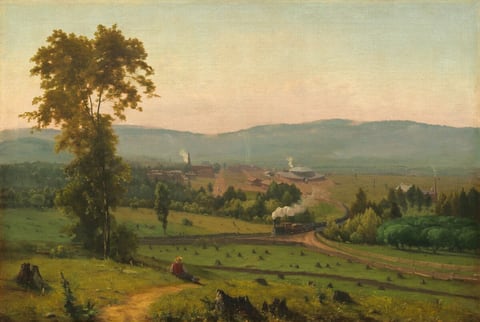
  3. We look across and down into a valley with a person sitting near a tall tree and a train puffing smoke beyond, all enclosed by a band of mountains in the distance in this horizontal landscape painting. Closest to us, several broken, jagged tree stumps are spaced across the painting’s width. A little distance away and to our left, the person wears a yellow, broad-brimmed hat, red vest, and gray pants. He reclines propped on his left elbow near a walking path beside a tall, slender tree with golden leaves. The green meadow stretching in front of him is dotted with tree stumps cut close to the ground. Beyond the meadow, puffs of white smoke trail behind a long steam locomotive that crosses a bridge spanning a tree-filled ravine, headed to our left. The ravine creates a diagonal line across the canvas, moving subtly away from us to our left. The train has climbed out of the valley, away from a cluster of brick-red buildings. The most prominent structure is a train roundhouse, a large building with a high, domed roof to the right of the tracks. Smoke rises from chimneys on long, warehouse-like buildings, and a steeple and smaller structures suggest a church and homes to our left. Hazy in the distance, a row of mountains lines the horizon, which comes about halfway up the composition. The sky above deepens from pale, shell pink over the mountains to watery, pale blue above. The artist signed the work in tiny letters in the lower left corner: “G. Inness.”
    The Lackawanna ValleyGeorge Inness, c. 1856Courtesy National Gallery of Art, Washington

Section 3, north wall
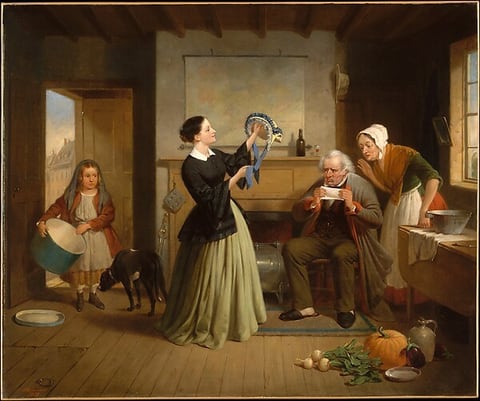
  1. The New Bonnet, by Francis William Edmonds, 1858
    The New BonnetFrancis William Edmonds, 1858Courtesy of The Metropolitan Museum of Art
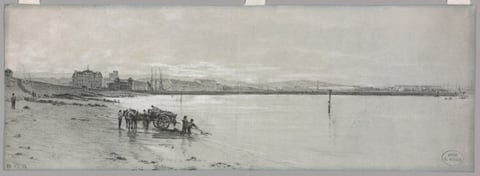
  2. A work made of black and white chalk on blue wove paper.
    SeasideCharles François Eustache, 1866Courtesy of the Art Institute of Chicago
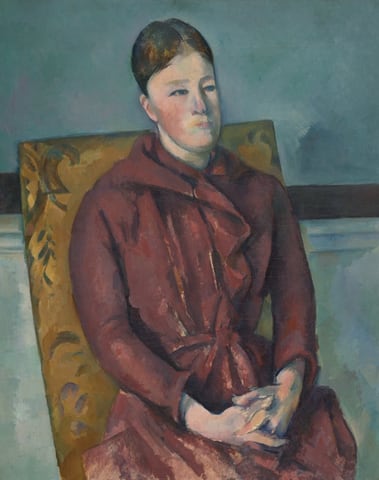
  3. Painting of a placid-looking, light-skinned woman in a maroon dress, seated in a chair with yellow upholstery, hands folded.
    Madame Cezanne in a Yellow ChairPaul Cézanne, 1888–90Courtesy of the Art Institute of Chicago

Walk on

  • The 19th century, room 2
  • More by Paul Cézanne 13 works
  • More Post-Impressionism 62 works
Ochre Editions

The world's museums, on your wall. Every work here is a reproduction of a public-domain original, credited to the museum that holds it.

Shop

All artCollectionsLimited dropsPrints and framing

Help

Find an orderShippingReturnsVerify a certificate

About

About Ochre EditionsMuseum creditsFor agentsDevelopers

Legal

Terms of UseTerms of SaleLimited Editions and CertificatesPrivacy PolicyCookie PolicyAcceptable Use PolicyAgent & API TermsCopyright and DMCA PolicyPrinting Your Own PhotoVulnerability Disclosure PolicyAccessibility StatementOpen-Access Credits
© 2026 Ochre EditionsPrices in US dollars. Prints ship within the United States.