Skip to content
Ochre Editions
ArtArtistsCollectionsGalleriesDrops
SearchSign inCart (0)
The galleries · Time and place

19th-century France

Works made in France in the 19th century.

237 works · hang 750 ·

Share 19th-century France, in the galleries

The rooms are imagined; every work on their walls is real.

Walk this roomRehang this room

First room, north wall

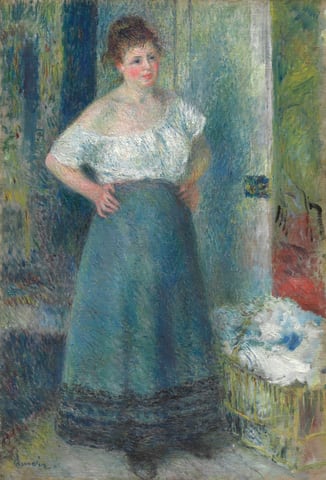
  1. A work made of oil on canvas.
    The LaundressPierre-Auguste Renoir, 1877–79Courtesy of the Art Institute of Chicago
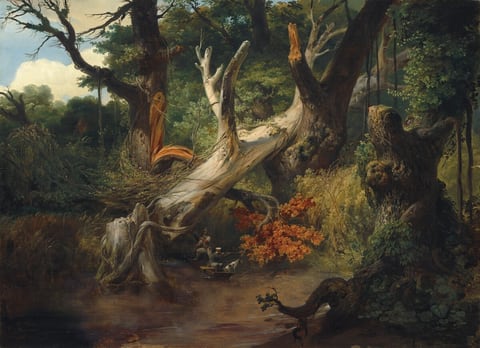
  2. A leafless, ash-white tree trunk has fallen from a broken stump into the wide V of a neighboring tree at the edge of a body of water near a verdant forest in this horizontal landscape painting. The fallen trunk creates a diagonal from near the lower left corner to the upper right. As it fell, it sheared off a substantial branch from a neighboring tree with a dark trunk. The bark where the damaged branch has pulled away is honey-orange, the same color as the leaves at the canopy, which has been pinned under the fallen trunk. Trees, vines, and other vegetation fill the space around and beyond this pair. In the lower right corner of the painting, vines grow over a broken stump, which deep in shadow. Between the stump and fallen tree, the peanut-brown surface of the water is smooth. Tiny in scale beneath the fallen tree and easily overlooked, there are two men and a dog in a boat. One man stands at the back of the boat and pushes it along with a long pole. He wears a tall, brown, cloth hat, a white shirt rolled up to the elbows under a blue vest, and loose-fitting pants. A second man wears a flat-topped, white hat with a black brim, a long, forest-green jacket, and tight-fitting slate-blue pants. He braces a rifle against one shoulder and shoots into the forest. The dog is white with brown spots, and it stands with its front paws on the edge of the boat, presumably ready to spring after the target. A patch of blue sky with puffy white clouds is seen above the trees in the upper left corner. The artist signed and dated the work in the lower right corner: “H. Vernet Rome 1833.”
    Hunting in the Pontine MarshesHorace Vernet, 1833Courtesy National Gallery of Art, Washington
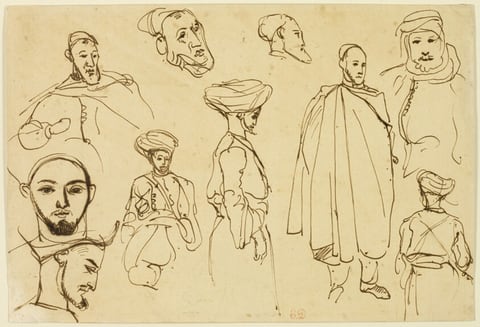
  3. A work made of pen and brown ink, with traces of graphite, on tan wove paper, laid down on cream wove paper.
    Sketches of Algerian MenEugène Delacroix, c. 1832Courtesy of the Art Institute of Chicago
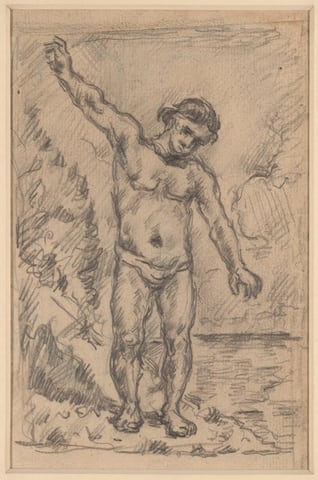
  4. A work made of graphite on cream laid paper (pieced).
    Bather With Outstretched Arms (recto); Study of a Tree (verso)Paul Cézanne, 1874/77Courtesy of the Art Institute of Chicago

First room, south wall
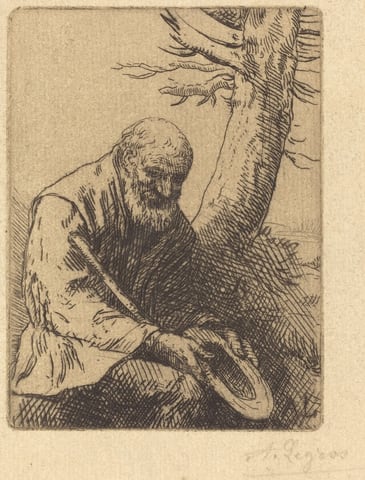
  1. The image depicts the upper half of a man's body, seated with his head tilted downwards. He has a pronounced brow and a long beard. His hair is sparse and closely cropped. He is wearing a textured cloak or robe, holding a hat in one hand and resting it on his knee. In the background, there is a large, bare tree trunk with bare branches.
    Beggar with Hat in Hand (Mendiant avec son chapeau a la main)Alphonse LegrosCourtesy National Gallery of Art, Washington
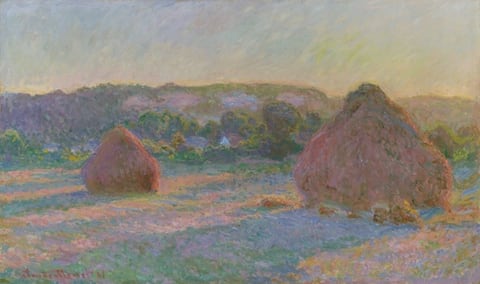
  2. Painting composed of short, dense brushstrokes depicts two domed stacks of wheat that cast long shadows on a field. The angled light indicates either a rising or setting sun.
    Stacks of Wheat (End of Summer)Claude Monet, 1890–91Courtesy of the Art Institute of Chicago
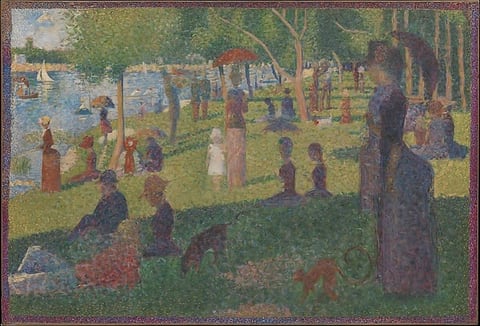
  3. Study for "A Sunday on La Grande Jatte", by Georges Seurat, 1884
    Study for "A Sunday on La Grande Jatte"Georges Seurat, 1884Courtesy of The Metropolitan Museum of Art

Second room, south wall
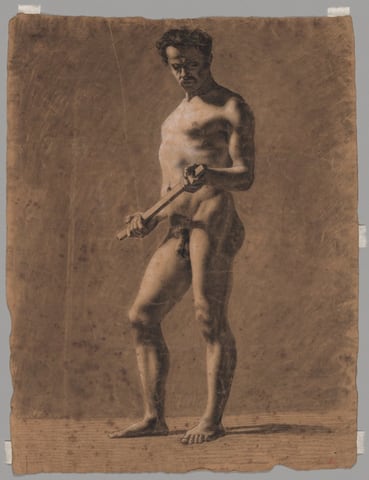
  1. A work made of black chalk and charcoal with stumping, heightened with white chalk (recto), and black chalk and charcoal with stumping (verso), on dark tan laid paper.
    Standing Academic Male Nude (recto); Sketch of Upper Arm (verso)Eugène Delacroix, 1816Courtesy of the Art Institute of Chicago
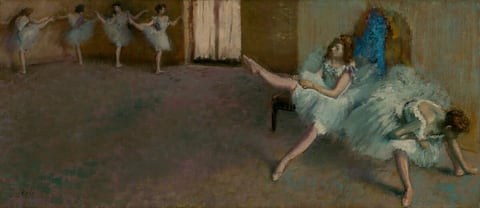
  2. In a dance studio, two ballerinas wearing knee-length tutus and ballet slippers sit on a bench and stretch to our right while four more pose at the back of the space, to our left, in this long, horizontal painting. The scene and dancers are loosely painted so many features are indistinct. All the women have light skin and dark brown hair. Each pale, robins’ egg-blue costume has a low-cut, tightly fitting, sleeveless bodice and a full skirt. Dabs of off white, teal, and blue suggest flowers lining the deep U of the neckline at the front and down the back of each bodice. Closest to us and nearly brushing the edges of the lower right corner of the canvas, one dancer sits on the end of a wooden bench and leans down between her legs, her feet widely planted. She rests her torso on an elbow folded onto one knee as she reaches for her left foot, farther from us, with her other hand. Her hair is pulled up and her face, looking downward, is deep in shadow. Sitting behind her on the bench, to our left, a second dancer lifts her right leg, toe pointing, as she pulls on her pale pink tights. Her other leg stretches straight, pointed toe brushing the floor, in front of her. This woman’s hair hangs loose around her shoulders. The pair is brightly lit from a source to our right, and an arched area of electric blue and mustard yellow behind them is difficult to interpret. The floor, which takes up about two-thirds of the composition, is painted with dabs of teal blue, pale fuchsia pink, and caramel brown. It leads us back to the upper left corner of the painting where four more four ballerinas stand in a line. The pair to our left stands with their backs to us, facing the wall with their right legs raised to shoulder height, toes pointed. The pair to our right faces us. They also stand with their right legs raised, creating a wide angle with their standing legs. All four ballerinas bend their arms gently at the elbow, and some tip their heads toward the raised legs. The rightmost dancer is illuminated by a pair of French doors at the back corner, at the top center of the painting. The wall behind the bench is streaked with mint green over honey brown, and the wall at the back of the room is leather brown. The visible, soft brushstrokes give the image a blurred, ethereal appearance in the dimmed studio. The artist signed the painting in the lower left corner, “Degas.”
    Before the BalletEdgar Degas, 1890/1892Courtesy National Gallery of Art, Washington
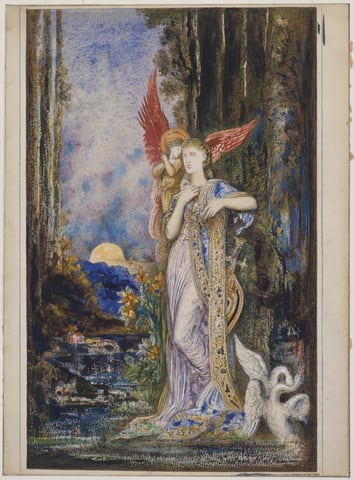
  3. A work made of watercolor and gouache, with pen and blue ink, over traces of graphite, on ivory wove paper, wrapped and adhered on verso to wood pulp board.
    InspirationGustave Moreau, c. 1893Courtesy of the Art Institute of Chicago

Second room, north wall
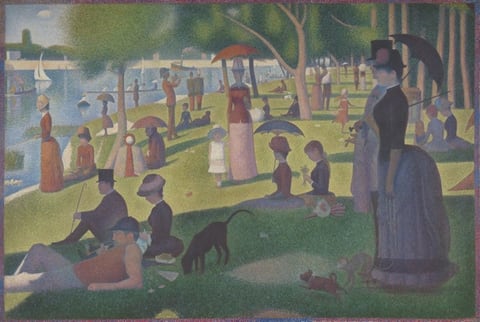
  1. Large painting of people in a crowded park, brushstrokes are dots.
    A Sunday on La Grande Jatte — 1884Georges Seurat, 1884–86, border added 1888–89Courtesy of the Art Institute of Chicago
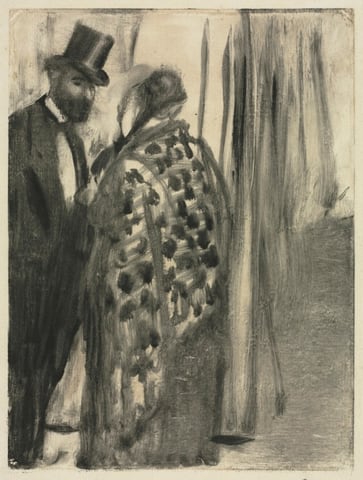
  2. Conversation: Ludovic Halévy and Madame Cardinal (The Conversation) for "La Famille Cardinal" by Ludovic Halévy, by Edgar Degas, c. 1880–83
    Conversation: Ludovic Halévy and Madame Cardinal (The Conversation) for "La Famille Cardinal" by Ludovic HalévyEdgar Degas, c. 1880–83Courtesy of the Cleveland Museum of Art

Third room, north wall
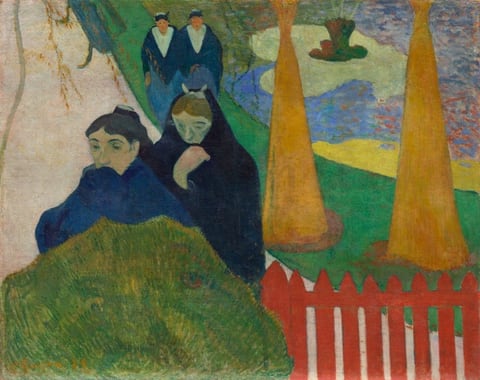
  1. Painting of four women with blue shawls walking near red fence.
    Arlésiennes (Mistral)Paul Gauguin, 1888Courtesy of the Art Institute of Chicago
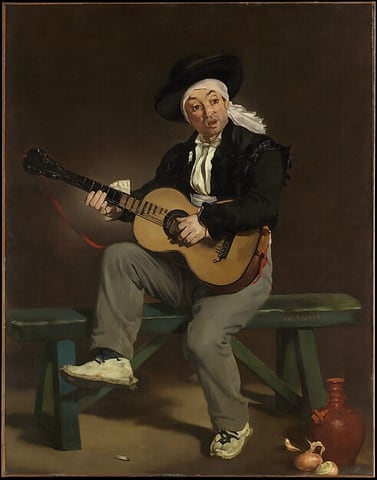
  2. The Spanish Singer, by Édouard Manet, 1860
    The Spanish SingerÉdouard Manet, 1860Courtesy of The Metropolitan Museum of Art

Third room, south wall
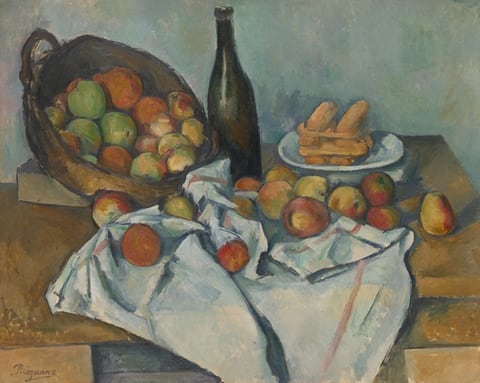
  1. Painting of a basket of green and red-yellow apples spilling over into a white cloth placed on a wooden table, with a dark green bottle and a plate of pale biscuits behind.
    The Basket of ApplesPaul Cézanne, c. 1893Courtesy of the Art Institute of Chicago
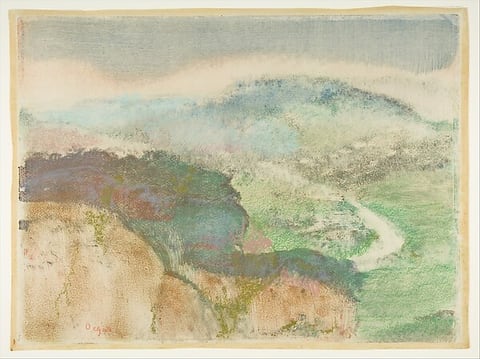
  2. Landscape, by Edgar Degas, 1892
    LandscapeEdgar Degas, 1892Courtesy of The Metropolitan Museum of Art

Walk on

  • 19th-century France, room 2
  • More by Edgar Degas 15 works
  • More Impressionism 53 works
Ochre Editions

The world's museums, on your wall. Every work here is a reproduction of a public-domain original, credited to the museum that holds it.

Shop

All artCollectionsLimited dropsPrints and framing

Help

Find an orderShippingReturnsVerify a certificate

About

About Ochre EditionsMuseum creditsFor agentsDevelopers

Legal

Terms of UseTerms of SaleLimited Editions and CertificatesPrivacy PolicyCookie PolicyAcceptable Use PolicyAgent & API TermsCopyright and DMCA PolicyPrinting Your Own PhotoVulnerability Disclosure PolicyAccessibility StatementOpen-Access Credits
© 2026 Ochre EditionsPrices in US dollars. Prints ship within the United States.