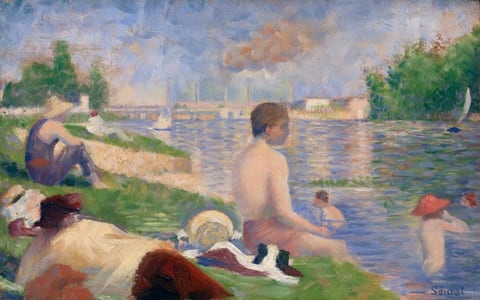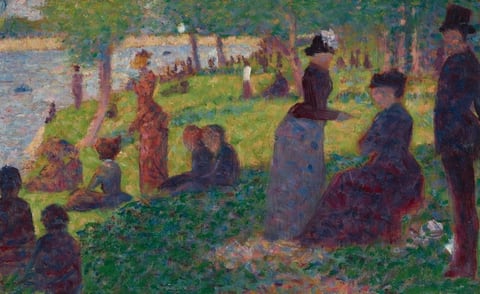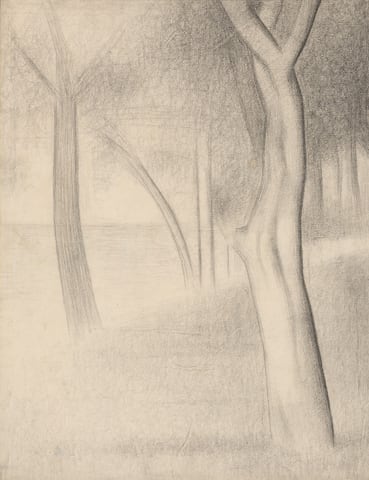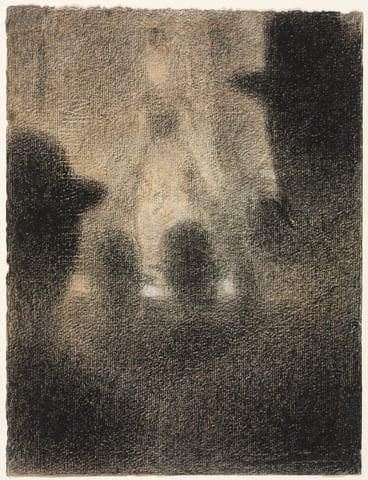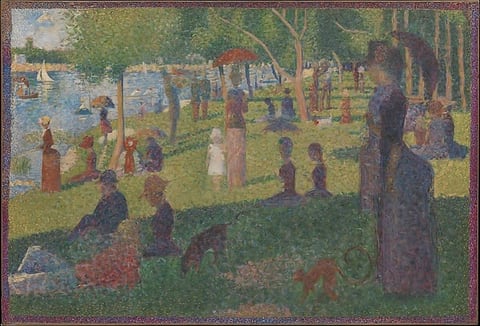
A Sunday on La Grande Jatte — 18841884–86, border added 1888–89
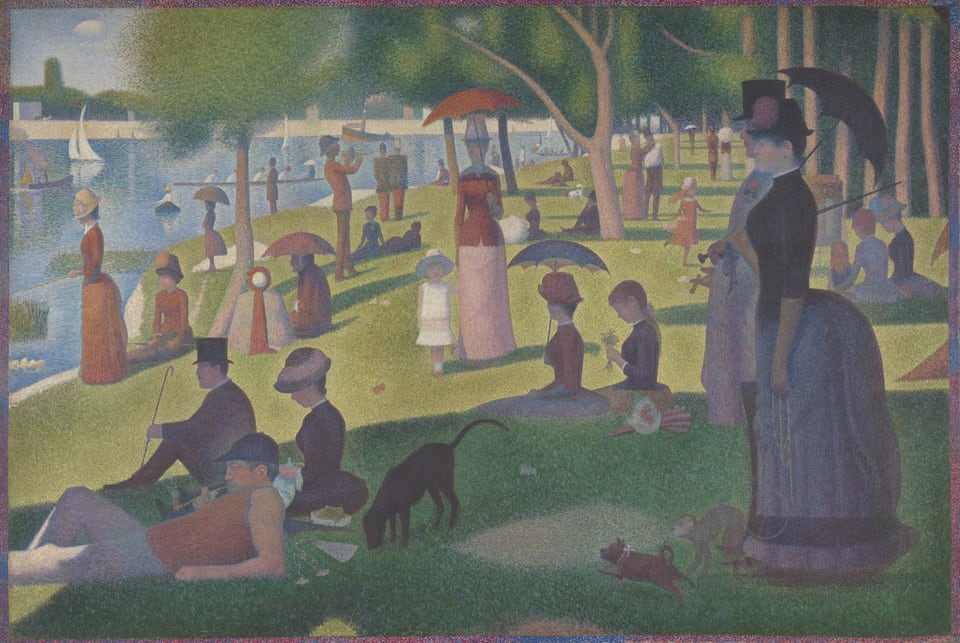
For his largest and best-known painting, Georges Seurat depicted Parisians enjoying all sorts of leisurely activities—strolling, lounging, sailing, and fishing—in the park called La Grande Jatte on the River Seine. More about this work
About this work
For his largest and best-known painting, Georges Seurat depicted Parisians enjoying all sorts of leisurely activities—strolling, lounging, sailing, and fishing—in the park called La Grande Jatte on the River Seine. He used an innovative technique called Pointillism that was inspired by optical and color theory, applying tiny dabs of different colored paint that viewers would see as a single, and Seurat believed, more brilliant hue.
Text from the Art Institute of Chicago.
What you’re looking at
Large painting of people in a crowded park, brushstrokes are dots.
Description from the Art Institute of Chicago.
How it was made
- Oil paint
- Pigment ground in a drying oil, usually linseed. It dries slowly, so painters could blend on the canvas, build up thin translucent glazes, and rework a picture over weeks. Canvas replaced wooden panels in the 1500s because it is lighter and can be rolled.
Georges Seurat
French, 1859–1891 · Born and died in Paris.
Seurat trained at the École des Beaux-Arts and studied the colour theories of Chevreul and others before developing pointillism, building pictures from small, separate touches of pure colour meant to combine in the eye. His large compositions, planned through many drawings and oil sketches, include Bathers at Asnières and A Sunday on La Grande Jatte — 1884, shown at the last Impressionist exhibition in 1886. His black conté crayon drawings are equally distinctive. He died suddenly at thirty-one.
Written by Ochre Editions.
Post-Impressionism
Artists who kept Impressionism's colour but pushed towards structure, symbol and feeling.
Rights and the museum’s record
Public domain. The Art Institute of Chicago has dedicated this image to the public domain under CC0, so anyone may copy, adapt and use it, for any purpose, without asking. Our prints and files are reproductions made from the museum’s image; the museum doesn’t endorse them.
- Object number
- 1926.224
- Credit
- Courtesy of the Art Institute of Chicago
- Type
- Painting
- Department
- Painting and Sculpture of Europe
- Licence
- CC0 1.0 Universal
- Museum record
- See it on the museum’s site