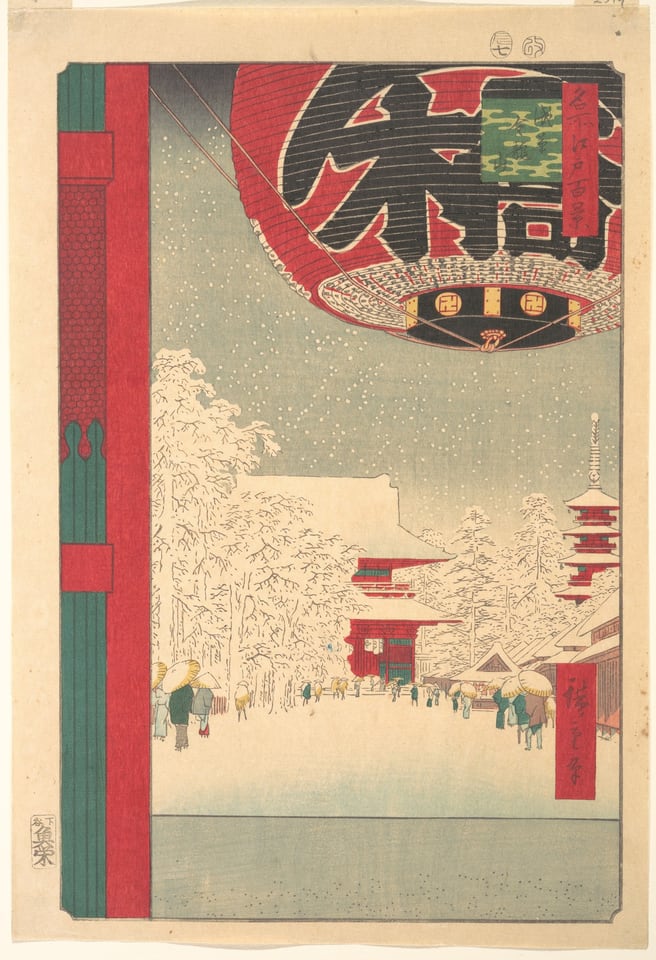
Kinryūsan Temple at Asakusa, from the series "One Hundred Famous Views of Edo"1856
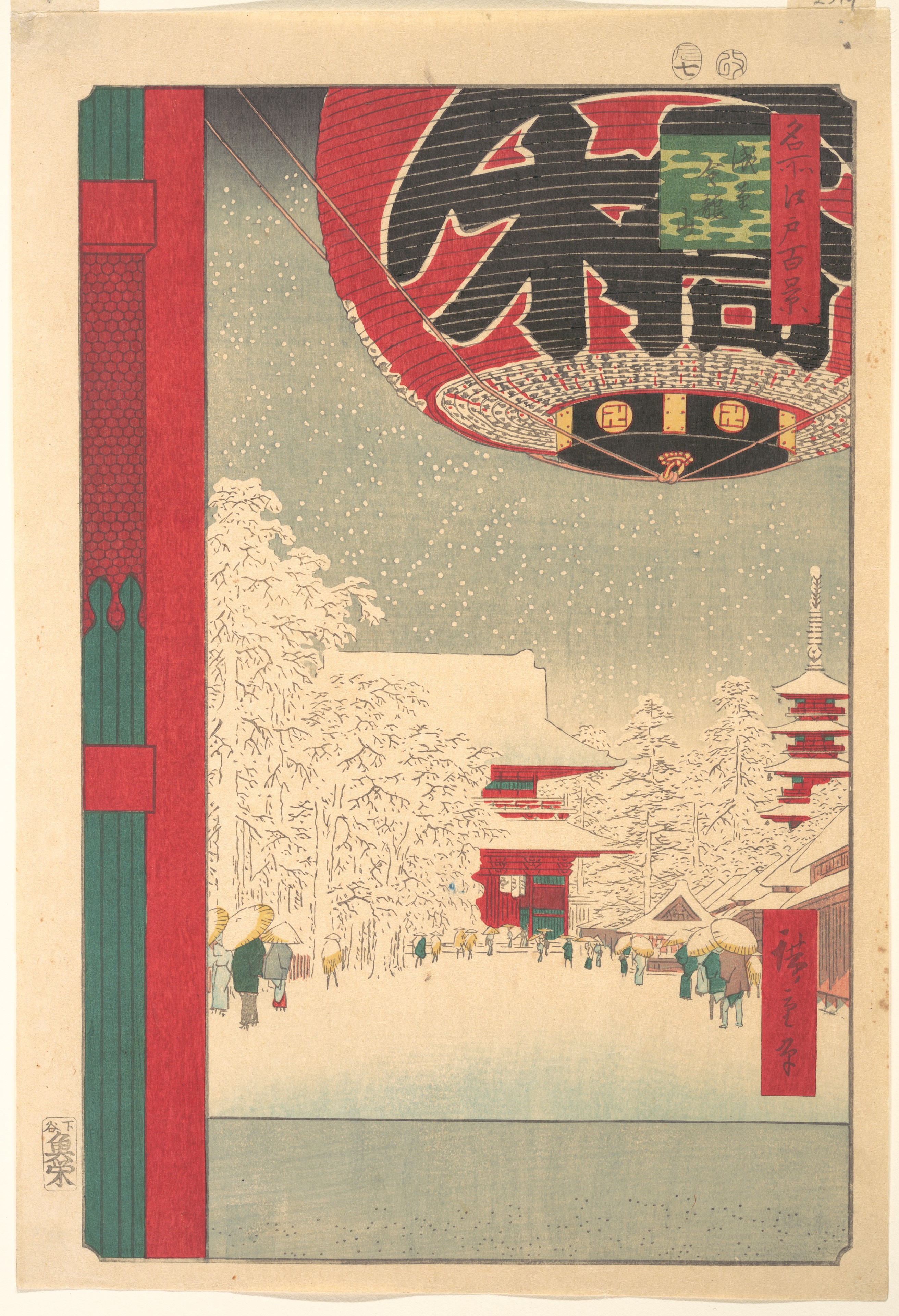
Seen from beneath the Kaminarimon gate, a giant red paper lantern hangs across the top of the print, framing the snowy approach to the Sensōji temple at Asakusa and its five-storey pagoda, while visitors with umbrellas pick their way along the white path. More about this work
About this work
Seen from beneath the Kaminarimon gate, a giant red paper lantern hangs across the top of the print, framing the snowy approach to the Sensōji temple at Asakusa and its five-storey pagoda, while visitors with umbrellas pick their way along the white path. Hiroshige’s daring framing, with the lantern cut off by the top edge, is typical of One Hundred Famous Views of Edo, the ambitious series he produced in his final years. The softly falling snow lends the busy temple district an unusual hush.
Written by Ochre Editions.
How it was made
- Colour woodblock print
- In Japan these were a team effort. The artist drew the design, a carver cut it into cherry-wood blocks, one block for each colour, and a printer brushed on the pigment and rubbed each sheet by hand. Full-colour prints of this kind were called nishiki-e, “brocade pictures”, from the 1760s on.
Utagawa Hiroshige
Japanese, 1797–1858
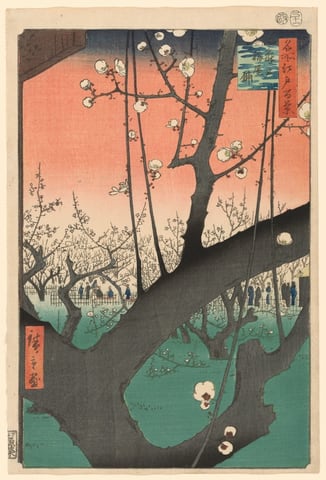
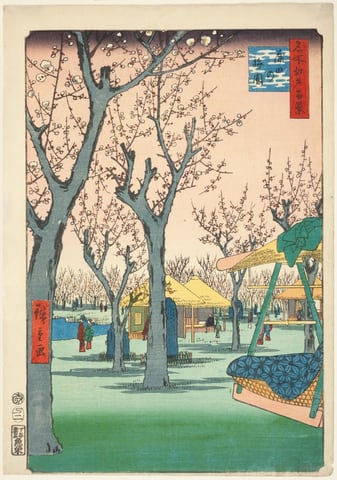
Hiroshige was born into a family of Edo fire wardens and trained under Utagawa Toyohiro. His breakthrough came in the early 1830s with The Fifty-three Stations of the Tōkaidō, scenes along the highway between Edo and Kyoto. He went on to design thousands of landscapes attentive to weather, season and the hour of day, ending with One Hundred Famous Views of Edo, still unfinished at his death. Van Gogh made a painted copy of one of its views, Plum Garden at Kameido.
Written by Ochre Editions.
Ukiyo-e
Japanese woodblock prints of the floating world: actors, courtesans, landscapes and the sea.
Rights and the museum’s record
Public domain. The Met has dedicated this image to the public domain under CC0, so anyone may copy, adapt and use it, for any purpose, without asking. Our prints and files are reproductions made from the museum’s image; the museum doesn’t endorse them.
- Object number
- JP2519
- Credit
- Courtesy of The Metropolitan Museum of Art
- Type
- Prints
- Department
- Asian Art
- Licence
- CC0 1.0 Universal
- Museum record
- See it on the museum’s site
Report this work
More by Utagawa Hiroshige
All their works
Close in colour