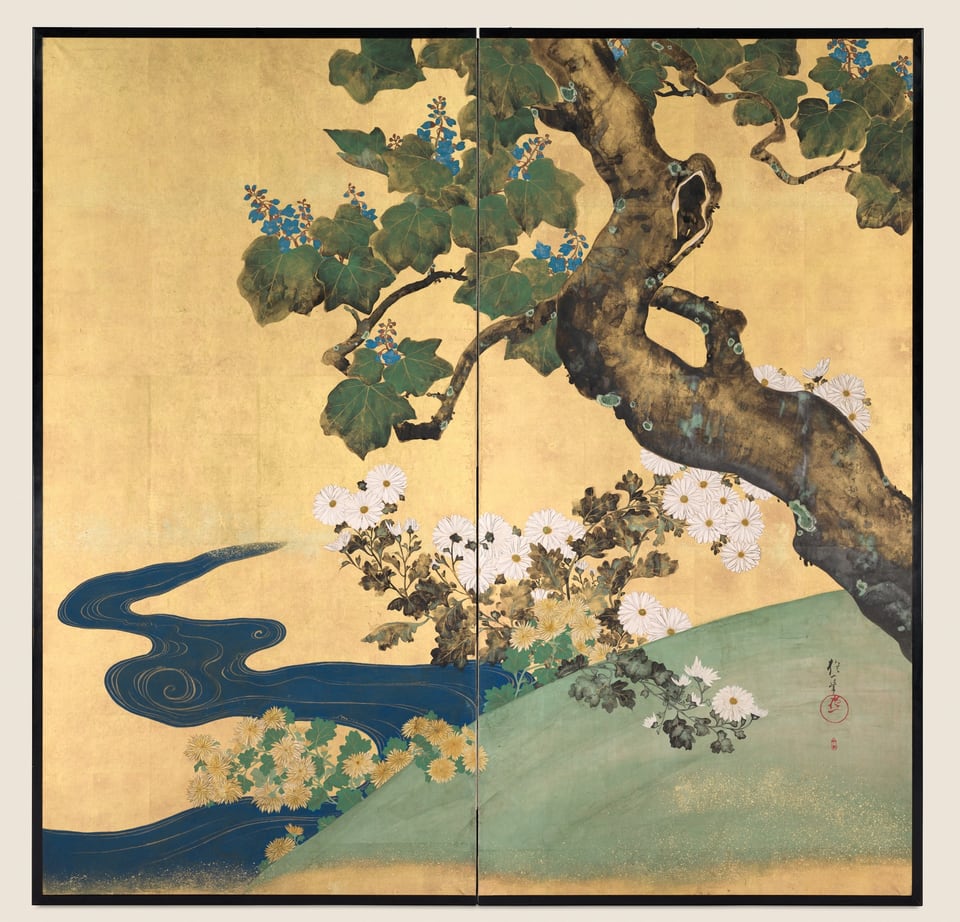
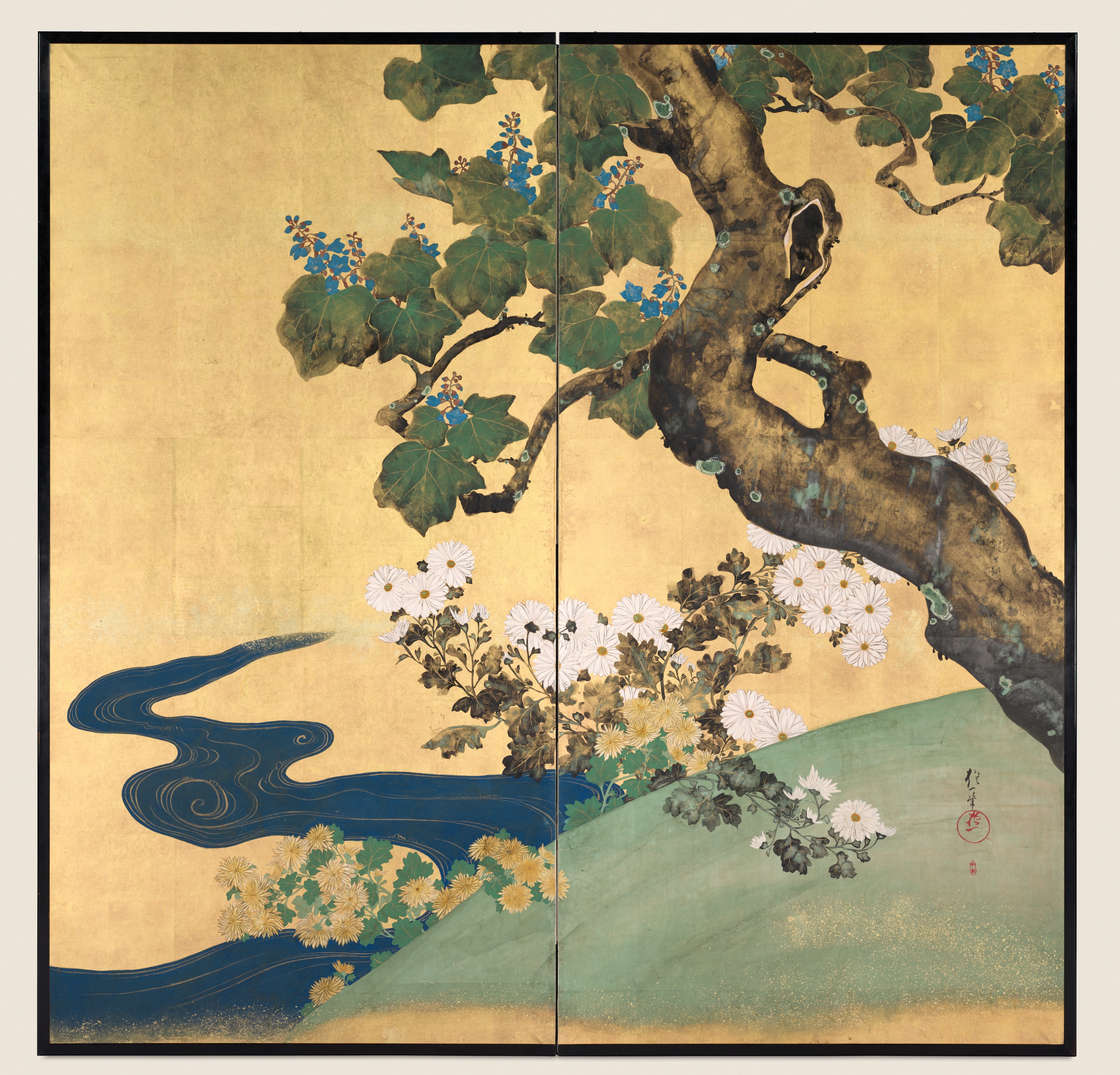
Paulownias and Chrysanthemumsearly 1800s
In this screen, Sakai Hōitsu expertly deployed a painting technique called “dripping-in” ( tarashikomi ). More about this work
About this work
In this screen, Sakai Hōitsu expertly deployed a painting technique called “dripping-in” ( tarashikomi ). Ink and color dripped on the surface, and allowed to pool there, created the illusionistic effect of lichen-dotted tree bark and twisted chrysanthemum leaves. Paulownia and chrysanthemum are signifiers of late spring and early autumn as well as emblems of the Japanese imperial house. Paulownia also has medicinal properties and associations with fortitude, while chrysanthemum symbolizes good government.
Text from the Cleveland Museum of Art.
How it was made
- Folding screen
- Panels joined by paper hinges, so the screen stands by itself in a zigzag. The picture runs across every panel, and screens were often made in pairs.
Sakai Hōitsu
Japanese, 1761–1828
Rights and the museum’s record
Public domain. The Cleveland Museum of Art has dedicated this image to the public domain under CC0, so anyone may copy, adapt and use it, for any purpose, without asking. Our prints and files are reproductions made from the museum’s image; the museum doesn’t endorse them.
- Object number
- 1964.386
- Credit
- Courtesy of the Cleveland Museum of Art
- Type
- Painting
- Department
- Japanese Art
- Licence
- CC0 1.0 Universal
- Museum record
- See it on the museum’s site
Report this work
Close in colour