George Washingtonca. 1779–81
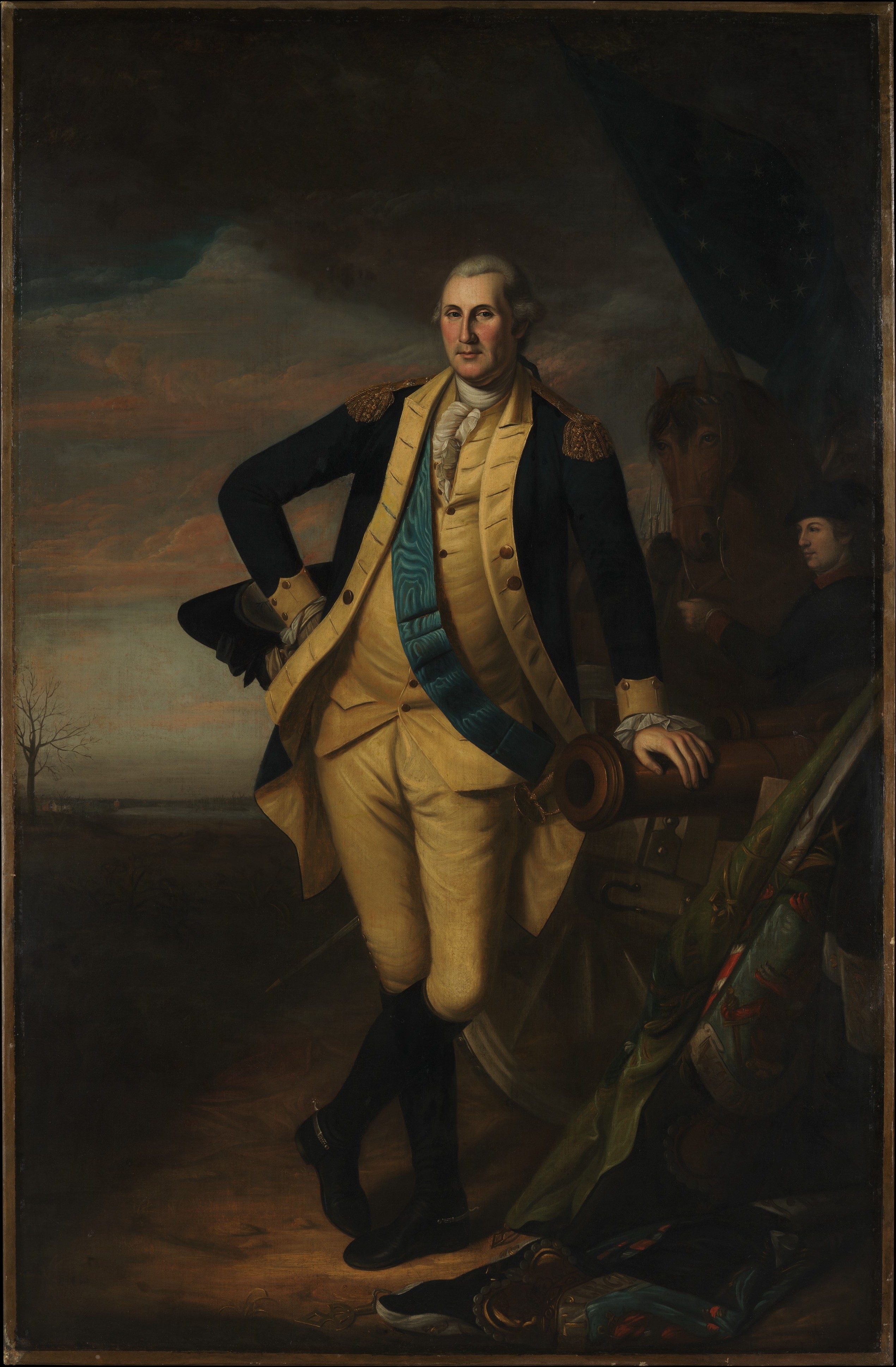
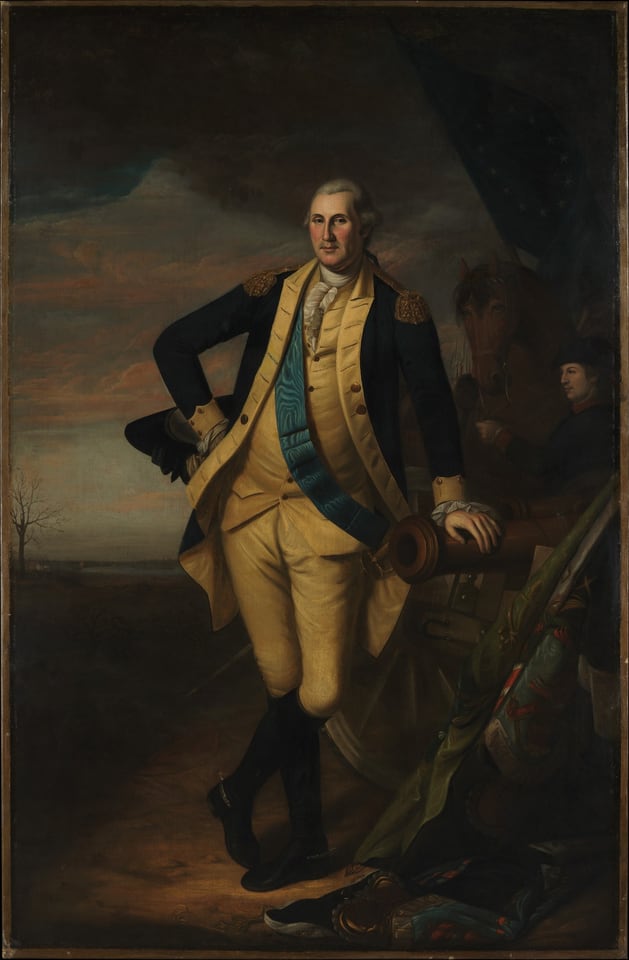
Washington stands at full length, leaning easily on a cannon, with captured enemy flags at his feet and a distant view of the battlefield. More about this work
About this work
Washington stands at full length, leaning easily on a cannon, with captured enemy flags at his feet and a distant view of the battlefield. The design celebrates his victories at Trenton and Princeton in the winter of 1776–77. Charles Willson Peale, who had fought in those campaigns with the Philadelphia militia, first painted the composition in 1779 for the Supreme Executive Council of Pennsylvania, and demand was such that he produced a number of replicas for other patrons; this canvas belongs to that group. The relaxed pose presents the commander as a gentleman-soldier, an image suited to the new republic.
Written by Ochre Editions.
How it was made
- Oil paint
- Pigment ground in a drying oil, usually linseed. It dries slowly, so painters could blend on the canvas, build up thin translucent glazes, and rework a picture over weeks. Canvas replaced wooden panels in the 1500s because it is lighter and can be rolled.
Charles Willson Peale
American, 1741–1827 · Born in Chester, Maryland; died in Philadelphia, Pennsylvania.
Peale trained as a saddler in Maryland before turning to painting, and studied in London with Benjamin West. Back in America he served in the Revolutionary War and painted George Washington from life several times, along with many leaders of the new republic. In 1786 he opened a museum in Philadelphia, showing portraits beside natural history specimens, including an excavated mastodon skeleton. He named several of his children after artists, among them Raphaelle, Rembrandt and Rubens, and several became painters.
Written by Ochre Editions.
Rights and the museum’s record
Public domain. The Met has dedicated this image to the public domain under CC0, so anyone may copy, adapt and use it, for any purpose, without asking. Our prints and files are reproductions made from the museum’s image; the museum doesn’t endorse them.
- Object number
- 97.33
- Credit
- Courtesy of The Metropolitan Museum of Art
- Type
- Painting
- Department
- The American Wing
- Licence
- CC0 1.0 Universal
- Museum record
- See it on the museum’s site