Eleazer Tyng1772
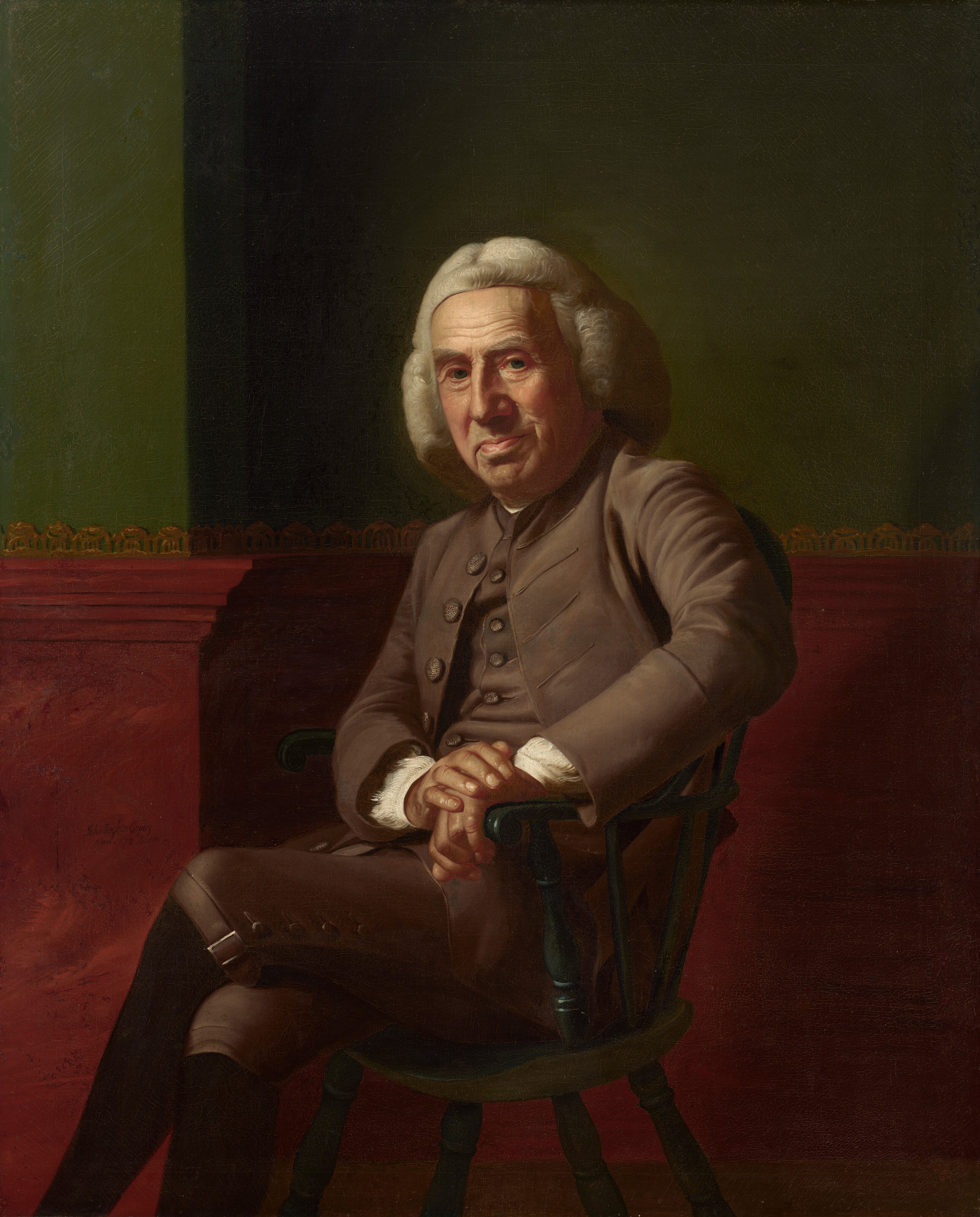
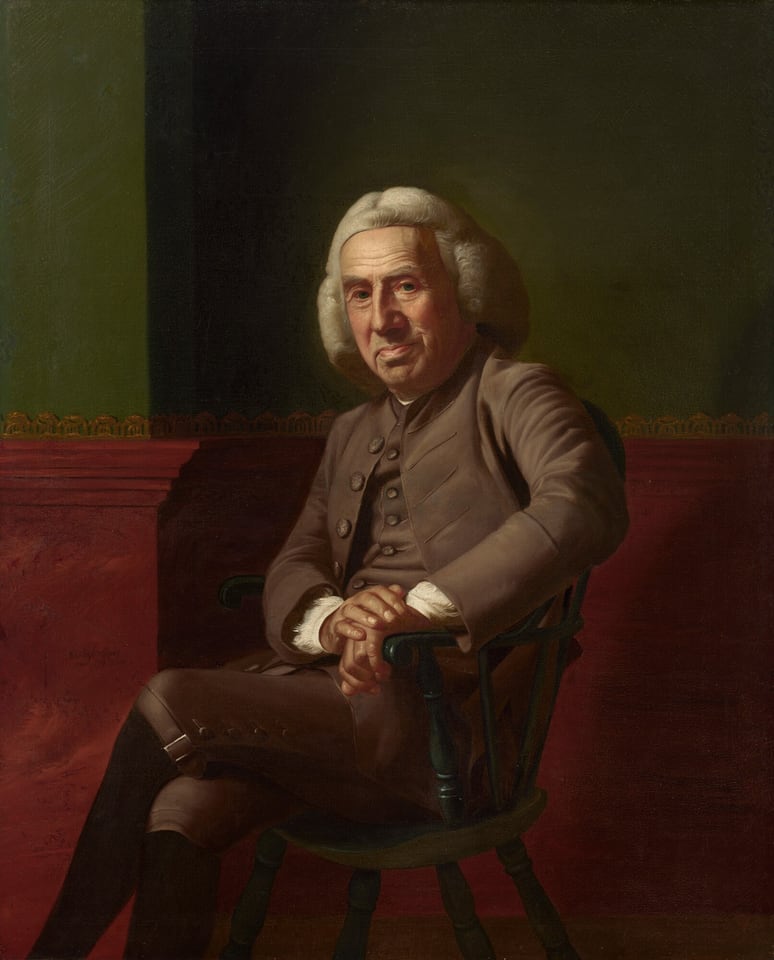
Eleazer Tyng, a prosperous Massachusetts landowner in old age, sits in a green wooden chair with his hands stacked on its arm, looking at us with heavy-lidded eyes and a hint of a wry smile. More about this work
About this work
Eleazer Tyng, a prosperous Massachusetts landowner in old age, sits in a green wooden chair with his hands stacked on its arm, looking at us with heavy-lidded eyes and a hint of a wry smile. Copley spares nothing of the lined, fleshy face, and his directness is part of the portrait’s power: this is a man of means presented without flattery. The painter signed and dated the picture as if inscribing it on the red wall beside the sitter’s knees: “John Singleton Copley pinx 1772. Boston.”
Written by Ochre Editions.
What you’re looking at
A pale-skinned, clean-shaven man with a heavily lined, paunchy face sits against a green and red wall in this vertical portrait painting. The man sits in a wooden chair painted forest green and rests both hands on the closer arm. His body and knees are angled to our left, and he turns his wide, square face to look at with heavy-lidded eyes. One brow seems slightly cocked, and he has a large nose. His lips are pulled up on one side over a round double chin. He wears a white, shoulder-length wig and a sable-brown suit. The cuffs of a white shirt are visible at his wrists where his hands are stacked on the arm of the chair. The knee-length breeches are buckled at the knee over black stockings. His legs are crossed away from us, and his feet extend off the bottom edge of the composition. The bottom half of the wall behind him is painted burgundy red up to and including a chair rail, and the wall above is moss green. The wall is lined with a gold scallop pattern along the top of the chair rail and a sliver of brown on across the bottom of the composition suggests a wood floor. The artist signed and dated the painting as if he had inscribed the red wall near the man’s knees, “John Singleton Copley pinx 1772. Boston.”
Description from the National Gallery of Art.
How it was made
- Oil paint
- Pigment ground in a drying oil, usually linseed. It dries slowly, so painters could blend on the canvas, build up thin translucent glazes, and rework a picture over weeks. Canvas replaced wooden panels in the 1500s because it is lighter and can be rolled.
John Singleton Copley
American, 1738–1815 · Born in Boston, Massachusetts; died in London.
Copley was largely self-taught and became colonial America’s finest portraitist, painting Boston merchants and their families with sharp, tactile realism, from glinting silver to polished mahogany. In 1774, on the eve of the Revolution, he left for Europe and settled in London, where he turned to large modern history paintings such as Watson and the Shark and The Death of Major Peirson. He never returned to America.
Written by Ochre Editions.
Rights and the museum’s record
Public domain. The National Gallery of Art has dedicated this image to the public domain under CC0, so anyone may copy, adapt and use it, for any purpose, without asking. Our prints and files are reproductions made from the museum’s image; the museum doesn’t endorse them.
- Object number
- 1965.6.1
- Credit
- Courtesy National Gallery of Art, Washington
- Type
- Painting
- Licence
- CC0 1.0 Universal
- Museum record
- See it on the museum’s site