Skip to content
Ochre Editions
ArtArtistsCollectionsGalleriesDrops
SearchSign inCart (0)
The galleries · Time and place

Spain

Works made in Spain, from every century in the collection.

46 works · hang 749 ·

Share Christ Carrying the Cross, in Spain

The rooms are imagined; every work on their walls is real.

Walk this roomRehang this room

Section 1, north wall

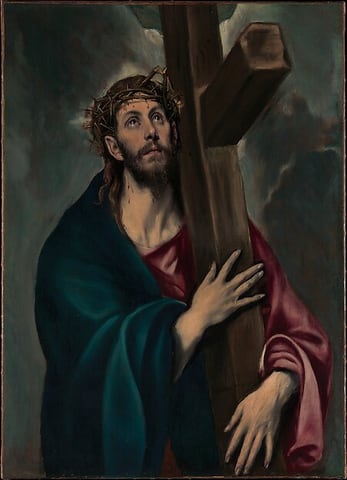
  1. Christ Carrying the Cross, by El Greco, ca. 1577–87
    Christ Carrying the CrossEl Greco, ca. 1577–87Courtesy of The Metropolitan Museum of Art
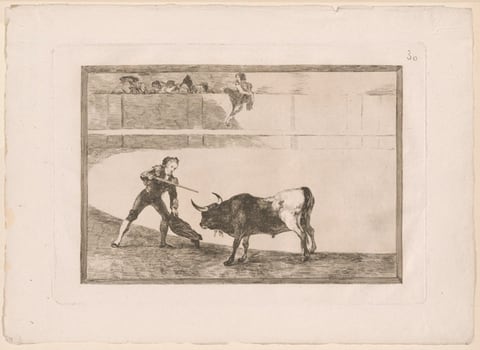
  2. A work made of etching, aquatint, drypoint and burin on ivory laid paper.
    Pedro Romero killing the halted bull, plate 30 from The Art of BullfightingFrancisco Goya, 1814/16, published 1816Courtesy of the Art Institute of Chicago
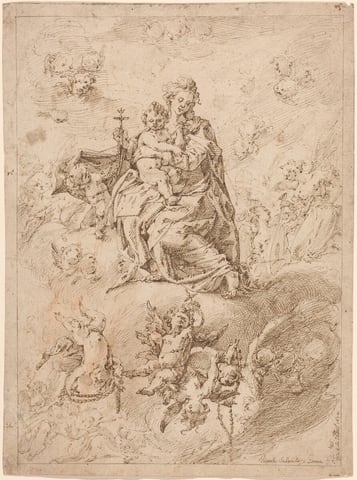
  3. The image depicts a woman seated with a child in her lap. The woman looks down at the child, who has curly hair. Both figures are intricately drawn in a detailed line drawing style. The woman wears a headdress and flowing garment, holding a cross-topped staff. The child clutches her arm. Surrounding them are cloud-like forms and cherubic figures with wings, some holding rosary beads. In the background, more clouds and angelic faces are sketched.
    The Madonna of the RosaryVicente Salvador Gómez, 1674Courtesy National Gallery of Art, Washington
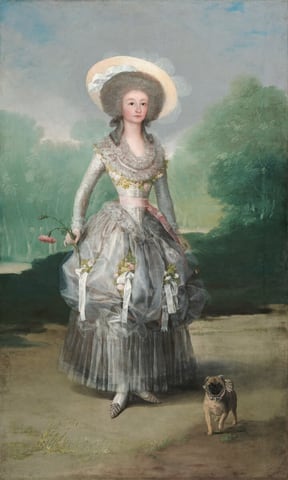
  4. A woman with pale skin, wearing a silvery-gray dress adorned with white ribbons and light pink roses, stands looking out at us with a small, pug dog by her feet in this vertical portrait painting. The woman’s body is angled slightly to our right but she looks at us with dark eyes under faint, arched brows. Her nose is rounded, her cheeks smooth and flushed, and her pale pink lips are closed. Her face is framed in a cloud of nickel-gray hair, and tendrils curl down over her shoulders. She wears a wide-brimmed straw hat with a white ribbon set on the back of her head and slightly off to one side. The bodice of her dress has a low, curving neck. This area is loosely painted to create the impression of layers of lace. A band of intertwined pale pink roses and delicate green leaves borders the outer edge of the lace. The dress has long, tight sleeves with lace at the cuffs and the notably narrow waist is tied with a blush-pink ribbon. The full, silver skirt is picked up to create a row of puffs, like the top of a muffin, around her knees. Bunches of pink roses and white ribbons are nestled into the puffs, and below, the skirt falls in long, vertical pleats to her ankles. She wears white stockings and pointed, petal-pink shoes. In her left arm, on our right, she holds a closed fan loosely at her side, almost lost behind the skirt. She holds a pink carnation with a full bloom and a bud on a long, curving stem in her other hand, by her hip. A caramel-brown pug with a black face, wearing a pink collar lined with three bells, stands facing us with one front paw lifted, to our right of the woman's feet. The landscape is painted in tones of mint and sage green for grass beneath trees enclosing the space the woman stands in, sand brown for the ground, and icy blue for the sky above.
    The Marquesa de PontejosFrancisco Goya, c. 1786Courtesy National Gallery of Art, Washington

Section 1, south wall
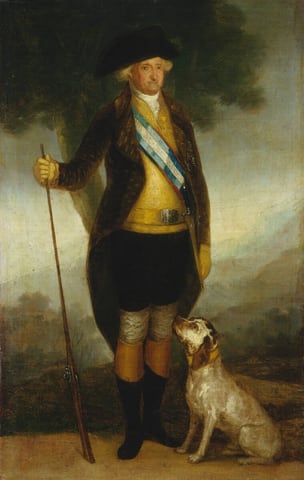
  1. This painting shows a man standing upright, his body slightly turned to the right. He has pale skin and curled white hair under a large black hat, and he wears a long brown jacket over a yellow vest with a white ruffled neck and a wide blue-and-white striped sash over his torso. His pants are black, and he wears tall black boots with brown tops. His hands are covered by yellow gloves, and he is holding a tall, thin rifle on the left, its bottom on the ground. Next to him on the right is a white dog with brown spots and large brown ears. The dog is sitting, looking up at the man. The background features an outdoor setting, with a landscape of hazy hills in shades of pale green and blue below a white and gray sky. There is a tall, dark green tree behind the man, and the ground he stands on is brown.
    Charles IV of Spain as HuntsmanUnrecorded Spanish maker, c. 1799/1800Courtesy National Gallery of Art, Washington
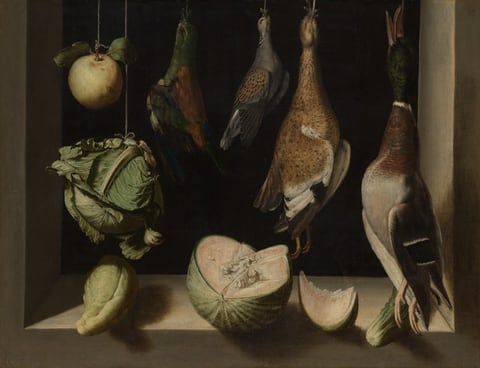
  2. Still life painting of dead waterfowl and vegetables in windowsill.
    Still Life with Game FowlJuan Sánchez Cotán, c. 1600–3Courtesy of the Art Institute of Chicago
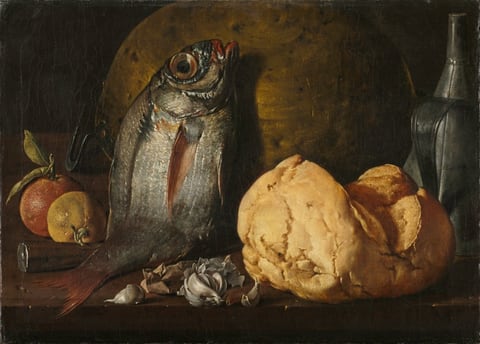
  3. Still Life with Fish, Bread, and Kettle, by Luis Meléndez, c. 1772
    Still Life with Fish, Bread, and KettleLuis Meléndez, c. 1772Courtesy of the Cleveland Museum of Art

Section 2, south wall
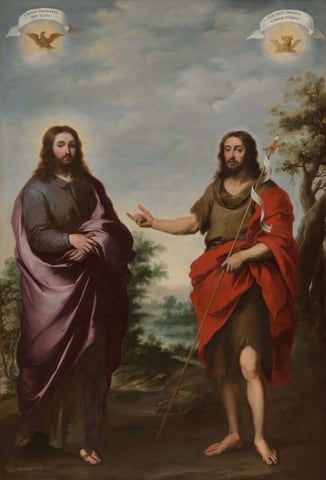
  1. A work made of oil on canvas.
    Ecce Agnus DeiBartolomé Esteban Murillo, c. 1655Courtesy of the Art Institute of Chicago
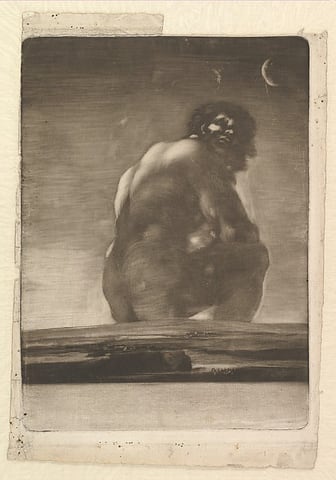
  2. Seated Giant, by Francisco Goya, by 1818 (possibly 1814–18)
    Seated GiantFrancisco Goya, by 1818 (possibly 1814–18)Courtesy of The Metropolitan Museum of Art
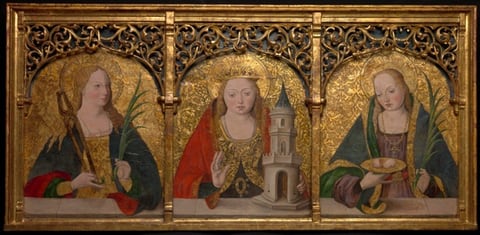
  3. A work made of tempera on panel.
    Saints Apollonia, Barbara, and AgathaMaster Alejo (Alejo Andía?), 1490–1500Courtesy of the Art Institute of Chicago

Section 2, north wall
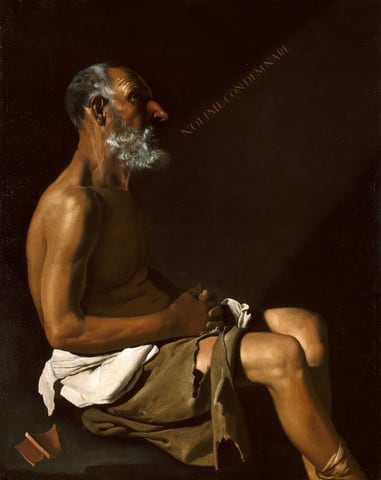
  1. A work made of oil on canvas.
    JobSpanish, c. 1618–c. 1630Courtesy of the Art Institute of Chicago
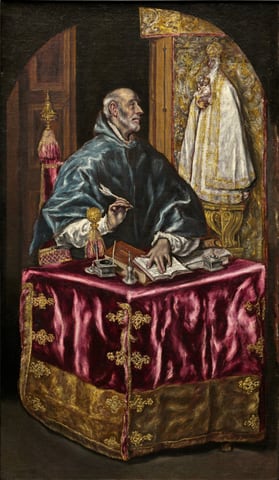
  2. A light-skinned man wearing a voluminous, ocean-blue, hooded robe sits at a cloth-draped writing table and looks up, fingers splayed over an open book and a pen held in his other hand, in this vertical painting. The man and desk take up most of the composition, which has an arched top. The man’s shoulders and body are angled to our right, and he looks off in that direction in profile. His balding head is rimmed with white hair curving over the large ear we can see, and he has a trimmed white and gray beard and mustache. His prominent nose is pointed, and his lips are closed. Light glints off the robe he wears so it shimmers in shades of topaz, aquamarine, and midnight blue. Voluminous white sleeves emerge under the mantle and are edged with narrow lace cuffs. His left hand, to our right, rests on an open book, which is propped against one or two other tomes. Near the edge of the table, two quills stand in the corners of a lidded inkwell, and a round, silver blotter, shaped like an upside-down chalice, and a lidded silver box sit nearby. The man’s chair has a tall post next to his shoulder to our left with a teardrop-shaped, gold finial. A second post, near his wrist, is lower and topped with a gold orb. The chair is draped in the same deep, raspberry-pink of the square table at which he sits. The tablecloth is edged with a wide band of gold along the bottom, and filigree-like gold decorations line the seams or folds at the corners. Brushstrokes are visible in many areas, especially in the colorfully charged blue and pink fabric. Beyond the man, to our right, a statuette of a person wearing a long, white robe over a white dress holds a baby. The clothing is edged with gold, and she wears a sphere-like gold crown. The baby also wears white and holds up one hand. The statuette stands on a platform supported by S-shaped corbels, and could have a projecting, squared awning over the top. This area is more loosely painted so some details are difficult to make out. In the background to our left, a wooden door stands open next to a dark space just behind the man’s head, so his profile is picked out against the shadow. The floor beneath is earth brown.
    Saint IldefonsoEl Greco, c. 1603/1614Courtesy National Gallery of Art, Washington
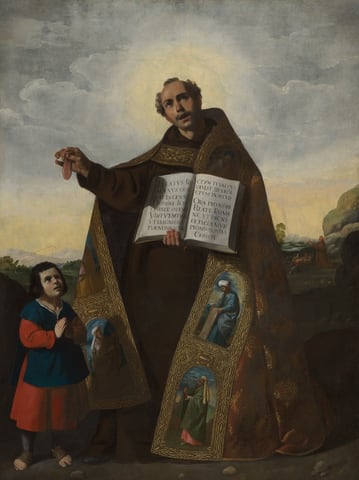
  3. A work made of oil on canvas.
    Saint Romanus of Antioch and Saint BarulasFrancisco de Zurbarán, 1638Courtesy of the Art Institute of Chicago

Section 3, north wall
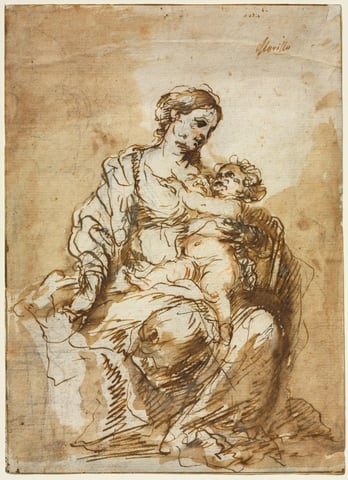
  1. Madonna Nursing the Christ Child, by Bartolomé Esteban Murillo, c. 1670–72
    Madonna Nursing the Christ ChildBartolomé Esteban Murillo, c. 1670–72Courtesy of the Cleveland Museum of Art
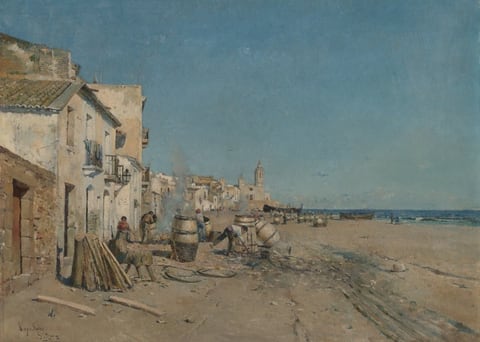
  2. A work made of oil on masonite.
    SitgesJuan Roig y Soler, 19th centuryCourtesy of the Art Institute of Chicago
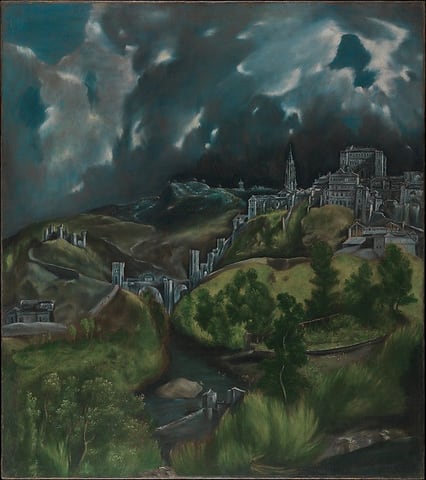
  3. View of Toledo, by El Greco, ca. 1599–1600
    View of ToledoEl Greco, ca. 1599–1600Courtesy of The Metropolitan Museum of Art

Walk on

  • Spain, room 2
  • More by El Greco 7 works
  • More Spanish Golden Age 21 works
Ochre Editions

The world's museums, on your wall. Every work here is a reproduction of a public-domain original, credited to the museum that holds it.

Shop

All artCollectionsLimited dropsPrints and framing

Help

Find an orderShippingReturnsVerify a certificate

About

About Ochre EditionsMuseum creditsFor agentsDevelopers

Legal

Terms of UseTerms of SaleLimited Editions and CertificatesPrivacy PolicyCookie PolicyAcceptable Use PolicyAgent & API TermsCopyright and DMCA PolicyPrinting Your Own PhotoVulnerability Disclosure PolicyAccessibility StatementOpen-Access Credits
© 2026 Ochre EditionsPrices in US dollars. Prints ship within the United States.