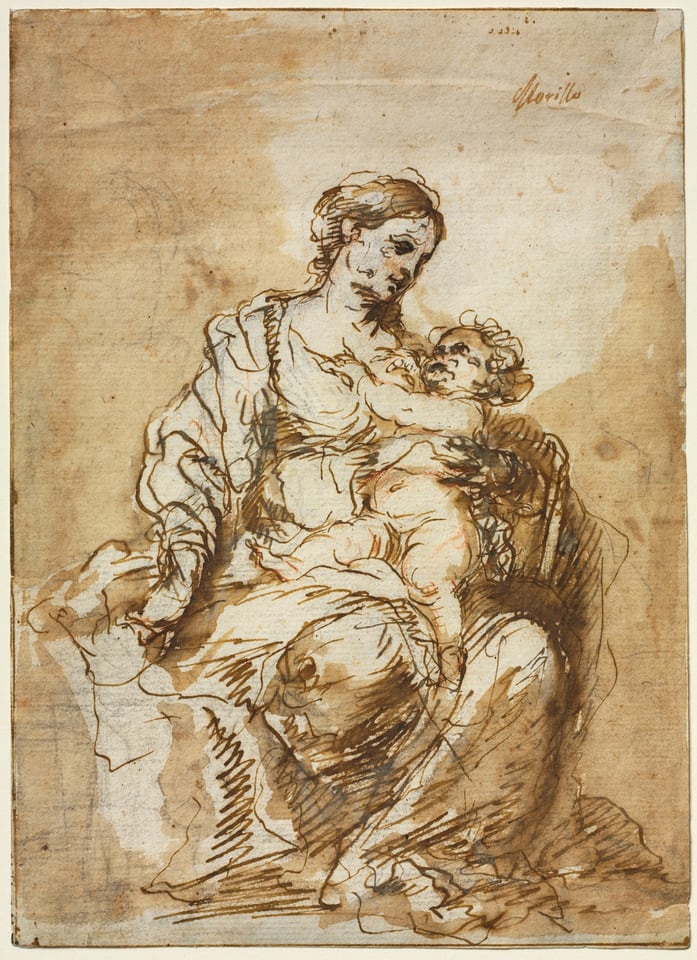
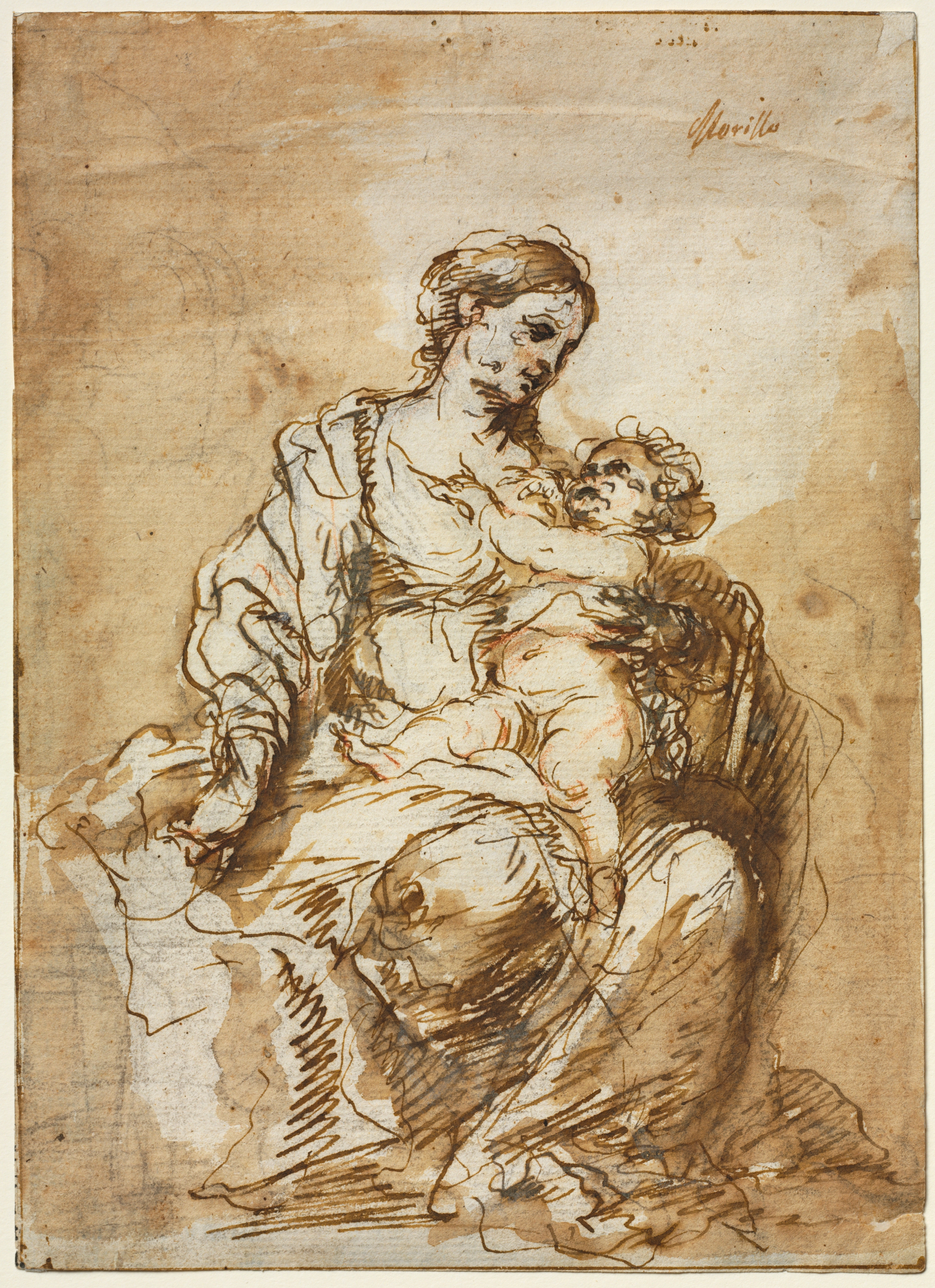
Madonna Nursing the Christ Childc. 1670–72
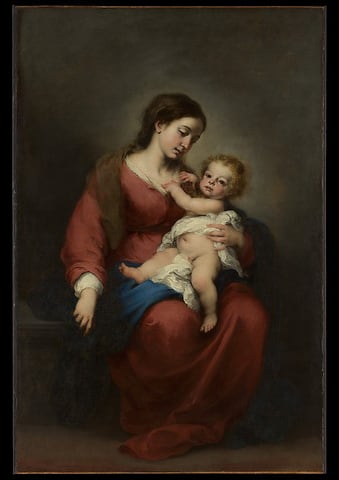
One of the finest of the rare drawings by Murillo, this sheet is a study for Virgin and Child , commissioned for the family chapel of the Marques de Santiago in Madrid and now at the Metropolitan Museum of Art, New York. More about this work
About this work
One of the finest of the rare drawings by Murillo, this sheet is a study for Virgin and Child , commissioned for the family chapel of the Marques de Santiago in Madrid and now at the Metropolitan Museum of Art, New York. Prized today for their dynamism, Murillo’s drawings served the practical purpose of working out the positions of the figures. Here, the artist suggested the tender bond between mother and child with the poignant connection of their gazes. His animated line and zigzag hatching create the feeling of incessant motion while the addition of ink wash creates deep shadows across the forms.
Text from the Cleveland Museum of Art.
How it was made
- Chalk
- Natural black, red and white chalks. Used together on toned paper they could give the warmth of flesh with very little effort, and they were favourites for studies from life.
- Pen and ink
- Drawn with a quill or reed pen, often with wash added by brush to model light and shadow.
Bartolomé Esteban Murillo
Spanish, 1617–1682 · Born and died in Seville.
Murillo spent nearly all his life in Seville, where he became the city’s leading painter after Zurbarán. His tender religious scenes, especially his many Immaculate Conceptions, and his warm, softly lit pictures of street children made him one of the most popular Spanish painters in Europe in later centuries. In 1660 he helped found an academy of drawing in Seville. He died after a fall from scaffolding while painting an altarpiece in Cádiz.
Written by Ochre Editions.
Rights and the museum’s record
Public domain. The Cleveland Museum of Art has dedicated this image to the public domain under CC0, so anyone may copy, adapt and use it, for any purpose, without asking. Our prints and files are reproductions made from the museum’s image; the museum doesn’t endorse them.
- Object number
- 1968.66
- Credit
- Courtesy of the Cleveland Museum of Art
- Type
- Drawing
- Department
- Drawings
- Licence
- CC0 1.0 Universal
- Museum record
- See it on the museum’s site
Report this work
More by Bartolomé Esteban Murillo
All their works
Close in colour