Skip to content
Ochre Editions
ArtArtistsCollectionsGalleriesDrops
SearchSign inCart (0)
The galleries · Time and place

Germany

Works made in Germany, from every century in the collection.

70 works · hang 7523 ·

Share Marcus Curtius Plunging into the Chasm, in Germany

The rooms are imagined; every work on their walls is real.

Walk this roomRehang this room

First room, north wall

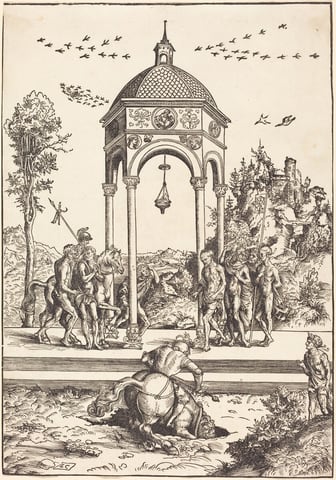
  1. This print features a detailed scene. In the center is a classical-style pavilion with arched openings and a domed roof adorned with intricate designs. A group of mostly-nude people is gathered around the pavilion, with one on horseback, holding a spear, and another holding a flag. In front of the pavilion, a knight on horseback appears to be falling into a dark hole in the ground. Vegetation, including trees and shrubs, is scattered throughout the landscape, and birds are seen flying in the sky above the pavilion. The horizon shows hills leading to a distant castle on a rocky formation on the right.
    Marcus Curtius Plunging into the ChasmLucas Cranach the ElderCourtesy National Gallery of Art, Washington
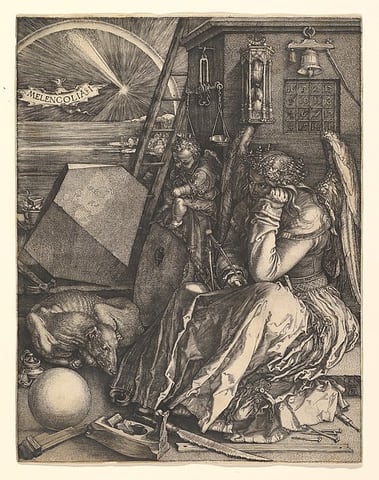
  2. Melencolia I, by Albrecht Dürer, 1514
    Melencolia IAlbrecht Dürer, 1514Courtesy of The Metropolitan Museum of Art
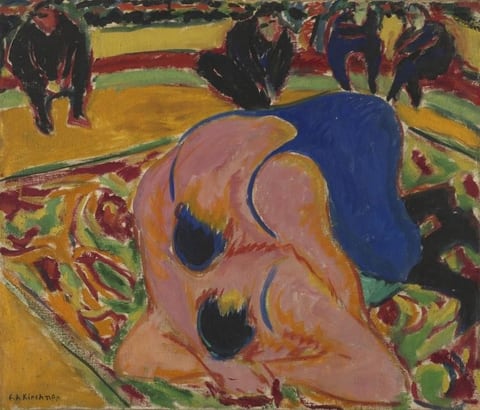
  3. Wrestlers in a Circus, by Ernst Ludwig Kirchner, 1909
    Wrestlers in a CircusErnst Ludwig Kirchner, 1909Courtesy of the Cleveland Museum of Art
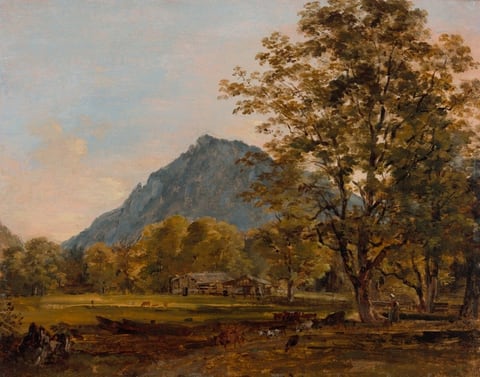
  4. A work made of oil on paper, laid onto cardboard.
    A Farmhouse in the Bavarian AlpsJohann Georg von Dillis, c. 1825Courtesy of the Art Institute of Chicago

First room, south wall
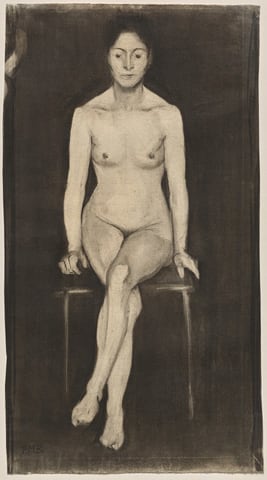
  1. Seated Female Nude (Self-Portrait?), by Paula Modersohn-Becker, c. 1899
    Seated Female Nude (Self-Portrait?)Paula Modersohn-Becker, c. 1899Courtesy of the Cleveland Museum of Art
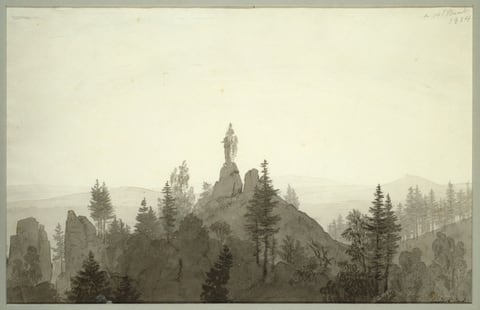
  2. Black ink drawing of forested landscape, statue of woman holding child at pinnacle of mountain.
    Statue of the Madonna in the MountainsCaspar David Friedrich, 1804Courtesy of the Art Institute of Chicago
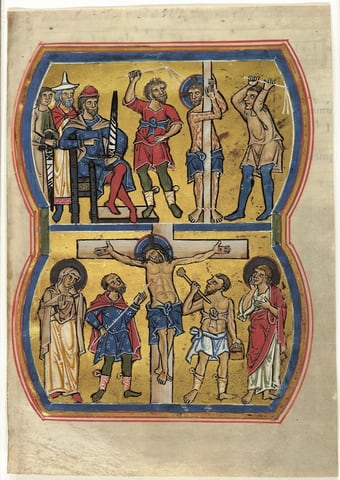
  3. A work made of opaque watercolor, gold leaf, and shell gold, with pen and red and white ink (recto), and pen and red and black ink (verso), on parchment.
    The Flagellation and The Crucifixion, from a PsalterGerman, about 1239Courtesy of the Art Institute of Chicago

Second room, south wall
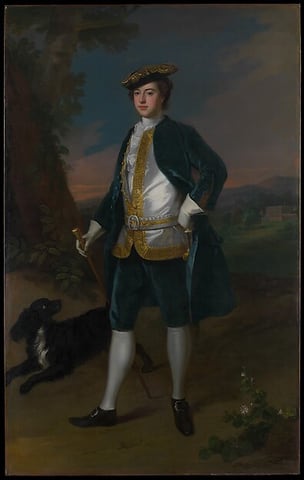
  1. Sir James Dashwood (1715–1779), by Enoch Seeman the Younger, 1737
    Sir James Dashwood (1715–1779)Enoch Seeman the Younger, 1737Courtesy of The Metropolitan Museum of Art
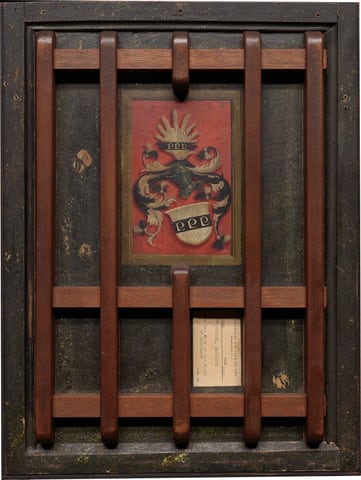
  2. The image shows a pattern of vertical and horizontal wooden bars forming a grid-like design. In the center, there is a rectangular panel with a decorative emblem against a red background. The emblem features swirling shapes. The structured wooden grid and ornate emblem suggest a vintage heraldic shield or coat of arms.
    Margarethe Vöhlin [reverse]Bernhard Strigel, 1527Courtesy National Gallery of Art, Washington
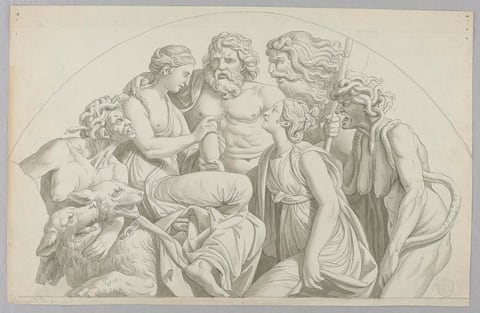
  3. PSYCHE ASKS PROSERPINE TO PUT A LITTLE OF HER BEAUTY IN AN URN FOR VENUS
    Psyche Asks Proserpine to Put a Little of her Beauty in an Urn for VenusJohann August Nahl The Younger, ca. 1781Courtesy of Cooper Hewitt, Smithsonian Design Museum

Second room, north wall
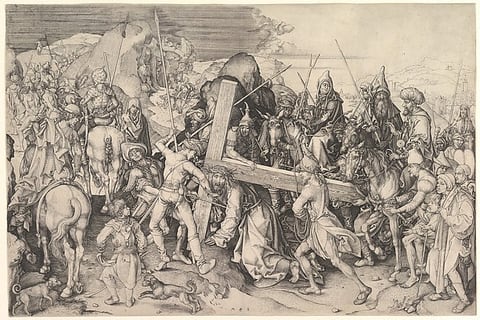
  1. Christ Carrying the Cross, by Martin Schongauer, ca. 1475–80
    Christ Carrying the CrossMartin Schongauer, ca. 1475–80Courtesy of The Metropolitan Museum of Art
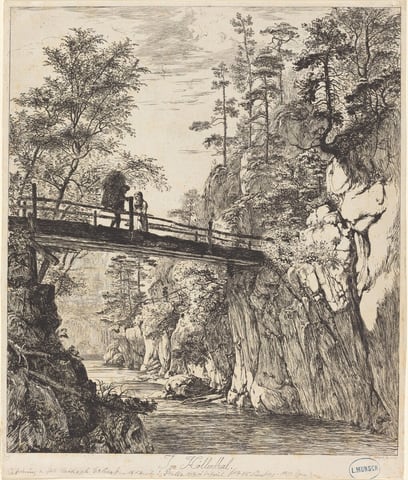
  2. The image shows a landscape with a wooden bridge crossing over a river in a valley. The scenery includes cliffs, trees, and flowing water below. The artwork features fine, detailed brushstrokes depicting the texture of the cliffs, foliage, and water. The color scheme is monochromatic with various shades of gray and sepia tones. Two figures are seen on the bridge, contributing to the sense of scale and activity in the serene setting.
    Im Höllenthal (In the Höllen Valley)Johann Christoph Erhard, 1818Courtesy National Gallery of Art, Washington
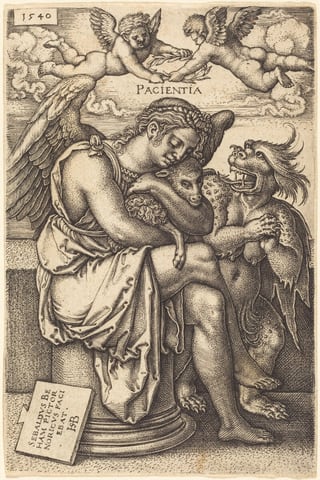
  3. This is a drawing of a winged figure with a sheep, accompanied by a mythical creature and cherubs. The central figure is holding the sheep tenderly. On the left, two cherubs are flying with a laurel branch, under the word "PACIENTIA." On the right is a mythical creature with dragon-like features. Below the scene, a plaque with an inscription is placed against the pedestal. The artwork is detailed with lines, cross-hatching, and shading, accentuating textures and forms.
    Pacientia (Patience)Sebald Beham, 1540Courtesy National Gallery of Art, Washington
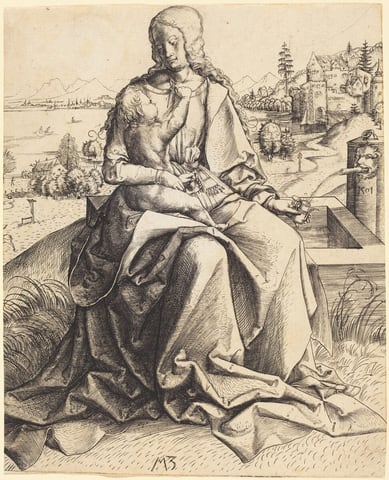
  4. The image shows a woman sitting with a child on her lap. The woman has a gentle expression and long hair, wearing a flowing robe. The child is facing her, reaching up with one hand. In the background are trees, hills, a building, and a fountain with a lion's head spouting water into a basin. The illustration is detailed, capturing textures and elements in the scene.
    Madonna and Child at a FountainMaster MZ, 1501Courtesy National Gallery of Art, Washington

Third room, north wall
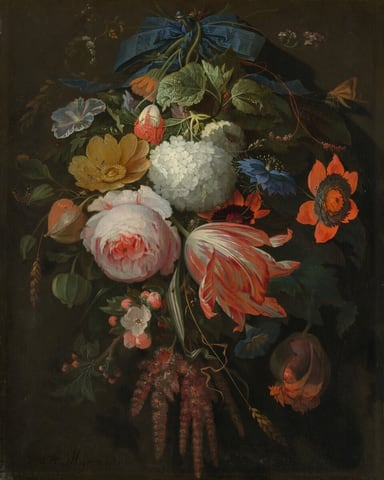
  1. A bouquet of flowers against a dark brown background hangs from a sapphire-blue bow to fill this vertical still life painting. The three largest blooms make a pyramid at the center. A pale pink, flat-leaved carnation is to the lower right of this trio. A red and white striped tulip with flame-shaped petals is next to it, to our right, and a white viburnum bloom, which is made of dozens of smaller clusters, is above. A tan-colored spider builds a web at the center of these three blossoms. Using the face of a clock to work around this trio, we find a spotted bug on a smaller viburnum and some frosty green leaves at noon. A muted orange moth rests on a stalk nearby. Down the right side, the layered vivid blue petals of a love-in-the-mist explode like a starburst. Two coral-red peonies, a mostly closed peony, a topaz-blue morning glory, and the fuzzy fingers of amaranth bring us to six o’clock. Up the left side are delicate pink crab apple blossoms, a spray of Chinese lanterns, a yellow rose with ants crawling across its splayed petals, a striped morning glory, and a few blue, orange, and red buds. A caterpillar rears up on a Chinese lantern bud and a ladybug sits on a leaf nearby. A few stalks of wheat are scattered throughout. Stems weave through the blue ribbon at the top, which is tied around a protruding nail. The artist signed the lower left corner, “AB Mignon f,” with the AB conjoined in a monogram.
    A Hanging Bouquet of FlowersAbraham Mignon, probably 1665/1670Courtesy National Gallery of Art, Washington
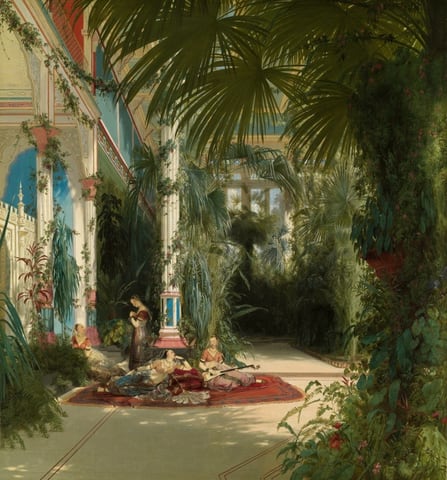
  2. Four women with musical instruments lounge in a massive garden courtyard.
    The Interior of the Palm House on the Pfaueninsel Near PotsdamCarl Blechen, 1834Courtesy of the Art Institute of Chicago

Walk on

  • Germany, room 2
  • Carl Blechen's contemporaries 8 works
  • More Romanticism 32 works
Ochre Editions

The world's museums, on your wall. Every work here is a reproduction of a public-domain original, credited to the museum that holds it.

Shop

All artCollectionsLimited dropsPrints and framing

Help

Find an orderShippingReturnsVerify a certificate

About

About Ochre EditionsMuseum creditsFor agentsDevelopers

Legal

Terms of UseTerms of SaleLimited Editions and CertificatesPrivacy PolicyCookie PolicyAcceptable Use PolicyAgent & API TermsCopyright and DMCA PolicyPrinting Your Own PhotoVulnerability Disclosure PolicyAccessibility StatementOpen-Access Credits
© 2026 Ochre EditionsPrices in US dollars. Prints ship within the United States.