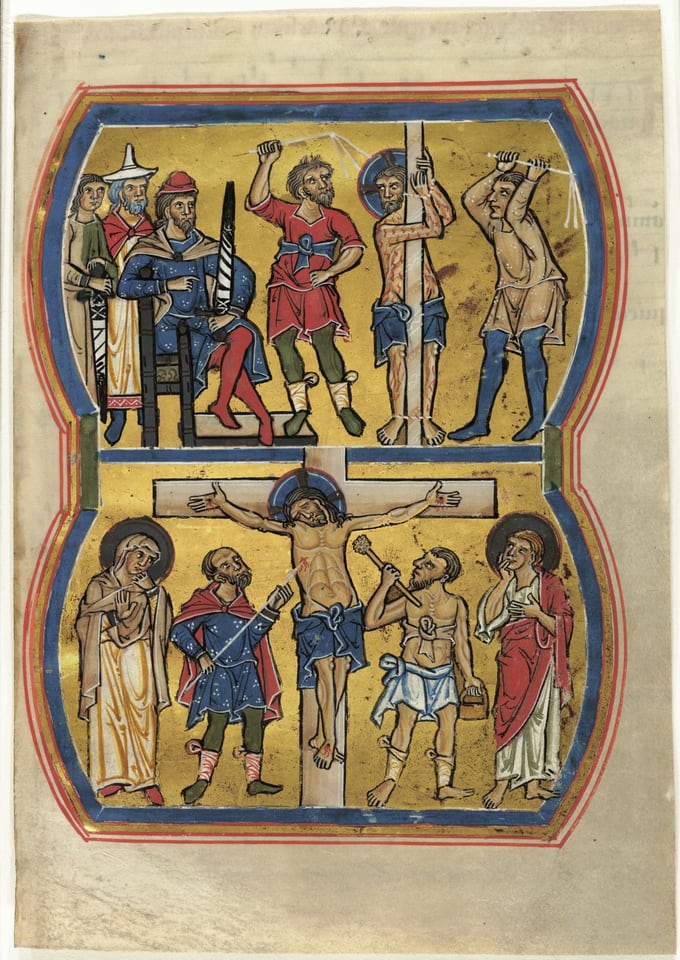
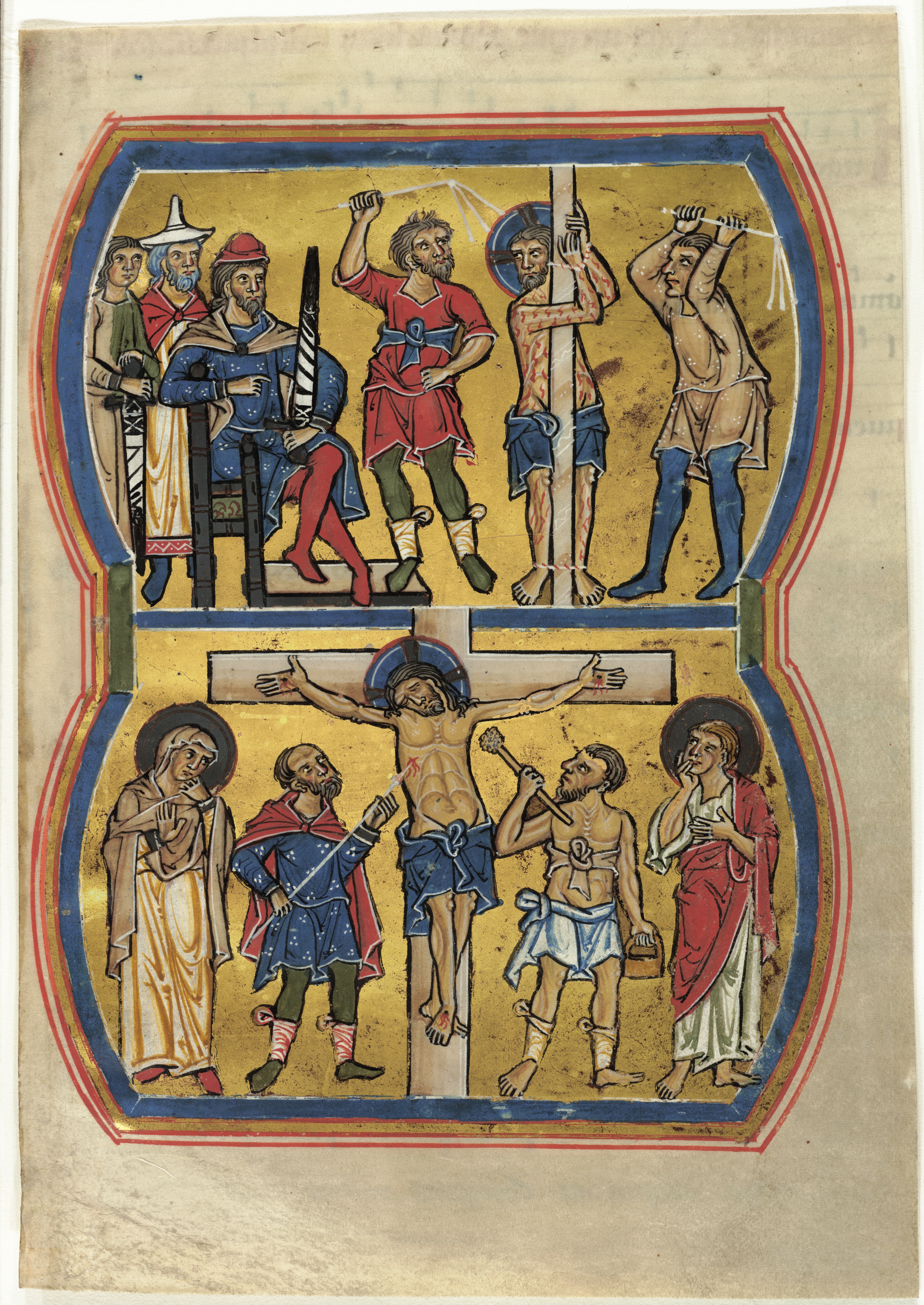
The Flagellation and The Crucifixion, from a Psalterabout 1239
German painted this in about 1239. It is now at the Art Institute of Chicago. More about this work
About this work
A work made of opaque watercolor, gold leaf, and shell gold, with pen and red and white ink (recto), and pen and red and black ink (verso), on parchment.
Description from the Art Institute of Chicago.
German painted this in about 1239. It is now at the Art Institute of Chicago.
How it was made
- Opaque watercolour
- Watercolour made opaque with white or chalk and laid in flat, even layers. Persian and Indian painters ground their colours from minerals, applied them with the finest brushes and burnished the finished page.
- Gold ground
- Gold leaf laid over a red clay and burnished to a mirror shine, often tooled with punches so it flickers in candlelight. Behind sacred figures it stands for heavenly light.
- Watercolour
- Pigment in gum arabic, thinned with water and laid in transparent washes. Nothing white is painted: the light is the paper showing through.
German
Braunschweig, Lower Saxony
Rights and the museum’s record
Public domain. The Art Institute of Chicago has dedicated this image to the public domain under CC0, so anyone may copy, adapt and use it, for any purpose, without asking. Our prints and files are reproductions made from the museum’s image; the museum doesn’t endorse them.
- Object number
- 1924.671
- Credit
- Courtesy of the Art Institute of Chicago
- Type
- Drawing and Watercolor
- Department
- Prints and Drawings
- Licence
- CC0 1.0 Universal
- Museum record
- See it on the museum’s site
Report this work
Close in colour