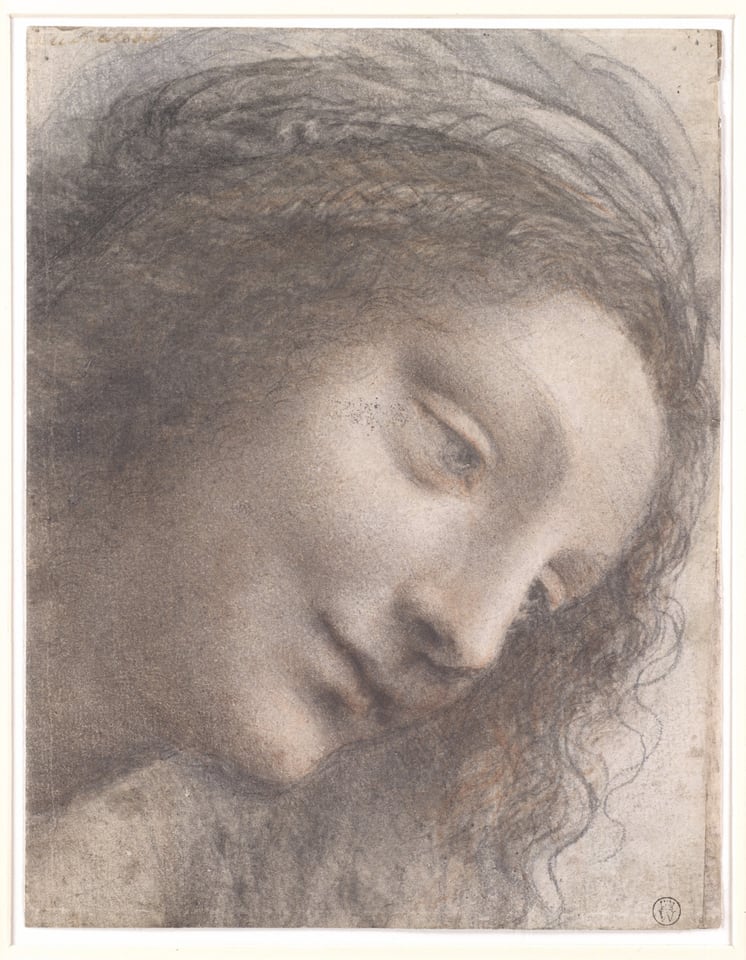
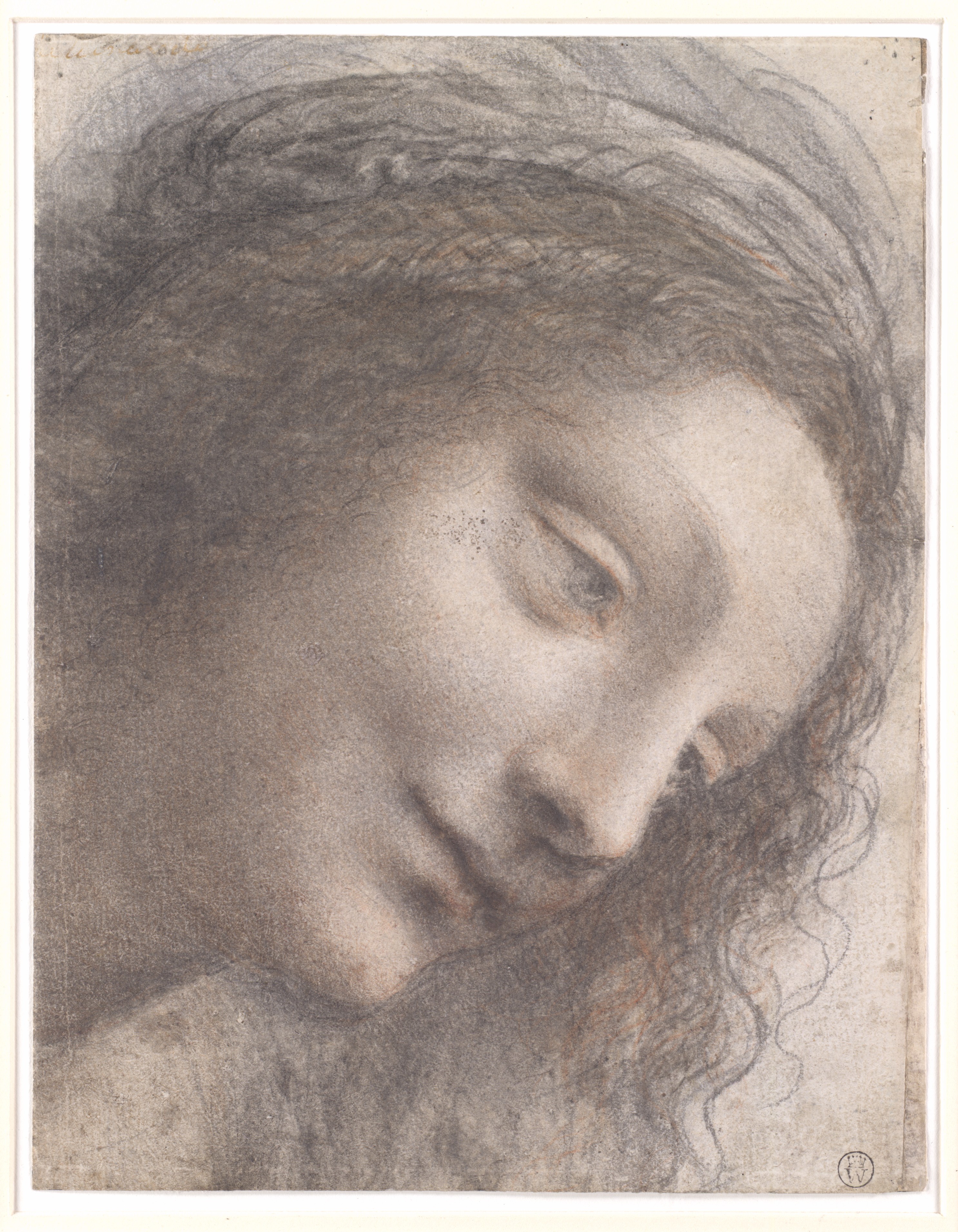
The Head of the Virgin in Three-Quarter View Facing Right1510–13
The Virgin’s head is turned in three-quarter view and tilted downward, her eyes lowered and a faint smile on her lips, modelled in black and red chalk and charcoal with a softness that seems to dissolve the contours into shadow. More about this work
About this work
The Virgin’s head is turned in three-quarter view and tilted downward, her eyes lowered and a faint smile on her lips, modelled in black and red chalk and charcoal with a softness that seems to dissolve the contours into shadow. Leonardo made this study around 1510–13 for the Virgin in his painting The Virgin and Child with Saint Anne, now in the Louvre. It is a supreme example of sfumato, his technique of soft transitions between light and dark, which gives the face its gentle, breathing presence.
Written by Ochre Editions.
How it was made
- Chalk
- Natural black, red and white chalks. Used together on toned paper they could give the warmth of flesh with very little effort, and they were favourites for studies from life.
- Charcoal
- Burnt willow or vine. It smudges and wipes away easily, which made it the natural tool for working out a composition.
- Pen and ink
- Drawn with a quill or reed pen, often with wash added by brush to model light and shadow.
Leonardo da Vinci
Italian, 1452–1519 · Born in Vinci; died in Amboise.
Leonardo trained in Florence in the studio of Andrea del Verrocchio and spent much of his career in Milan in the service of Ludovico Sforza, where he painted The Last Supper. Painter, engineer, anatomist and student of nature, he left relatively few finished paintings, among them the Mona Lisa, but thousands of notebook pages and drawings on every subject. His soft modelling of light and shade, called sfumato, transformed painting. He died in France at Amboise, a guest of Francis I.
Written by Ochre Editions.
Rights and the museum’s record
Public domain. The Met has dedicated this image to the public domain under CC0, so anyone may copy, adapt and use it, for any purpose, without asking. Our prints and files are reproductions made from the museum’s image; the museum doesn’t endorse them.
- Object number
- 51.90
- Credit
- Courtesy of The Metropolitan Museum of Art
- Type
- Drawings
- Department
- Drawings and Prints
- Licence
- CC0 1.0 Universal
- Museum record
- See it on the museum’s site
Report this work
More by Leonardo da Vinci
All their works
Close in colour