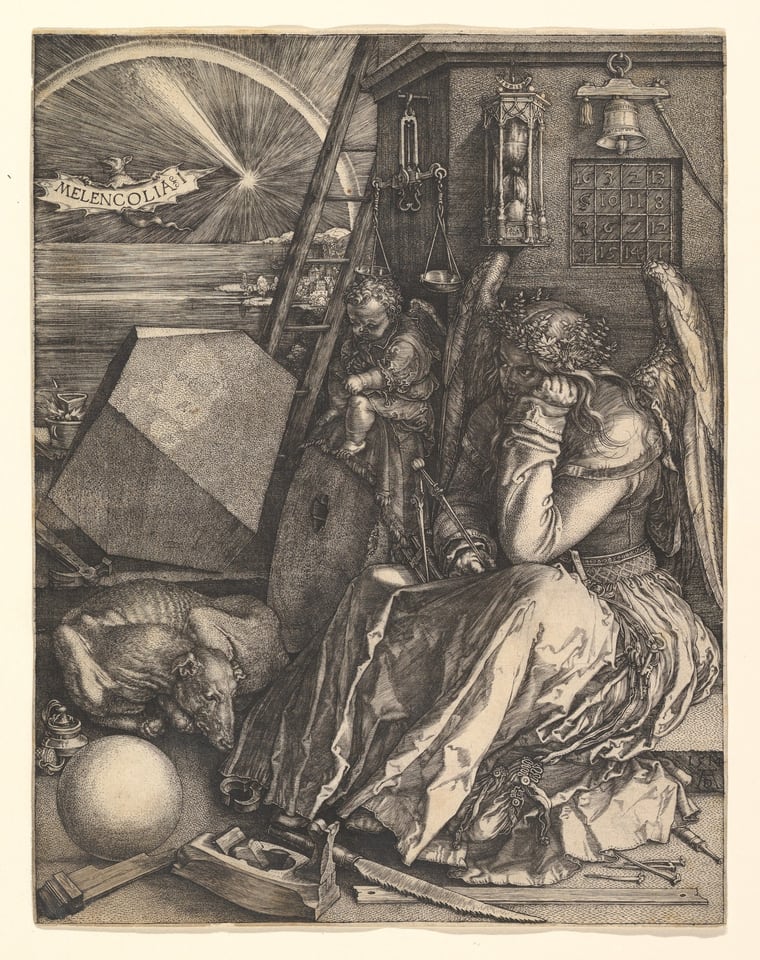
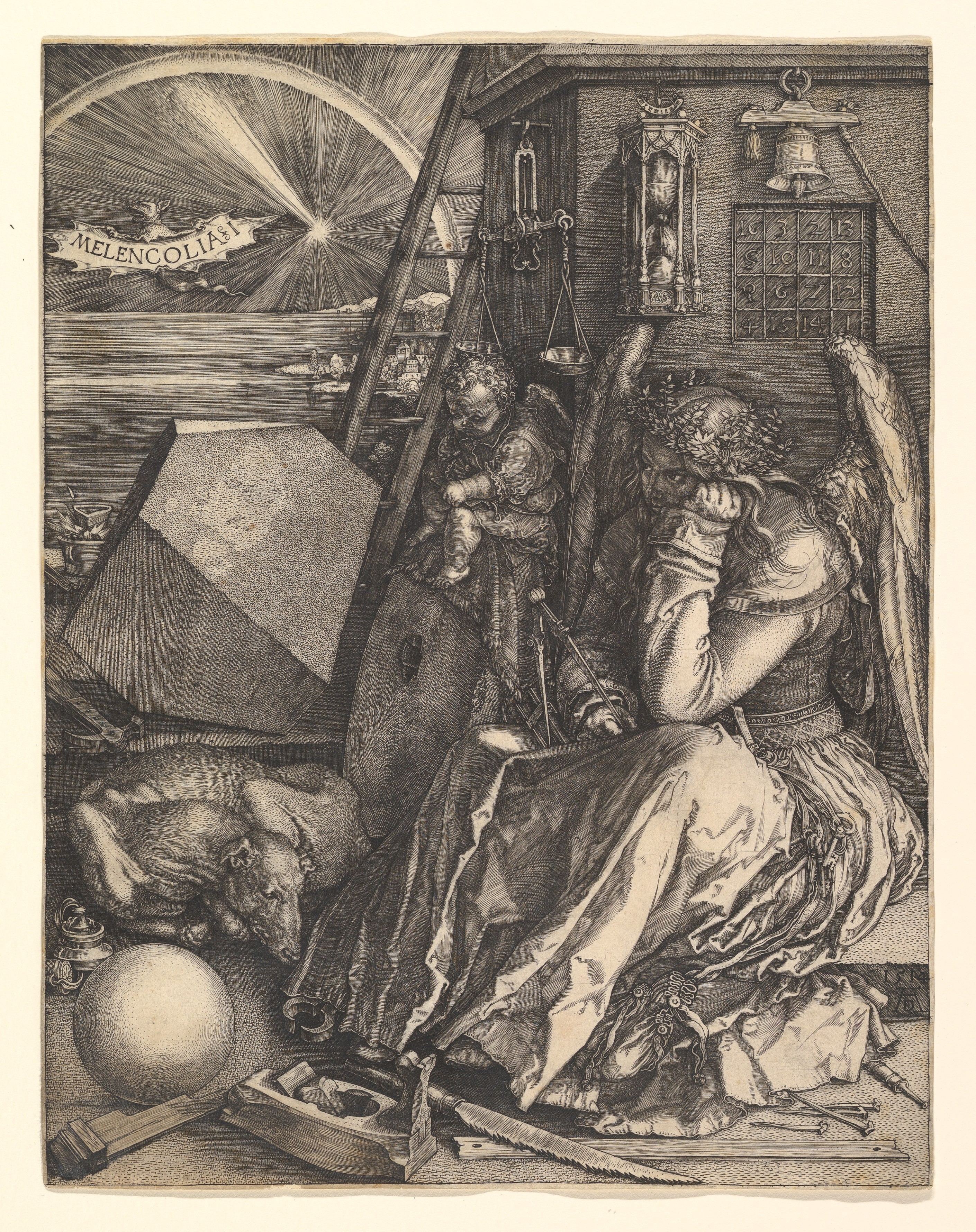
Melencolia I1514
A winged figure sits slumped, chin on fist, surrounded by the tools of measurement and making: a compass in her lap, a plane and saw at her feet, an hourglass, scales and a bell on the wall behind, a ladder, a huge faceted stone and a sphere. More about this work
About this work
A winged figure sits slumped, chin on fist, surrounded by the tools of measurement and making: a compass in her lap, a plane and saw at her feet, an hourglass, scales and a bell on the wall behind, a ladder, a huge faceted stone and a sphere. A sleeping dog and a scribbling putto keep her company, and a bat-like creature carries the title across a sky lit by a comet and a rainbow. The engraving is often read as an image of creative inertia, the melancholic temperament thought to afflict artists and thinkers. Look for the magic square on the wall, whose bottom row includes the date 1514.
Written by Ochre Editions.
How it was made
- Engraving
- Lines cut directly into a metal plate with a steel burin, which makes them swell and taper. It took years to master, and for centuries it was how paintings travelled as pictures.
Albrecht Dürer
German, 1471–1528 · Born and died in Nuremberg.
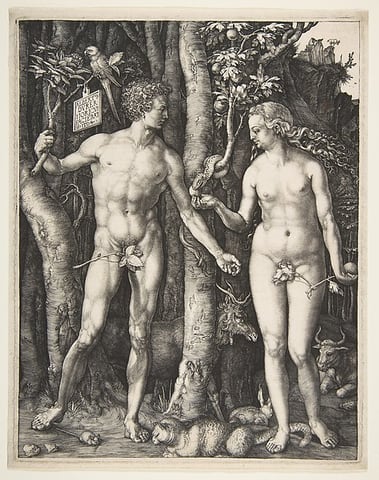
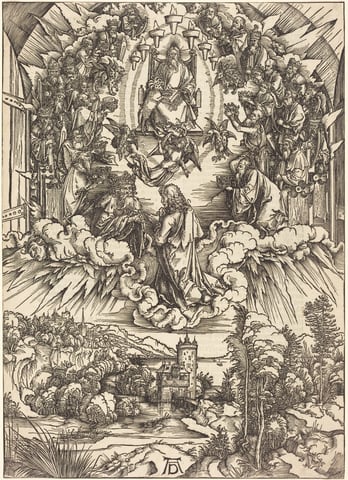
Dürer trained as a goldsmith with his father and then under the Nuremberg painter Michael Wolgemut, whose studio produced woodcut book illustrations. Two journeys to Italy brought him into contact with Venetian painting and the theory of proportion, which he set out to bring north. He raised woodcut and engraving to new heights of detail and ambition, issuing his own series such as The Apocalypse and The Life of the Virgin, and his engraving Adam and Eve of 1504 shows his study of the ideal human figure.
Written by Ochre Editions.
Rights and the museum’s record
Public domain. The Met has dedicated this image to the public domain under CC0, so anyone may copy, adapt and use it, for any purpose, without asking. Our prints and files are reproductions made from the museum’s image; the museum doesn’t endorse them.
- Object number
- 43.106.1
- Credit
- Courtesy of The Metropolitan Museum of Art
- Type
- Prints
- Department
- Drawings and Prints
- Licence
- CC0 1.0 Universal
- Museum record
- See it on the museum’s site
Report this work
More by Albrecht Dürer
All their works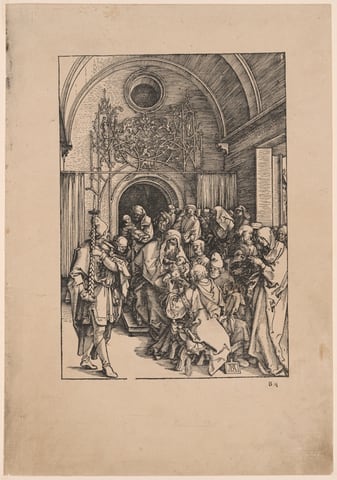
Close in colour