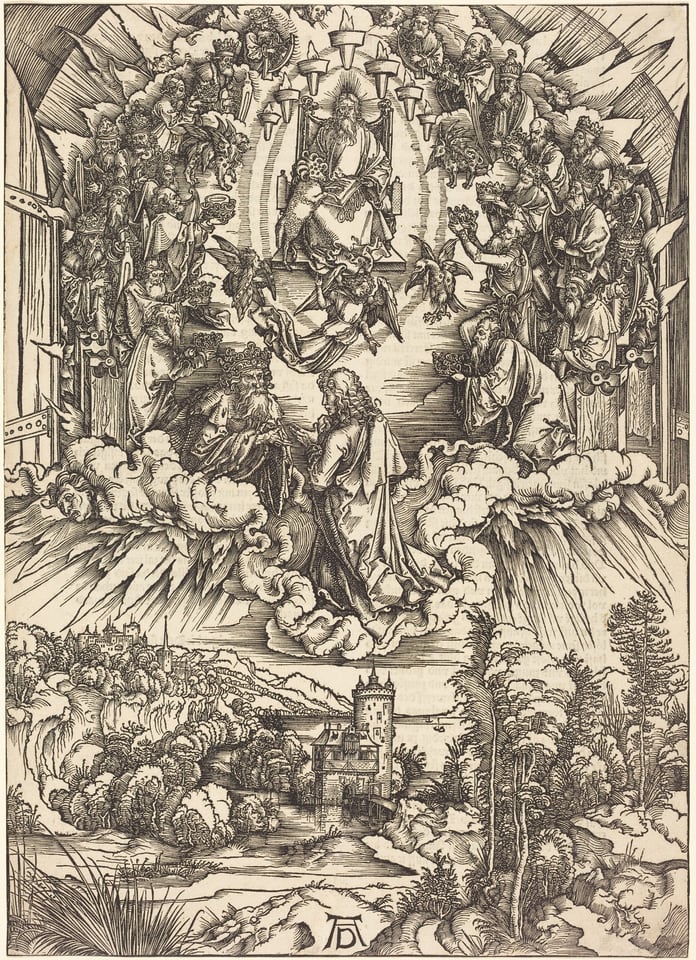
Saint John before God and the Eldersprobably c. 1496/1498
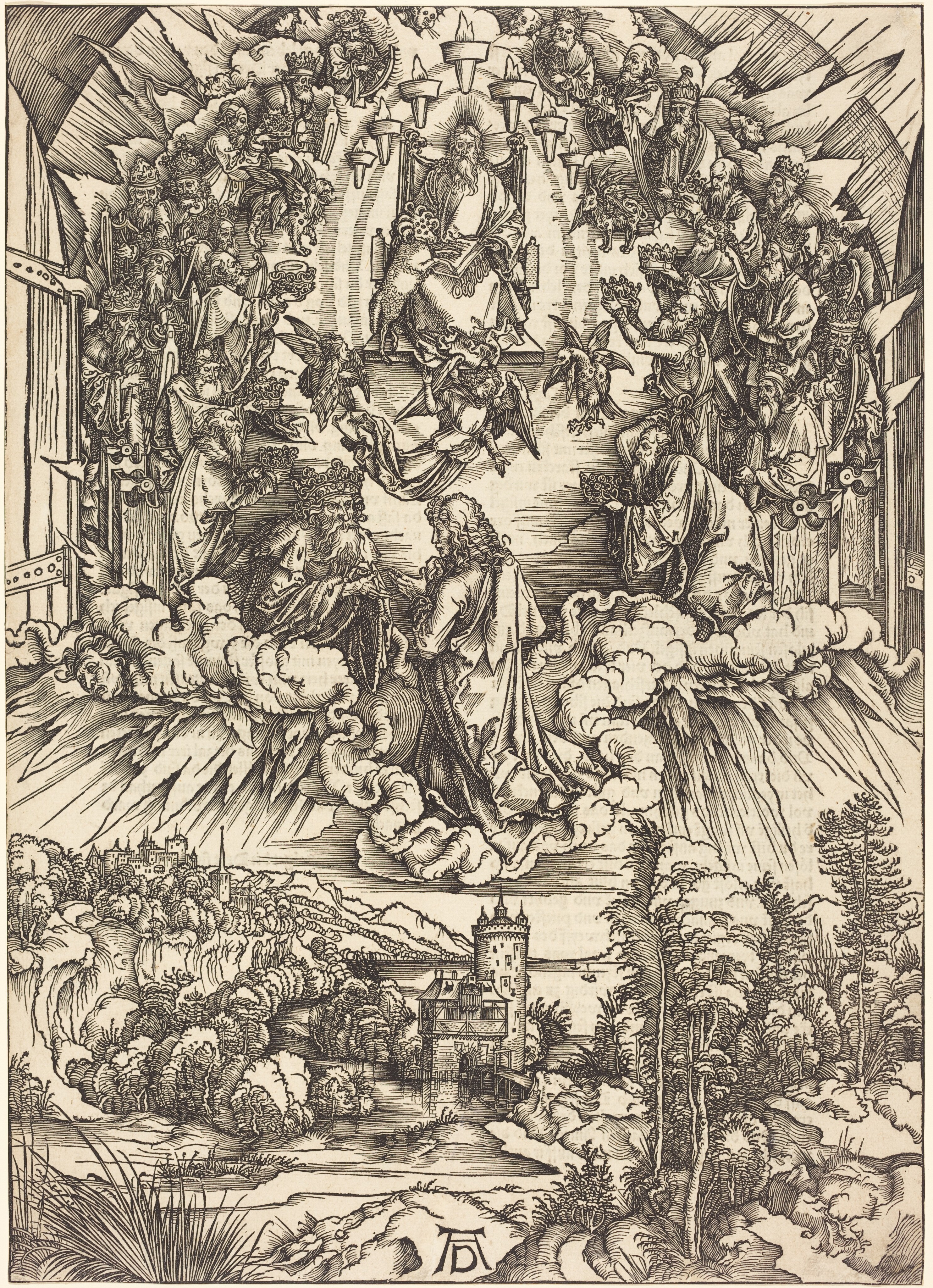
In this woodcut from Dürer’s Apocalypse, Saint John, summoned through a door in heaven, comes before God enthroned among clouds, who holds the book sealed with seven seals. More about this work
About this work
In this woodcut from Dürer’s Apocalypse, Saint John, summoned through a door in heaven, comes before God enthroned among clouds, who holds the book sealed with seven seals. The crowned elders of the Book of Revelation sit in a semicircle around them, some holding the golden bowls of incense mentioned in the text, while winged hosts gather above. Far below lies an ordinary landscape of trees, river and hilltop castles, the earthly world the vision looks down on. Dürer published the fifteen Apocalypse woodcuts himself in 1498, and their density of line and drama made his name across Europe while he was still in his twenties.
Written by Ochre Editions.
What you’re looking at
The image features a celestial scene with multiple figures depicted from head to waist. Two central figures are engaged in a conversation amidst clouds. One figure appears seated, possibly on a throne, holding a book. Both figures have long hair and beards. The robes worn by the figures are detailed. Other figures surround them in a semi-circle, some wearing crowns, holding items like bowls. Heavenly hosts with wings are seen above. The background shows a detailed landscape with trees, a river, and castles nestled in hills.
Description from the National Gallery of Art.
How it was made
- Woodcut
- A relief print. The block is cut away around the lines, so the lines stand up to take the ink, and the sheet is pressed onto them.
- Laid paper
- Handmade on a mould of close-set wires, which leave fine parallel lines you can see when the sheet is held to the light.
Albrecht Dürer
German, 1471–1528 · Born and died in Nuremberg.
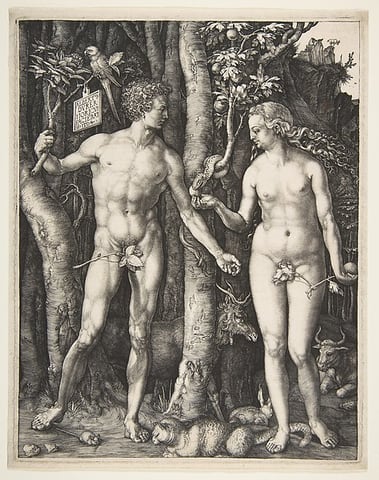
Dürer trained as a goldsmith with his father and then under the Nuremberg painter Michael Wolgemut, whose studio produced woodcut book illustrations. Two journeys to Italy brought him into contact with Venetian painting and the theory of proportion, which he set out to bring north. He raised woodcut and engraving to new heights of detail and ambition, issuing his own series such as The Apocalypse and The Life of the Virgin, and his engraving Adam and Eve of 1504 shows his study of the ideal human figure.
Written by Ochre Editions.
Rights and the museum’s record
Public domain. The National Gallery of Art has dedicated this image to the public domain under CC0, so anyone may copy, adapt and use it, for any purpose, without asking. Our prints and files are reproductions made from the museum’s image; the museum doesn’t endorse them.
- Object number
- 1971.39.3
- Credit
- Courtesy National Gallery of Art, Washington
- Type
- Licence
- CC0 1.0 Universal
- Museum record
- See it on the museum’s site
Report this work
More by Albrecht Dürer
All their works
Close in colour