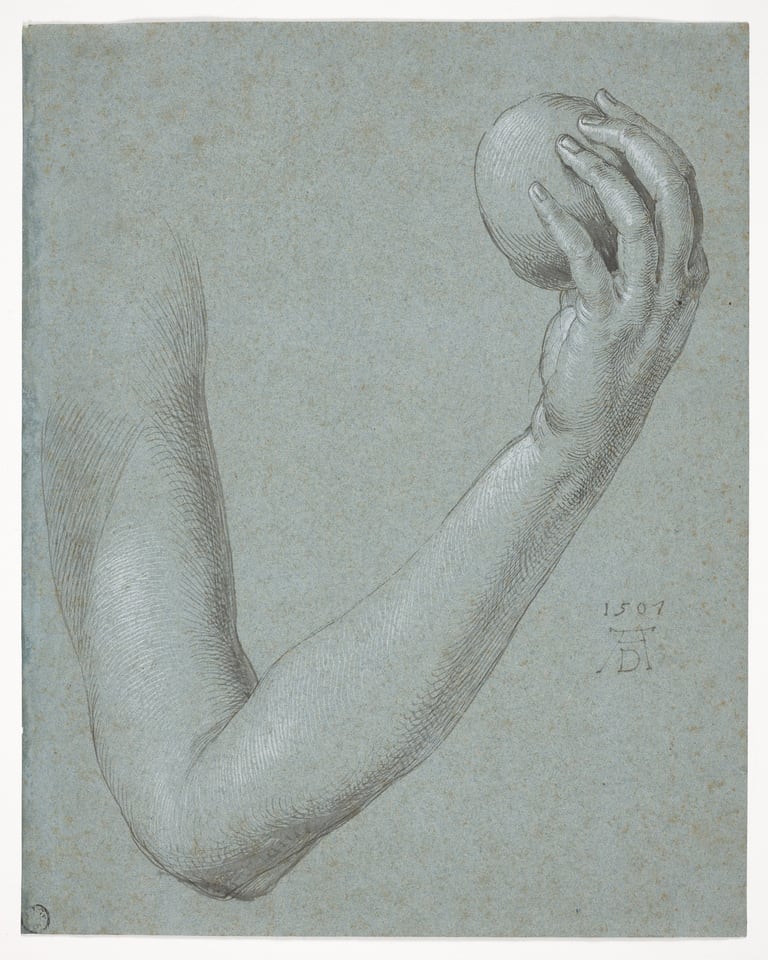
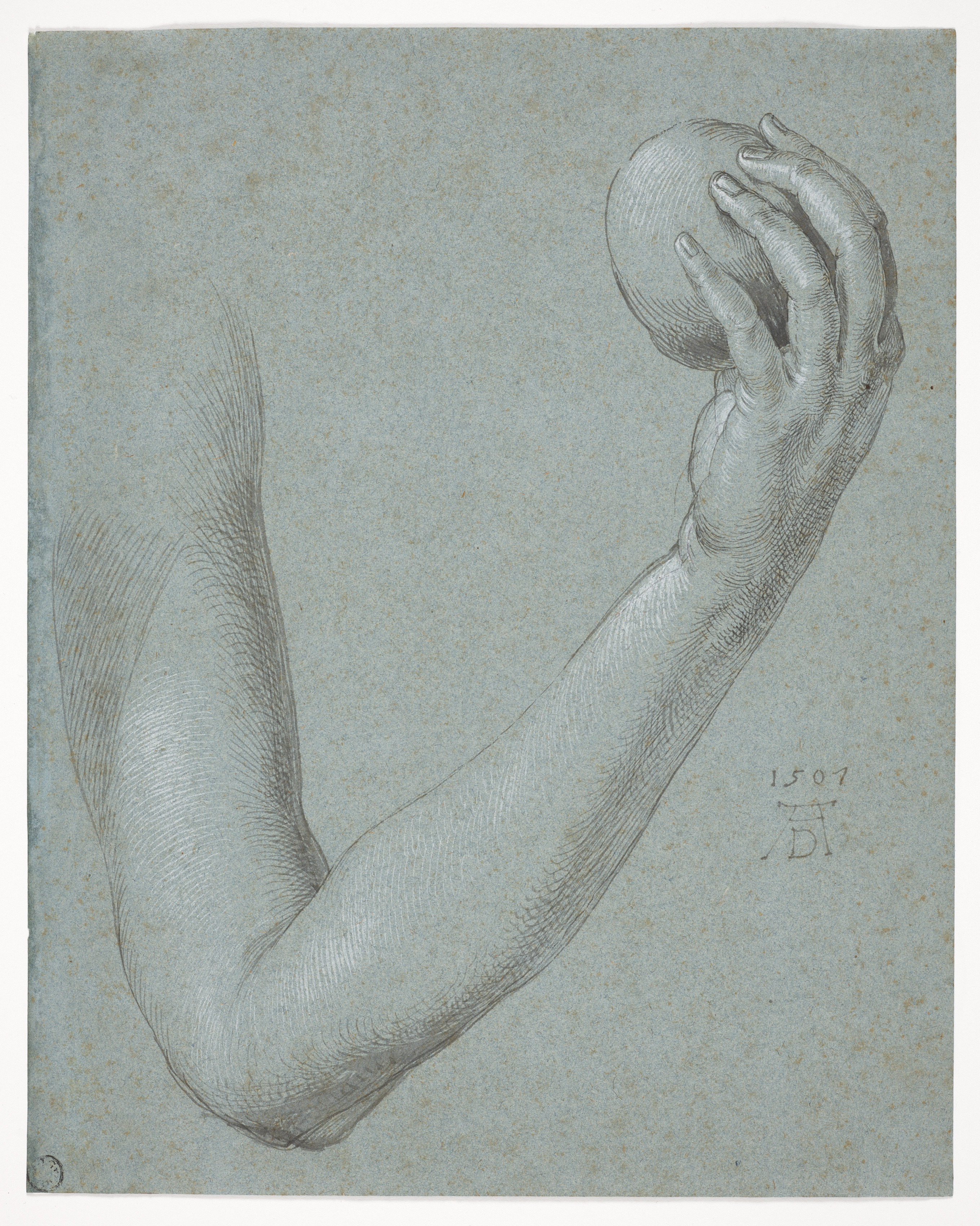
Arm of Eve1507
Arm of Eve is the only surviving preparatory drawing for Dürer’s life-size panels of Adam and Eve in the Museo del Prado, Madrid. More about this work
About this work
Arm of Eve is the only surviving preparatory drawing for Dürer’s life-size panels of Adam and Eve in the Museo del Prado, Madrid. It is also one of the few surviving drawings by the artist made on Venetian blue paper, a support he began to use for his chiaroscuro studies while visiting Venice in the winter of 1506–7. With extraordinary economy of means, using only black and gray ink and a limited amount of wash and gouache for shading and heightening, Dürer suggested the grace and balance of the complete human form in this composition of a disembodied arm and hand. Such a study of a hand in ideal proportions cannot help but suggest the hand of the artist, a self-referential nod to his own abilities.
Text from the Cleveland Museum of Art.
How it was made
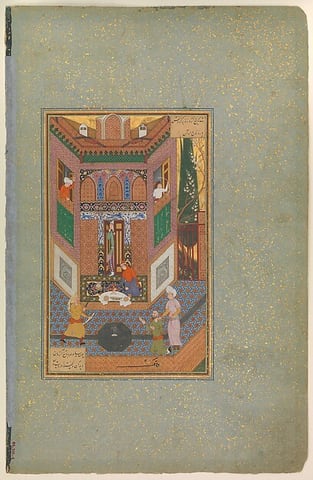
- Opaque watercolour
- Watercolour made opaque with white or chalk and laid in flat, even layers. Persian and Indian painters ground their colours from minerals, applied them with the finest brushes and burnished the finished page.
Albrecht Dürer
German, 1471–1528 · Born and died in Nuremberg.
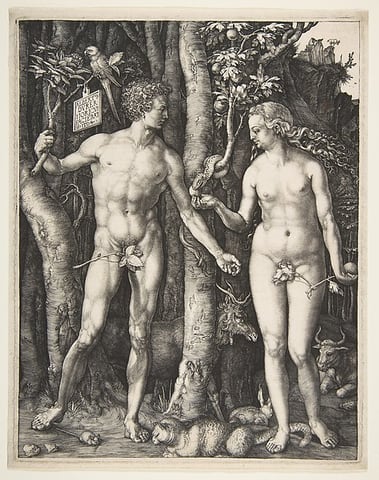
Dürer trained as a goldsmith with his father and then under the Nuremberg painter Michael Wolgemut, whose studio produced woodcut book illustrations. Two journeys to Italy brought him into contact with Venetian painting and the theory of proportion, which he set out to bring north. He raised woodcut and engraving to new heights of detail and ambition, issuing his own series such as The Apocalypse and The Life of the Virgin, and his engraving Adam and Eve of 1504 shows his study of the ideal human figure.
Written by Ochre Editions.
Renaissance
European art from about 1400 to 1600, when painters rediscovered perspective and the classical past.
Rights and the museum’s record
Public domain. The Cleveland Museum of Art has dedicated this image to the public domain under CC0, so anyone may copy, adapt and use it, for any purpose, without asking. Our prints and files are reproductions made from the museum’s image; the museum doesn’t endorse them.
- Object number
- 1965.470
- Credit
- Courtesy of the Cleveland Museum of Art
- Type
- Drawing
- Department
- Drawings
- Licence
- CC0 1.0 Universal
- Museum record
- See it on the museum’s site
Report this work
More by Albrecht Dürer
All their works
Close in colour