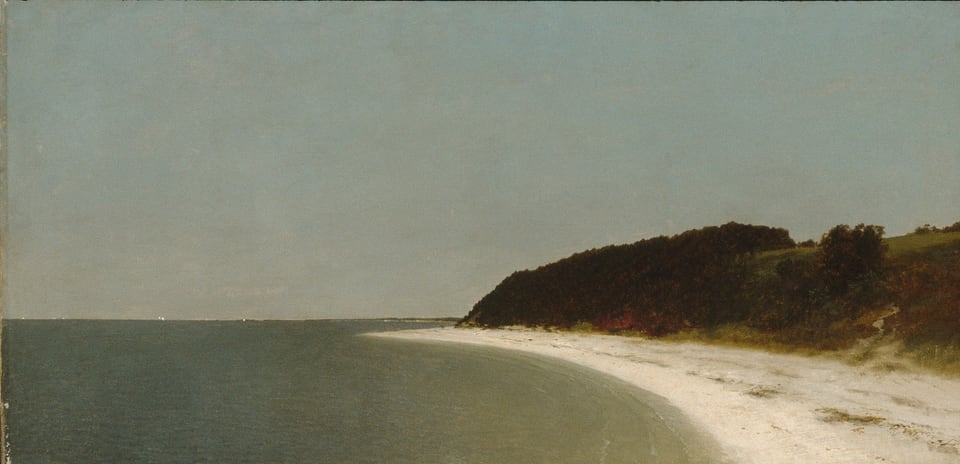
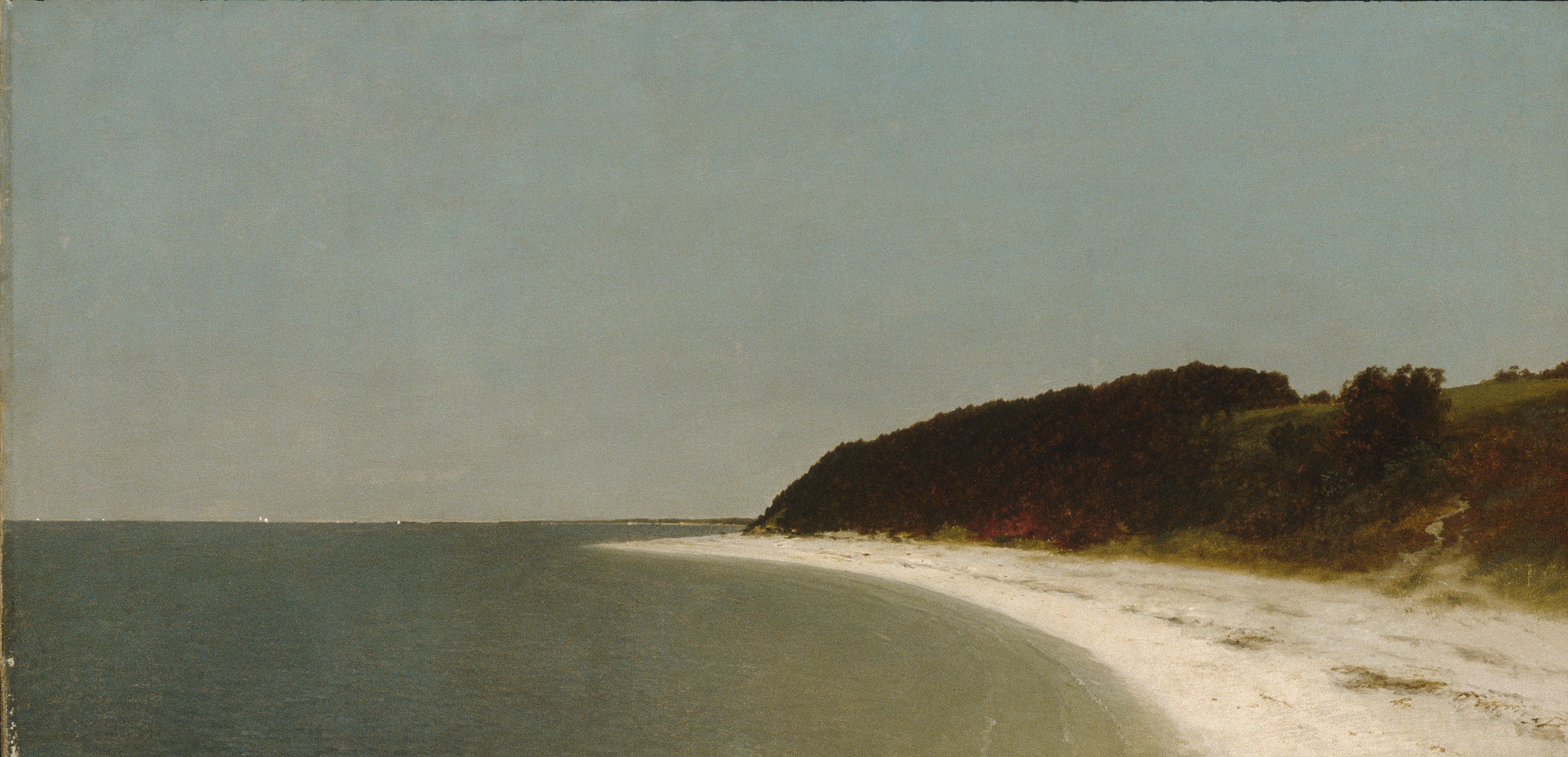
Eaton's Neck, Long Island1872
A curving strip of sandy beach meets a broad expanse of calm water beneath a vast, pale sky. More about this work
About this work
A curving strip of sandy beach meets a broad expanse of calm water beneath a vast, pale sky. Kensett painted this spare, almost empty composition in 1872, the last summer of his life, which he spent on the Connecticut shore of Long Island Sound. The paintings of that summer, found in his studio after his death in December, reduce the landscape to a few bands of colour and light, and they are among the most quietly daring American landscapes of the century.
Written by Ochre Editions.
How it was made
- Oil paint
- Pigment ground in a drying oil, usually linseed. It dries slowly, so painters could blend on the canvas, build up thin translucent glazes, and rework a picture over weeks. Canvas replaced wooden panels in the 1500s because it is lighter and can be rolled.
John Frederick Kensett
American, 1816–1872 · Born in Cheshire, Connecticut; died in New York.
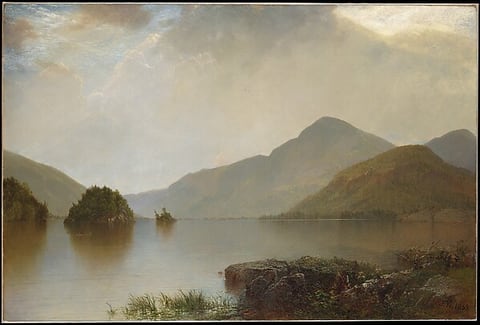
Kensett trained as an engraver before spending seven years in Europe, sketching in England and Italy. Back in New York in 1847 he became a leading figure of the second generation of the Hudson River School. His quiet coastal views of Newport, Long Island and Lake George, with broad still water and soft light, are central to what later writers called Luminism. He was a founder of the Metropolitan Museum of Art.
Written by Ochre Editions.
Hudson River School
American landscape painters of the mid-1800s who made wilderness their grand subject.
Rights and the museum’s record
Public domain. The Met has dedicated this image to the public domain under CC0, so anyone may copy, adapt and use it, for any purpose, without asking. Our prints and files are reproductions made from the museum’s image; the museum doesn’t endorse them.
- Object number
- 74.29
- Credit
- Courtesy of The Metropolitan Museum of Art
- Type
- Painting
- Department
- The American Wing
- Licence
- CC0 1.0 Universal
- Museum record
- See it on the museum’s site
Report this work
More by John Frederick Kensett
All their works
Close in colour