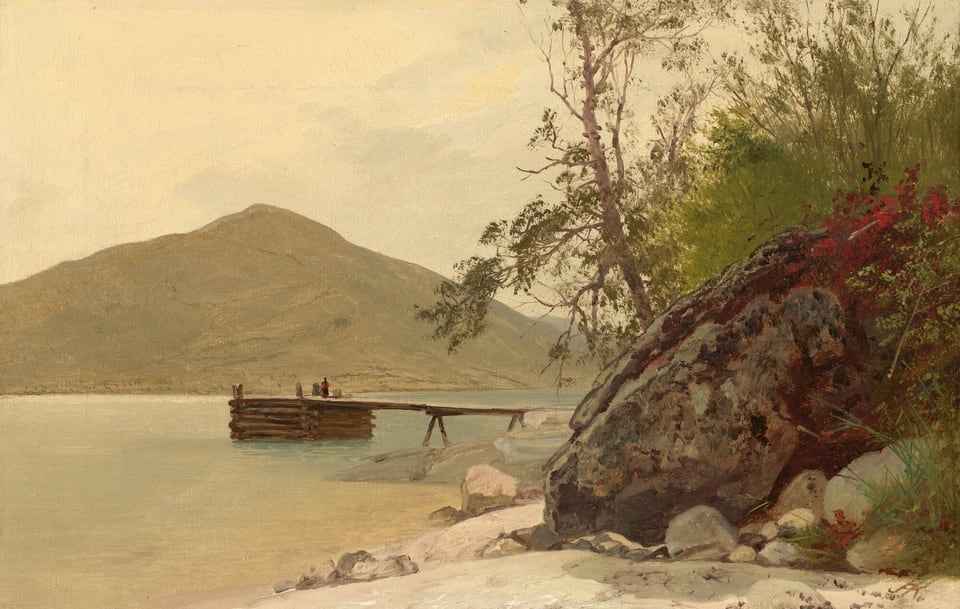
Landing at Sabbath Day Pointc. 1853
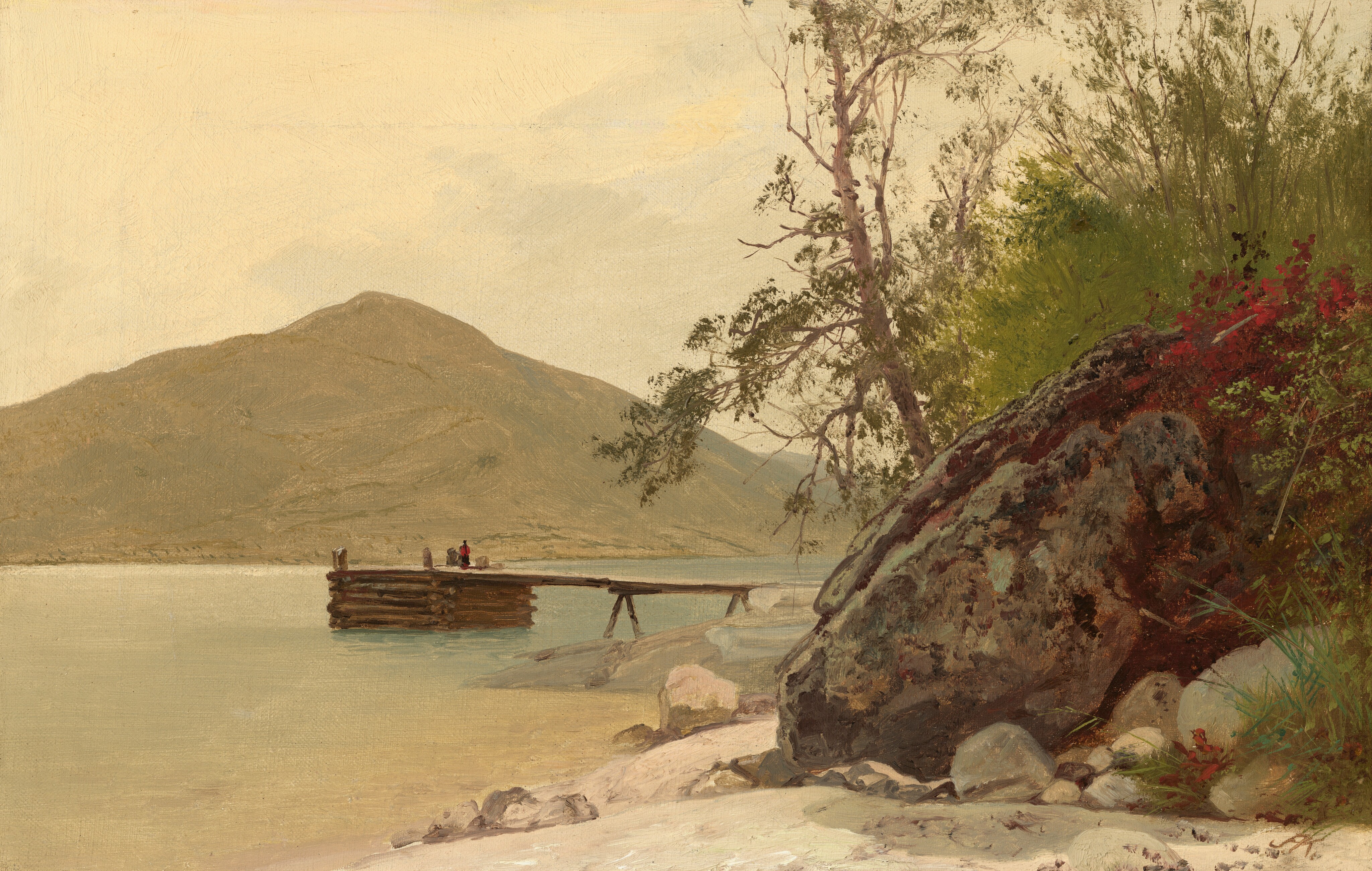
A large weathered rock with greenery and red flowers anchors the right foreground, while a wooden dock juts into the calm water of Lake George and a figure in red sits with his back to us, looking towards a pale green hill under a soft, cloudy sky. More about this work
About this work
A large weathered rock with greenery and red flowers anchors the right foreground, while a wooden dock juts into the calm water of Lake George and a figure in red sits with his back to us, looking towards a pale green hill under a soft, cloudy sky. Sabbath Day Point, on the lake’s western shore, was a favourite stopping place for travellers and artists, and John Frederick Kensett returned to Lake George throughout his career. This early view already shows his love of calm water and gentle, even light.
Written by Ochre Editions.
What you’re looking at
The painting depicts a tranquil lake scene with a low horizon line showing a pale green hill in the background under a pale, cloudy sky. Closer to us, on the right, there is a large, textured rock surrounded by greenery and red flowers. In the distance, a wooden dock extends into the lake on the left, and a person wearing red appears to sit or stand with their back to us.
Description from the National Gallery of Art.
How it was made
- Oil paint
- Pigment ground in a drying oil, usually linseed. It dries slowly, so painters could blend on the canvas, build up thin translucent glazes, and rework a picture over weeks. Canvas replaced wooden panels in the 1500s because it is lighter and can be rolled.
John Frederick Kensett
American, 1816–1872 · Born in Cheshire, Connecticut; died in New York.
Kensett trained as an engraver before spending seven years in Europe, sketching in England and Italy. Back in New York in 1847 he became a leading figure of the second generation of the Hudson River School. His quiet coastal views of Newport, Long Island and Lake George, with broad still water and soft light, are central to what later writers called Luminism. He was a founder of the Metropolitan Museum of Art.
Written by Ochre Editions.
Hudson River School
American landscape painters of the mid-1800s who made wilderness their grand subject.
Rights and the museum’s record
Public domain. The National Gallery of Art has dedicated this image to the public domain under CC0, so anyone may copy, adapt and use it, for any purpose, without asking. Our prints and files are reproductions made from the museum’s image; the museum doesn’t endorse them.
- Object number
- 1968.7.1
- Credit
- Courtesy National Gallery of Art, Washington
- Type
- Painting
- Licence
- CC0 1.0 Universal
- Museum record
- See it on the museum’s site
Report this work
More by John Frederick Kensett
All their works
Close in colour